
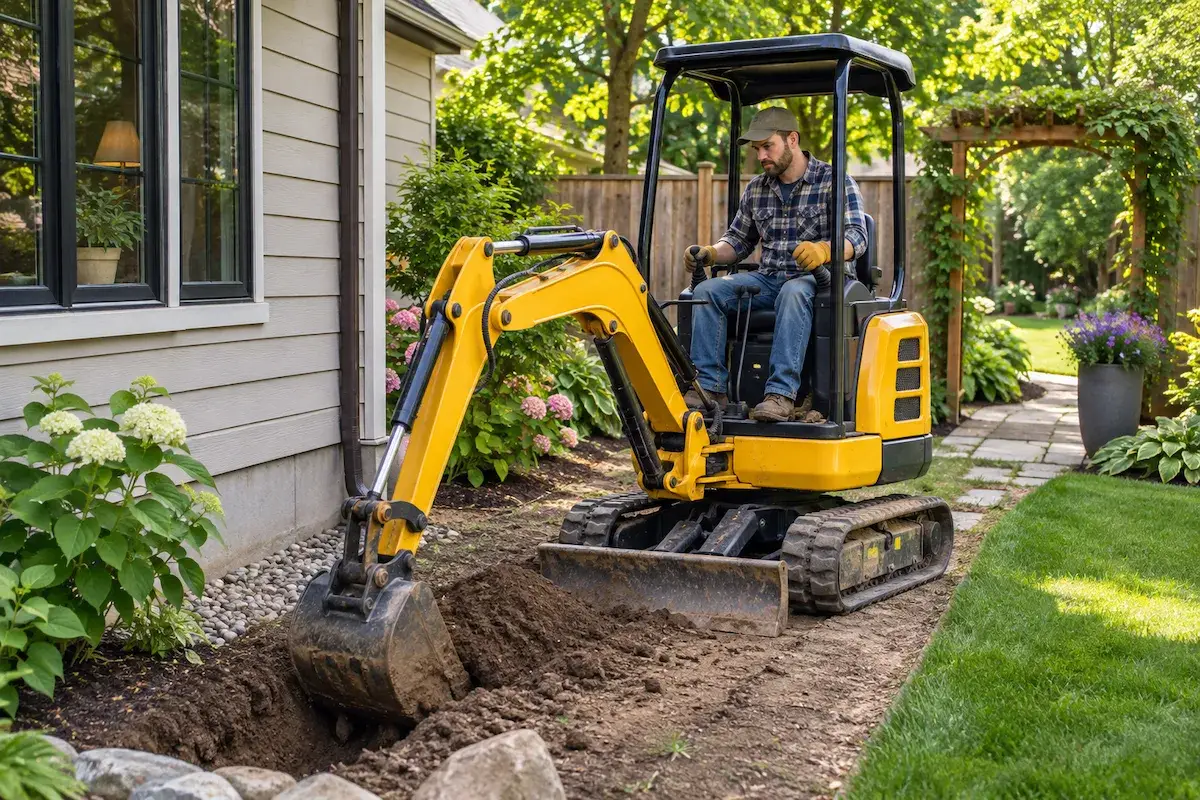
The best mini excavator for homeowners is not necessarily the smallest, cheapest or most powerful machine. It is the machine that matches the owner’s recurring projects, property access, digging requirements, transport arrangements and ownership budget.
Whether you need to plant trees, improve drainage, renovate a garden or maintain a small acreage, choosing the wrong machine can leave you with equipment that is too limited for the work or too large for the property.
This guide explains how to choose a mini excavator for personal use, using real machine specifications and practical buying considerations rather than unsupported brand rankings.
Quick Answer: What Is the Best Mini Excavator for Homeowners?
A 0.5-ton micro excavator may be a suitable option for homeowners with narrow access and light recurring excavation tasks. A 1.2-ton mini excavator deserves evaluation when more digging depth or reach is required, while a 2.5-ton or larger machine may be necessary for more demanding projects.
For occasional or one-time excavation, renting may remain the more practical choice. The right decision depends on the actual workload, available space, transport arrangements and total cost of ownership.
1. Is a Mini Excavator Worth Buying for Home Use?
Owning a mini excavator can make sense when a property requires regular excavation, drainage maintenance, landscaping or other recurring work. Having a machine available between projects can reduce dependence on rental schedules and outside contractors.
However, ownership also creates responsibilities for storage, maintenance, repairs and transportation. Homeowners should consider how frequently the machine will be used before deciding to buy.
| Homeowner Situation | Buying Consideration | Renting Consideration |
|---|---|---|
| One-time excavation project | Ownership may be difficult to justify | Often more practical for short-term work |
| Recurring seasonal maintenance | Machine availability can be valuable | May work if tasks can be grouped together |
| Multiple property improvement projects | Purchase cost can be spread across multiple projects | Repeated rental and delivery costs should be compared |
| Limited storage or transport capacity | Ownership arrangements must be resolved first | Reduces long-term storage responsibilities |
| Long-term private land ownership | May support regular maintenance and improvement | Depends on usage frequency and local rental availability |
There is no universal number of operating hours at which buying becomes cheaper than renting. Compare local rental rates, delivery charges, expected usage and ownership costs using the framework in our rent vs buy a mini excavator guide.
2. What Can Homeowners Do with a Mini Excavator?
A compact excavator can reduce manual labor on private-property projects when its confirmed capability matches the job.
Garden Renovation and Landscaping
Typical tasks include removing small amounts of soil, preparing planting areas, reshaping garden beds and performing light landscaping excavation.
Tree and Shrub Planting
A micro excavator may help prepare planting pits for trees and shrubs, particularly where repeated manual digging would be time-consuming.
Drainage and Irrigation
Homeowners may use a suitable machine to prepare shallow drainage channels, irrigation trenches or small ditch-maintenance projects.
Private Land Maintenance
Owners of small acreages, orchards and rural properties may find a compact excavator useful for recurring light excavation and property improvement tasks.

These are potential applications, not guarantees that every compact excavator can perform them. Larger tree stumps, deep trenches and substantial earthmoving may require greater machine capability. Our guide to what a mini excavator can do explains the broader range of excavator applications and limitations.
Importante: Excavation near foundations, buried utilities, retaining walls or unstable ground requires appropriate site assessment and qualified planning. Identify underground services before digging and follow applicable safety requirements.
3. What Size Mini Excavator Should a Homeowner Buy?
Choosing the right size starts with the property and the work rather than the machine’s commercial tonnage.
Measure the Full Access Route
Check gates, side passages, corners, overhead restrictions and the space available at the work area. A narrow machine is only useful if it can reach the intended excavation position.
For example, a machine with a transport width of 640 mm should not be assumed to pass through an opening of exactly 640 mm. Practical clearance is required for alignment and movement. See our mini excavator width guide for access measurement considerations.
Confirm the Required Digging Depth and Reach
Measure the deepest recurring excavation and the horizontal reach required from where the machine can stand. Maximum digging depth should not be treated as a routine working depth under every condition.
El mini excavator digging depth guide explains how to compare excavation requirements with model-specific specifications.
Check Working Space, Transport and Storage
The machine needs sufficient room for upper-structure rotation, boom movement and attachment operation. Homeowners should also confirm how the machine will be transported, stored and maintained between projects.
These requirements should be evaluated together before selecting a machine class.
4. 0.5 Ton vs 1.2 Ton vs 2.5 Ton Mini Excavators for Homeowners
The following comparison uses three ZHAOLU machine classes as purchasing references. The figures are model-specific and should not be assumed to apply to every excavator in the same commercial weight class.
| Decision Factor | 0,5 toneladas | 1,2 toneladas | 2,5 toneladas |
|---|---|---|---|
| Reference model | ZL-05 | ZL-17 | ZL-35 |
| Maximum digging depth | 912 mm (35.9 in) | 1,940 mm (76.4 in) | Confirm model specification |
| Maximum digging radius | 1,962 mm (77.2 in) | 3,380 mm (133.1 in) | Confirm model specification |
| Access requirements | 640 mm transport width; practical clearance required | Confirm machine width and available access | Confirm machine dimensions and site access |
| Potential applications | Planting pits, garden renovation and light trenching | Deeper excavation and more demanding property projects | Projects requiring greater confirmed machine capability |
| Transport considerations | Confirm actual transport weight and trailer capacity | Confirm transport weight, trailer and towing vehicle | Evaluate complete transport requirements |
| Best reason to evaluate | Restricted access and light recurring work | Smaller machine lacks required depth or reach | Regular work exceeds smaller-machine capability |

This comparison is not a performance test or a universal tonnage recommendation. Buyers should compare the exact machine configuration with their property requirements.
For a broader overview of compact machine classes, see our Guía de tamaños de miniexcavadoras.
5. Essential Features to Look for in a Homeowner Mini Excavator
Additional features are valuable when they solve a real problem on the property. Buying a machine with more features does not automatically make it a better choice.
| Feature | Por qué es importante | What to Confirm |
|---|---|---|
| Compact transport dimensions | Restricted property access and storage | Maximum width and height in the relevant configuration |
| Digging capability | Completing recurring excavation tasks | Required depth, reach and applicable digging-force specifications |
| Boom swing | Offset digging beside fences or obstacles | Availability, swing angle and usable offset |
| Tail swing configuration | Rear clearance during upper-structure rotation | Rear swing radius and overhang |
| Bucket selection | Planting, trenching and soil removal | Bucket width, mounting dimensions and compatibility |
| Hydraulic attachments | Additional property maintenance tasks | Auxiliary flow, pressure, return requirements, attachment weight and mounting compatibility |
| Configuración del motor | Fuel, maintenance and destination requirements | Installed engine model and applicable documentation |
| Maintenance access | Routine inspection and servicing | Service points, maintenance schedule and required tools |
| Spare parts and warranty | Long-term ownership support | Parts supply arrangements, warranty terms and claim procedures |
Boom swing allows lateral positioning of the digging assembly, while tail swing concerns the rear of the upper structure during rotation. These are different considerations and must be confirmed separately. See our swing boom guide y zero tail swing mini excavator guide for more information.
Retractable tracks, quick couplers and powered attachments should also be confirmed for the exact machine being quoted. Our Guía de accesorios para miniexcavadoras explains the main compatibility considerations.
6. ZL-05: A Compact Option for Narrow-Access Home Projects
The ZHAOLU ZL-05 0.5 Ton Micro Excavator provides a real example of a compact machine that homeowners can evaluate for restricted-access and light excavation projects.
Its transport width of 640 mm is particularly relevant when garden gates, narrow passages or limited storage space restrict the choice of equipment.
| Especificaciones | ZL-05 Reference |
|---|---|
| Commercial class | Microexcavadora de 0,5 toneladas |
| Peso en servicio | 420 ± 20 kg (approximately 926 ± 44 lb) |
| Transport width | 640 mm (25.2 in) |
| Transport height with handles removed | 1,101 mm (43.3 in) |
| Maximum digging depth | 912 mm (35.9 in) |
| Maximum digging radius | 1,962 mm (77.2 in) |
| Boom swing | 50° left / 50° right |
| Bucket offset | 245 mm left / 245 mm right |
| Motor | Rato gasoline engine |
| Engine power | 6,5 HP |
| Maximum system flow | 12 l/min |
The 0.5-ton designation is the commercial product class, not its exact operating weight. The maximum system flow should not be interpreted as the available auxiliary hydraulic flow for powered attachments.
When Should Homeowners Evaluate the ZL-05?
- Property access is highly restricted.
- Recurring excavation tasks are relatively light.
- Tree planting and garden renovation are common projects.
- Shallow drainage or irrigation work is required.
- Compact equipment storage is important.
- Offset digging may help with machine positioning.
When Should You Consider Another Machine?
- Regular excavation exceeds the confirmed depth or reach.
- More demanding soil removal is required.
- The required attachment is not confirmed compatible.
- Required lifting or material-handling capability cannot be verified.
- Site conditions require a different machine configuration.
The ZL-05 is not a universal solution for every homeowner. It should be evaluated against the actual work and available space. Review the ZL-05 MICROEXCAVADORA DE 0,5 T product page for machine details.
Consejo para el comprador: A narrow machine and a swing boom do not automatically establish zero tail swing or sufficient operating clearance. Confirm the complete working envelope before selecting equipment for confined spaces.
7. When Should Homeowners Choose a Larger Mini Excavator?
A larger mini excavator deserves evaluation when the smaller machine regularly approaches or exceeds its confirmed working limits.
Common reasons include deeper drainage excavation, greater required reach, larger recurring soil-removal tasks and attachment requirements that cannot be supported by the smaller machine.
For example, the ZL-17 1.2 Ton Mini Excavator has a maximum digging depth of 1,940 mm and a maximum digging radius of 3,380 mm. These provide a useful model-specific comparison with the ZL-05’s confirmed dimensions.
However, additional depth and reach are only useful when the property can accommodate the machine and its working movements. Transport and storage requirements must also be considered.
Homeowners can compare the ZL-17 MINIEXCAVADORA DE 1,2 T with the smaller ZL-05 before deciding. For more demanding applications, the ZL-35 MINIEXCAVADORA DE 2,5 T represents another class to evaluate using confirmed model-specific specifications.
8. How Much Does It Cost to Own a Mini Excavator?
Homeowners should compare total ownership cost rather than the advertised machine price alone.
The main cost categories include:
- Machine purchase price and selected options.
- Shipping, delivery, applicable duties and taxes.
- Fuel and routine maintenance.
- Wear parts, replacement components and repairs.
- Secure storage arrangements.
- Transportation equipment and related expenses.
- Insurance where applicable.
For imported equipment, request a quotation that clearly explains the delivery terms and identifies which shipping, customs and local delivery expenses are included or excluded.
Nuestro Guía de precios de miniexcavadoras explains purchase-price considerations, while the Operating Cost per Hour Guide covers operating and ownership cost factors.
Can You Transport and Store the Machine?
Before purchasing, confirm the actual transport weight, trailer payload rating, towing vehicle capacity, securing requirements and applicable local transport rules. Include any attachments and equipment carried with the machine.
Storage should also be planned according to the machine dimensions, security requirements and manufacturer recommendations. See our mini excavator trailer guide for additional transport considerations.
9. Should Homeowners Buy New, Buy Used or Rent?
Each purchasing option has advantages and limitations. The appropriate choice depends on the owner’s workload, budget and ability to maintain equipment.
| Option | Potential Advantages | Potential Limitations |
|---|---|---|
| Buy new | Opportunity to confirm the configuration, warranty terms and supplier support before ordering | Higher initial investment and ongoing ownership responsibilities |
| Buy used | Potentially lower acquisition cost | Condition, maintenance history and repair requirements must be evaluated |
| Rent | No long-term ownership or storage commitment | Rental charges, delivery costs, scheduling and availability |
A homeowner with recurring property projects may benefit from ownership, while someone completing one major project may be better served by renting or hiring a qualified contractor.
See our new vs used mini excavator guide for more detailed purchasing considerations.
10. Common Mistakes First-Time Mini Excavator Buyers Make
- Choosing by price alone: A low purchase price cannot compensate for insufficient working capability.
- Choosing by tonnage alone: Commercial machine classes do not establish exact dimensions or specifications.
- Measuring only the entrance gate: The complete access route and working area must be evaluated.
- Relying on maximum specifications: Maximum depth and reach are not guaranteed routine working conditions.
- Assuming attachment compatibility: Mounting interfaces and hydraulic requirements must be confirmed.
- Ignoring after-sales support: Verify replacement parts arrangements, warranty coverage and service requirements.
- Overlooking ownership costs: Transportation, storage and maintenance affect the long-term purchase decision.
- Ignoring operator experience: First-time users should receive appropriate instruction, read the operating manual and understand pre-operation inspections before starting work.
11. Homeowner Mini Excavator Buying Checklist
Before requesting a quotation, prepare the following information. A clear description of the property and recurring projects helps the supplier evaluate the appropriate machine configuration.
| Item to Check | What to Confirm |
|---|---|
| Recurring projects | Main applications and expected frequency of use |
| Property access | Narrowest opening, height restrictions and access route |
| Available working space | Room for positioning, rotation and attachment movement |
| Digging requirements | Required depth, reach and ground conditions |
| Machine configuration | Exact model, dimensions, weight and installed engine |
| Archivos adjuntos | Required tools and confirmed compatibility |
| Destination requirements | Applicable import, documentation and emissions requirements |
| Transport and storage | Suitable transport arrangements and secure storage |
| Maintenance and spare parts | Service requirements and replacement parts arrangements |
| Garantía | Written coverage, exclusions and claim procedure |
| Total delivered cost | Machine price and all applicable delivery-related charges |

Buyers should obtain the confirmed machine configuration and commercial terms in writing before placing an order.
12. Final Verdict: Which Mini Excavator Should You Buy?
| Your Situation | Recommended Starting Point |
|---|---|
| Narrow garden access and light recurring excavation | Evaluate a compact 0.5-ton micro excavator |
| Private land with greater depth and reach requirements | Evaluate a 1.2-ton mini excavator |
| More demanding recurring excavation | Evaluate a 2.5-ton or larger machine using confirmed specifications |
| Occasional or one-time projects | Compare rental or qualified contractor services |
The best mini excavator for homeowners is the one whose confirmed capabilities match the actual property and workload. For narrow-access and light recurring projects, the ZL-05 provides a compact machine reference worth evaluating.
Explore the available configurations on our Miniexcavadoras en Venta | 0,5–2,5 t | ZHAOLU page before making your final purchasing decision.
Find the Right Mini Excavator for Your Property
Planning to purchase a mini excavator for your garden, private land or small property? ZHAOLU can review your requirements against available machine configurations before preparing a quotation.
For a more useful recommendation, please provide:
- Destination country and postal code.
- Main intended applications.
- Narrowest property access width.
- Required digging depth and horizontal reach.
- Required attachments and quantity.
Frequently Asked Questions About Mini Excavators for Homeowners
What is the best mini excavator for homeowners?
The best machine depends on property access, recurring projects, required digging depth, available working space and ownership budget. A 0.5-ton micro excavator may suit light narrow-access work, while a larger machine may be necessary for more demanding projects.
Is a 0.5 ton mini excavator enough for home use?
It may be sufficient for planting pits, garden renovation, shallow trenching and other light excavation tasks. Suitability depends on the confirmed machine capability and actual site conditions.
What size mini excavator is best for a small property?
Property size alone does not determine machine size. Consider the access route, deepest recurring excavation, required reach, ground conditions and available working space.
How wide is a small excavator for home use?
Width varies by model. The ZHAOLU ZL-05 has a confirmed transport width of 640 mm, approximately 25.2 inches. Additional practical clearance must be allowed when passing through restricted openings.
Is it cheaper to buy or rent a mini excavator?
Renting may be more economical for occasional projects, while ownership may become attractive for recurring work. Compare local rental and delivery costs with the purchase price, maintenance, storage and expected usage.
Can a small mini excavator remove tree stumps?
Suitability depends on stump size, root structure, soil conditions and confirmed machine capability. A micro excavator should not be assumed suitable for large stump removal. More demanding work may require larger equipment or a qualified contractor.
What attachments should homeowners consider?
A digging bucket is a common starting point. Grading buckets, narrow trenching buckets and powered attachments may be useful depending on the work. Confirm mounting and hydraulic compatibility before purchasing.
Can a beginner operate a mini excavator?
First-time operators should receive appropriate instruction, understand the manufacturer operating manual and perform required pre-operation inspections. Compact machine size does not eliminate excavation risks.
What should homeowners check before importing a mini excavator?
Confirm the exact machine configuration, engine, dimensions, attachment compatibility, delivered cost, spare parts arrangements and warranty terms. U.S. buyers should also review applicable engine emissions requirements using our Mini Excavator EPA Requirements Guide.