
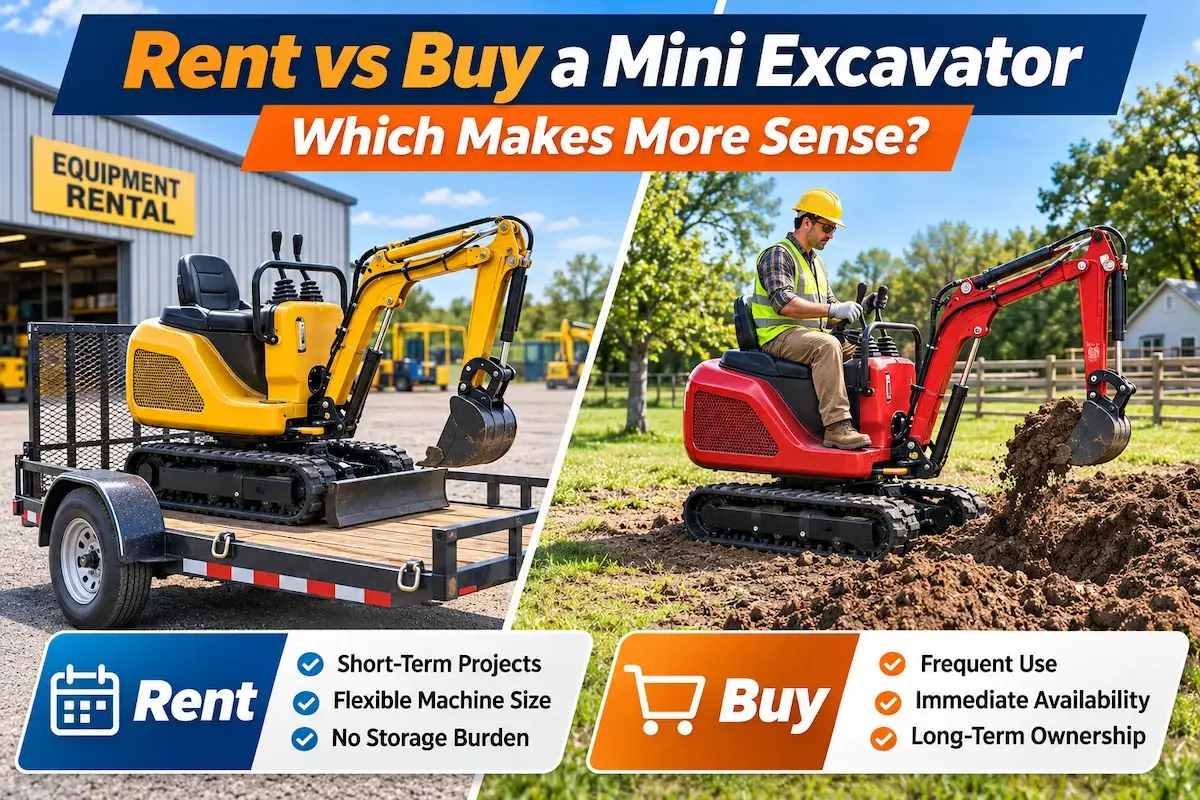
The rent vs buy a mini excavator decision is not simply a comparison between a daily rental rate and the purchase price. The better question is how often you need the machine, how long you need it available, what it costs to move and maintain, and whether owning it creates enough operational value to justify the commitment.
This guide is written for small contractors, landscapers, farm and property owners, utility contractors and first-time equipment buyers who have already concluded that a mini excavator may fit the work and now need to decide how to access one. It is not about starting a rental business. It is about choosing between renting a machine and owning one for your own work.
Quick Answer: Rent or Buy a Mini Excavator?
| Situation | Rent Usually Makes More Sense | Buy Usually Makes More Sense |
|---|---|---|
| Occasional short project | Often yes | Usually not justified |
| Repeated monthly work | Worth comparing | Often becomes a stronger option |
| Uncertain machine size | Often yes, because size can change between jobs | Requires a stable size requirement |
| Consistent machine size | Worth comparing | Often becomes a stronger option |
| Need for immediate machine availability | Depends on local rental supply | Often a strong operational advantage |
| Limited storage | Often yes | Requires practical storage |
| No transport setup | Often yes, if delivery is included in the rental | Requires transport capability |
| Existing trailer or transport setup | Still worth comparing | Reduces the ownership barrier |
| Seasonal demand | Often yes | Depends on annual utilization |
| Long-term property maintenance | Depends on frequency | Often becomes a stronger option if the work repeats |
| Special one-off attachment requirement | Often yes | Only if the attachment is part of regular work |
| Frequent recurring excavation | Worth comparing | Often a stronger option |
The table describes general decision directions. It is not a financial recommendation. The correct decision depends on local rental rates, purchase prices, financing, storage, transport and the buyer’s actual workload.
Why Daily Rental Rate vs Purchase Price Is the Wrong Comparison
A common mistake is to look at a daily rental rate and divide the purchase price by it. That calculation ignores too many costs on both sides.
On the rental side, the relevant cost may include:
- Rental period
- Delivery and pickup
- Attachment charges
- Insurance or damage waiver where applicable
- Standby or idle days
- Repeat rentals over the year
- Repeated mobilization costs
On the ownership side, the relevant cost may include:
- Purchase price
- Financing cost where applicable
- Mantenimiento periódico
- Piezas de desgaste
- Unexpected repairs
- Seguros
- Storage
- Transport
- Archivos adjuntos
- Depreciation
- Valor de reventa
Fuel and operator labor may apply under either rental or ownership. If the same machine class and workload are being compared, treat common operating costs consistently rather than counting them on only one side.
The useful comparison is not one day of rental against the purchase price. It is the total cost of having the machine available for the required work against the total cost of owning, operating and eventually reselling the machine.
What Does Renting a Mini Excavator Really Cost?
Rental agreements vary by market and rental company. The buyer should confirm the actual cost structure rather than assume a single daily rate represents the total.
Rental Period
Rental charges may be structured by day, week or month, and the structure may change depending on duration. A longer rental period can be cheaper per day, but the total cost still depends on the actual period required for the job.
Delivery and Pickup
A low machine rental rate may not represent the delivered cost. Delivery and pickup, especially for a machine that needs a trailer or a low-loader, can change the cost of the rental. Buyers should confirm whether delivery is included or charged separately.
Archivos adjuntos
Extra buckets, breakers, augers or other attachments may change the rental cost. The attachment that fits the job may not be included in the base machine rental, and the attachment itself may be charged separately.
Insurance or Damage Waiver
Rental companies may require or offer insurance or a damage waiver. Whether it applies, and what it covers, depends on the rental company and the market. Buyers should confirm the terms rather than assume.
Idle or Standby Days
Idle or standby days can become an important hidden cost of renting. The machine may be physically required on site for several days even if it only works for a few. Work may depend on material delivery, inspection, weather, other trades or backfilling timing.
If the machine is billed for the whole period it is on site, the effective cost per productive work day can be higher than the daily rate suggests.
Availability
The required size or attachment may not always be available when the buyer needs it. On a tight schedule, availability can become more important than the rental rate.
What Does Owning a Mini Excavator Really Cost?
Ownership brings costs that are not visible in the purchase price. Buyers should plan for the following where applicable:
- Purchase price
- Financing cost where applicable
- Mantenimiento periódico
- Piezas de desgaste
- Unexpected repairs
- Seguros
- Storage
- Transport
- Archivos adjuntos
- Depreciation
- Valor de reventa
Resale value is not guaranteed. Maintenance cost varies by model, operating hours, operating conditions and maintenance practices. Depreciation depends on the machine, the market and the condition of the machine at the time of resale.
Buyers should not assume that ownership automatically reduces cost. Ownership converts rental cost into capital cost, plus ongoing operating cost. Whether that conversion is favourable depends on the amount of useful work the machine will generate.
El Guía de precios de miniexcavadoras explains how configuration and commercial terms affect the purchase price. Buyers should confirm current pricing for the exact configuration being considered.
Usage Frequency: How Often Will You Actually Need the Machine?
Frequency matters, but there is no universal threshold that applies to every buyer. The relevant question is not only how many days per year the machine will work, but how the machine’s availability fits the actual workflow.
Useful distinctions:
- One short project
- Several projects per year
- Monthly recurring work
- Weekly use
- Daily commercial use
Buyers should also distinguish engine operating hours from calendar availability. A machine may need to remain on a property or a jobsite for several days even when it is not running continuously. That availability has value if the work depends on the machine being present.
Machine Availability Can Be More Valuable Than the Rental Rate
For some buyers, availability is the deciding factor rather than the rental rate.
For a contractor, a last-minute job may arrive that needs a machine within days. For a landscaper, a customer may approve drainage or planting work unexpectedly. For a farm, an irrigation or drainage repair may become urgent. For a property maintenance business, small excavation tasks may appear unpredictably.
Ownership can allow the machine to be used when needed without booking, waiting, delivery scheduling or return deadlines. But this is only valuable if the machine is used enough to justify the capital commitment. If the machine sits unused for most of the year, the convenience may not justify ownership.
Do You Always Need the Same Mini Excavator Size?
Machine size is often one of the strongest arguments for renting.
If projects vary greatly — one job needs a micro excavator, another needs a larger compact class, and another requires substantially larger equipment — renting may offer flexibility that one owned machine cannot provide.
If most jobs repeatedly require the same compact machine class, ownership becomes easier to justify because the machine can be selected once and used across many similar jobs.
El Guía de tamaños de miniexcavadoras explains machine class selection across the compact range.
Rent vs Buy for Small Contractors
Renting may fit a contractor who is new, whose workload is uncertain, whose machine sizes change between projects, or who has not yet established storage and transport capability.
Buying may fit a contractor whose excavation work repeats, whose machine size requirement is consistent, whose customers generate recurring work, and who already has storage, transport and maintenance capability.
This is not a financial recommendation. The decision depends on the contractor’s local rental rates, purchase prices and workload. No specific financing structure, ROI figure or payback period should be assumed without the contractor’s own local data.
Rent vs Buy for Landscaping Businesses
Landscaping work often includes drainage, planting pits, garden renovation, small retaining-wall preparation, soil removal, irrigation work and property improvement.
If these tasks are occasional, or if the required machine size changes between projects, renting may remain practical. If excavation becomes a routine paid service with repeatable machine requirements, ownership deserves closer evaluation.
El Mini Excavator for Landscaping guide covers excavator selection for that application in more detail.
Rent vs Buy for Farms, Orchards and Property Owners
Farms and properties often need excavation for irrigation maintenance, ditch maintenance, tree planting, drainage, small trenches, property repair and similar work.
A farm or property owner may not generate a “revenue per machine day.” Ownership can still provide value through availability, repeated maintenance and reduced scheduling friction. But if excavation is rare and the work is spread across the year, renting may remain more economical.
Farms with recurring irrigation, drainage or orchard work may gain more operational value from ownership than properties with a single project and no ongoing excavation requirement.
El Mini Excavator for Farm Use guide covers farm and property selection in more detail.
When Buying a Micro Excavator Can Make Sense
A buyer who repeatedly performs light excavation in restricted areas may not need a larger mini excavator. Typical tasks include small landscaping, tree planting pits, light trenching, irrigation maintenance, orchard work, garden soil removal, ditch maintenance and property work.
In those situations, a micro excavator can be worth evaluating as an owned machine, because the recurring work fits a consistent, compact machine class and the access advantage is repeated across jobs.
As one real micro-excavator reference, the ZL-05 0.5 Ton Micro Excavator lists the following current specifications:
| Especificaciones | ZL-05 Reference |
|---|---|
| Peso en servicio | 420 ± 20 kg |
| Ancho de transporte | 640 mm |
| Transport Height | 1101 mm with handles removed |
| Profundidad máxima de excavación | 912 mm |
| Maximum Vertical Digging Depth | 594 mm |
| Maximum Digging Radius | 1962 mm |
| Maximum Digging Height | 1837 mm |
| Maximum Dumping Height | 1320 mm |
| Boom Swing | 50° left / 50° right |
| Desplazamiento de la cuchara | 245 mm left / 245 mm right |
| Referencia del motor | Rato gasoline engine |
| Potencia del motor | 6,5 HP |
| Maximum System Flow | 12 l/min |
The ZL-05 does not replace rental for every buyer, does not always cost less than renting, and does not replace larger excavators. The correct positioning is this: if the buyer repeatedly performs light excavation in narrow-access environments, a micro excavator such as the ZL-05 may be a category worth evaluating for ownership. The full configuration is listed on the ZL-05 MICROEXCAVADORA DE 0,5 T product page.
A Simple Rent-vs-Buy Calculation
The following is a decision framework, not formal accounting advice. Exact accounting methods vary, and local data should be supplied by the buyer for their own market.
Annual Rental Cost
Annual Rental Cost = Rental Charges + Delivery / Pickup + Attachment Charges + Applicable Insurance / Waiver Costs + Repeated Mobilization Costs
Annualized Ownership Cost
Annualized Ownership Cost = Annualized Capital Cost + Financing Cost + Maintenance + Repairs + Insurance + Storage + Transport
The annualized capital cost can be estimated from the machine’s purchase value and expected residual value over the planned ownership period. If depreciation is used to represent this capital cost, do not subtract the full resale value again.
Total Ownership Cost Over the Planned Ownership Period
Total Ownership Cost Over the Planned Ownership Period = Purchase Price + Financing Cost + Maintenance + Repairs + Insurance + Storage + Transport − Net Resale Proceeds
The two ownership formulas above should be used as alternatives, not combined. The annualized view suits ongoing annual comparisons. The total-period view suits a full lifecycle cost calculation.
Effective Cost per Productive Day
Effective Cost per Productive Day = Total Annual Equipment Cost ÷ Productive Use Days
Productive use should reflect actual work generated, not simply calendar ownership. A machine that sits most of the year carries the same capital cost but generates fewer productive days.
For a more detailed ownership calculation, our mini excavator operating cost per hour guide shows how to combine fuel, maintenance, wear, repairs, depreciation and annual utilization into a consistent hourly machine cost.
When Renting Is the Better Decision
- Short one-off project
- Uncertain future work
- Changing machine requirements
- A special machine only occasionally needed
- No practical storage
- No practical transport setup
- Limited ability to maintain equipment
- The buyer wants to test a machine class before purchasing
Renting is not a weaker decision. It is the correct decision when the buyer’s actual demand does not support ownership.
When Buying Is the Better Decision
- Repeated work
- A consistent machine size
- High value placed on immediate availability
- Existing storage
- Existing transport capability
- The ability to maintain the machine
- A long-term use plan
Buying is not automatically cheaper. Ownership becomes a stronger option when the machine will be used productively across many jobs and when the buyer can manage the practical responsibilities that come with ownership.
Can Renting and Buying Work Together?
Yes. A hybrid strategy is often more practical than treating rent and buy as mutually exclusive.
A typical hybrid approach:
- Own the machine class used most frequently
- Rent larger machines when a specific project requires them
- Rent special attachments rather than purchasing them for occasional work
- Rent extra machines during peak workload
This balances the availability benefit of ownership against the flexibility benefit of rental. It is not always optimal, but it reflects how many contractors actually operate.
What Should You Confirm Before Buying Instead of Renting?
If the buyer is leaning toward ownership, several practical points should be confirmed before ordering:
- Aplicación principal
- Machine size
- Required digging depth
- Minimum access width
- Archivos adjuntos
- Transport method
- Storage
- Maintenance capability
- Expected annual usage
- País de destino
- Cantidad
El Mini Excavator Order Checklist explains how to confirm the final configuration before paying a deposit, and the Mini Excavator Trailer Guide explains trailer payload and tow vehicle planning.
Final Decision: Should You Rent or Buy a Mini Excavator?
A practical framework:
- Rent if: demand is temporary, machine size changes often, workload is uncertain, or ownership logistics are inconvenient.
- Buy if: excavation work repeats, the same machine class fits most jobs, availability matters and storage, transport and maintenance are manageable.
- Hybrid: own the high-frequency machine and rent occasional specialty or larger equipment.
The decision should not be reduced to one number. It should reflect the buyer’s workload, the machine’s useful availability, and the buyer’s ability to manage the practical responsibilities of ownership.
Have You Decided That Ownership Makes Sense?
If you have concluded that ownership is the right choice for your work, send ZHAOLU the main application, required digging depth, minimum access width, attachments, quantity and destination country. ZHAOLU can help compare suitable mini excavator classes based on the confirmed requirements.
ZHAOLU cannot decide whether renting is financially better in your local market without your local rental and purchase data, but we can help confirm which machine class matches your confirmed work requirements.
Review the Miniexcavadoras en Venta | 0,5–2,5 t | ZHAOLU page or the ZL-05 MICROEXCAVADORA DE 0,5 T product page.
Frequently Asked Questions: Rent vs Buy a Mini Excavator
Is it better to rent or buy a mini excavator?
It depends on how often the machine will be used, whether the required machine size is consistent, and whether storage, transport and maintenance are practical. Renting suits temporary or uncertain demand. Buying suits repeated work with a consistent machine class.
How often should I use a mini excavator before buying one?
There is no universal threshold. The relevant question is how much productive work the machine will generate across the year, how the machine’s availability fits the workflow, and whether ownership costs are lower than rental costs for the same amount of useful machine availability.
Is renting a mini excavator cheaper than buying?
Renting can be cheaper when the machine is needed only occasionally. Whether it is cheaper overall depends on local rental rates, purchase prices, utilization, storage, transport and maintenance. There is no universal answer.
What costs should I consider when renting a mini excavator?
Rental charges, delivery and pickup, attachment charges, insurance or damage waiver where applicable, standby days, repeated mobilization and machine availability should be considered.
What costs should I consider when owning a mini excavator?
Purchase price, financing where applicable, routine maintenance, wear parts, unexpected repairs, insurance, storage, transport, attachments, depreciation and resale value should be considered.
Should a small contractor rent or buy a mini excavator?
A new contractor with uncertain workload may benefit from renting. A contractor with recurring excavation work, a consistent machine size and practical storage and transport may find ownership a stronger option.
Should a landscaper buy a mini excavator?
If excavation becomes a routine paid service with repeatable machine requirements, ownership deserves evaluation. If the work is occasional or the machine size changes between projects, renting may remain practical.
Does buying a mini excavator make sense for farm or property work?
It depends on the frequency and type of work. Farms with recurring irrigation, drainage or orchard tasks may gain more operational value from ownership than properties with a single large project and no ongoing excavation requirement.
Can I buy one mini excavator and rent larger machines when needed?
Yes. A hybrid strategy — owning the most frequently used machine class and renting larger or specialty machines when required — is often more practical than treating rent and buy as mutually exclusive.
When does buying a micro excavator make sense?
Buying a micro excavator may be worth evaluating when the buyer repeatedly performs light excavation in narrow-access environments, such as planting, shallow trenching, irrigation maintenance and property work. The machine class and configuration should still be confirmed against the actual work.