
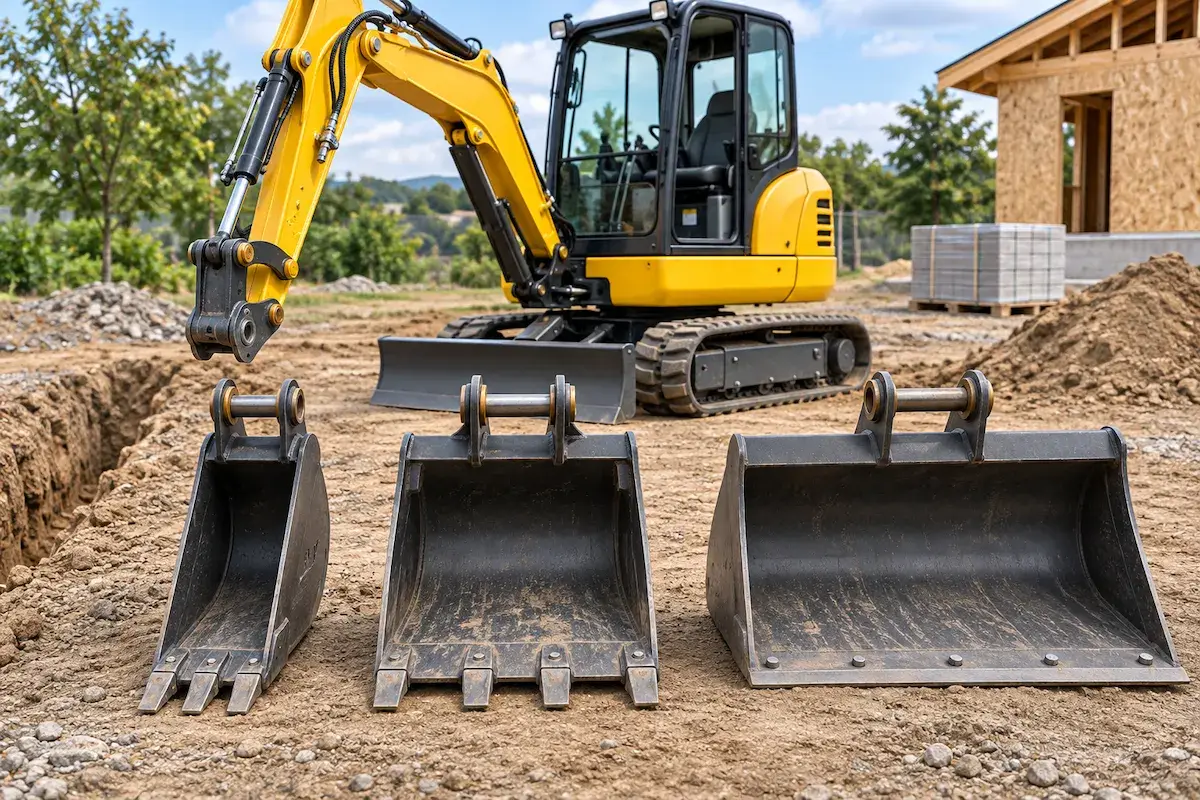
Mini excavator bucket size is not just a single width figure. Bucket width, capacity, weight, geometry, teeth and mounting dimensions all affect whether a bucket fits the machine and suits the job. Buyers who choose by excavator tonnage alone often end up with a bucket that is too wide, too heavy, too small, or unable to fit the dipper arm.
This guide explains the parameters that make up “bucket size,” how to match a bucket to a trench or digging requirement, why mounting dimensions matter as much as width, and what buyers should send a supplier before requesting a bucket quotation.
Quick Answer: What Size Bucket Does a Mini Excavator Need?
There is no universal bucket size that applies to all mini excavators. The right bucket depends on the required trench or digging width, the soil and material, the machine class, the bucket weight, the bucket capacity, and the mounting configuration of the specific machine.
Bucket width is usually the first decision, because it relates directly to the trench or excavation path. Capacity, weight, teeth and mounting dimensions are then checked against the machine. A bucket that fits one mini excavator is not automatically compatible with another, even within the same tonnage class.
Mini Excavator Bucket Size at a Glance
| Parameter | What It Means | Por qué es importante |
|---|---|---|
| Bucket width | The cutting / excavation path of the bucket | Directly affects trench width and the excavation width per pass |
| Bucket capacity | How much material the bucket can hold under the stated measurement basis | Affects material moved per pass and working load |
| Bucket weight | The empty weight of the bucket | Affects machine balance, lift and dig load, and stability |
| Diámetro del pasador | Diameter of the mounting pins | Must match the dipper arm or coupler |
| Pin centers | Distance between pin centerlines | Must match the arm or coupler interface |
| Ear / mounting width | Width of the bucket mounting brackets | Must fit the arm or coupler opening |
| Teeth / cutting edge | Type and number of teeth or edge design | Affects penetration and bucket wear |
| Coupler compatibility | Whether the bucket can be used with the machine’s coupler | Affects fitment and changeover speed |
None of these parameters should be assumed from the machine tonnage alone. They must be confirmed against the specific machine and the specific bucket.
What Does “Bucket Size” Actually Mean?
Bucket size is not a single number. It describes a set of parameters that together define the bucket’s working shape and its fitment to the machine.
At minimum, “bucket size” includes width, capacity, empty weight, mounting dimensions and tooth or edge configuration. Two buckets that both measure 300 mm wide may have different capacities, different depths, different weights and different mounting interfaces. They are not interchangeable just because the width matches.
For that reason, buyers comparing bucket options should compare the full set of parameters rather than a single width figure. The machine, the job and the mounting dimensions all contribute to the decision.
Bucket Width vs Bucket Capacity
Bucket width and bucket capacity describe different things and should not be treated as interchangeable specifications.
Bucket width describes the cutting or excavation path. It is the dimension that most directly affects trench width, working footprint and how much ground is cut per pass.
Bucket capacity describes how much material the bucket can hold under the measurement basis used by the manufacturer. Different manufacturers may use different capacity definitions or bucket geometries, so buyers should confirm how the figure is defined before comparing buckets from different sources.
Neither figure replaces the other. A bucket can be wide but shallow, or narrow but deep. The correct bucket combines width, capacity and geometry for the specific job.
Why There Is No Universal Bucket Size by Excavator Tonnage
It is common for buyers to assume that a given excavator tonnage maps to a fixed bucket width or capacity. That assumption does not hold across different manufacturers or even across models from the same manufacturer.
Machines in the same tonnage class may differ in:
- Boom and arm design
- Pin diameter and pin-center distance
- Ear / mounting width
- Coupler type and interface
- Hydraulic capability
- Machine stability and lifting balance
- Bucket weight limits in practice
- Target applications
Tonnage may be an initial screening reference, but it is not a final fitment rule. The bucket must be matched to the specific machine configuration and the specific job, not to a category label.
How to Choose Bucket Width
Bucket width should start with the job, not with the machine tonnage. Three common use cases illustrate the logic.
Trenching
For trenching, the required trench width is usually the starting point. The required width should come from the project specification — for example, the pipe, cable or drainage requirement — rather than from a generic rule. A bucket narrower than the required trench width will not produce the necessary working space, while a bucket wider than necessary increases spoil volume and backfill work.
General Digging
For general excavation, bucket width is balanced against material moved per pass, penetration resistance, machine capability and soil type. A wider bucket moves more material per pass in suitable loose soil but can increase resistance in dense or compacted ground. A narrower bucket reduces cutting width and can be easier to penetrate into difficult ground.
Grading and Backfilling
For grading, backfilling and surface finishing, a wider bucket is often more suitable because it covers more surface area per pass. But wider buckets should still be checked against the machine’s capability, the material density and the working stability. Wider does not automatically mean more efficient in every condition.
How to Choose Bucket Capacity
Bucket capacity should not be chosen purely on the largest available figure. Capacity affects the working load the bucket places on the machine, and a larger bucket is not automatically more productive.
Relevant considerations include:
- Material density
- Bucket empty weight
- Machine stability
- Digging and hydraulic capability
- Working cycle and job type
- Required material moved per pass
A larger bucket may carry more volume, but the actual material mass also increases. The bucket should match the machine’s capability and the material being handled, not the largest figure available in a catalog.
Bucket Weight and Material Weight
The machine must handle both the empty bucket and the material carried inside it. As bucket capacity increases, the material mass carried per pass can also increase, depending on the material being handled.
This combined bucket-and-material load is not the same as the machine’s rated lifting capacity. Rated lifting capacity depends on separate manufacturer data and the actual lifting configuration. The Mini Excavator Lifting Capacity Guide explains lifting performance separately.
Digging Bucket vs Trenching Bucket vs Grading Bucket
| Bucket Type | Typical Purpose | Main Selection Factor |
|---|---|---|
| General digging bucket | General excavation, moving soil, loading material | Balance between width, capacity and machine capability |
| Trenching bucket | Narrow trenches for pipes, cables, drainage, irrigation | Required trench width and soil conditions |
| Grading bucket | Leveling, backfilling, surface finishing | Bucket width and flat-bottom design |
El Guía de accesorios para miniexcavadoras explains attachment selection and compatibility across bucket types and other attachments.
How Soil Type Changes Bucket Selection
Soil conditions affect how a given bucket behaves in real work. Loose soil, clay, compacted ground, gravel, roots and mixed material all respond differently to bucket width, bucket geometry and tooth configuration.
A bucket that works well in loose soil may encounter more resistance in compacted clay or mixed ground. A narrower bucket may penetrate difficult ground more easily in some conditions, while a wider bucket may move more material efficiently in softer, uniform soil. The right choice depends on the specific material and the actual job.
This article does not provide a soil-type-to-bucket-width table, because the correct bucket depends on the specific machine, material and project. Buyers should describe the actual ground conditions to the supplier.
Bucket Size vs Mini Excavator Digging Force
Bucket width by itself does not determine the excavator’s published digging-force rating. Rated bucket and arm digging force are primarily related to the machine’s hydraulic system, cylinder dimensions, linkage geometry and the rating configuration used by the manufacturer.
However, the bucket fitted to the machine can affect how the available force is applied at the cutting edge. Bucket geometry, tooth-tip position and cutting width can influence penetration and working resistance. A wider bucket usually contacts more material per pass and may encounter greater resistance in dense or compacted ground.
The key point is that a narrower bucket does not increase the machine’s published rated digging force. It may simply apply the available machine capability over a narrower cutting path. The Mini Excavator Digging Force Guide explains bucket breakout force and arm digging force in more detail.
Why an Oversized Bucket Can Be a Problem
An oversized bucket may create issues that reduce practical efficiency rather than improve it. Depending on the machine and material, an oversized bucket can:
- Increase the working material load beyond what the machine handles efficiently
- Slow the digging cycle
- Reduce penetration in difficult ground
- Affect machine stability during the working cycle
- Increase stress and wear on the machine and bucket
- Reduce overall working efficiency
These effects depend on the specific machine, the bucket, the material and the working conditions. The bucket should be matched to the machine and the job, not selected purely on the largest available figure.
How to Measure Bucket Compatibility
Bucket compatibility is not only about width. The mounting dimensions of the bucket must match the machine or coupler interface, or the bucket cannot be fitted.
Pin Diameter
The mounting-pin diameter must be compatible with the dipper arm, bucket linkage or coupler being used. If the dimensions do not match, the bucket will not be a direct fit and may require an approved coupler, adapter or bushing arrangement. Buyers should confirm the exact interface rather than assume that similar pin sizes are interchangeable.
Pin Centers / Pin-to-Pin Distance
The distance between the centerlines of the two mounting pins must match the arm or coupler interface. Even relatively small differences in pin-center distance can prevent direct fitment or interfere with the required linkage movement.
Ear Width / Mounting Width
The width of the bucket mounting brackets (often called the ear width or dipper width) must fit the opening on the arm or coupler. Terminology for this dimension varies by market and manufacturer, but the requirement is the same: the mounting bracket must match the interface.
Pin Arrangement and Mounting Geometry
Different machines and couplers may use different pin arrangements or mounting geometry. Two buckets with the same width, capacity and pin diameter are not automatically interchangeable if the mounting arrangement differs.
Two buckets with the same width are not automatically interchangeable. The full mounting configuration must be confirmed.
Quick Coupler Compatibility
If the machine uses a quick coupler, bucket compatibility depends on the coupler interface as well as the bucket’s mounting dimensions. Buyers should confirm:
- The coupler type
- Pin compatibility between the bucket and the coupler
- Pickup dimensions of the coupler
- Bucket interface dimensions
A bucket that fits the dipper arm directly may not fit the coupler, and a bucket that fits the coupler may not match the arm if the coupler is removed. For buyers choosing between mechanical and hydraulic quick couplers, confirm the coupler specification and mounting interface with the supplier before ordering compatible buckets.
How Bucket Width Affects Trench Work
Bucket width is directly related to trench width. When the bucket cuts through the ground, the resulting trench width is approximately the bucket’s cutting width under ideal conditions. In practice, the finished trench width is also affected by soil conditions, operator technique and the bucket’s geometry.
Bucket width should be selected based on the required finished trench width, the pipe or cable or drainage requirement, the working clearance needed around the installed material, and the soil conditions. The required trench width should come from the project specification, not from a generic rule.
A bucket narrower than the required trench width will not produce the necessary working space. A bucket wider than necessary increases spoil volume, backfill work and surface disruption. The correct width is the one that matches the project specification and the machine’s working capability.
Bucket Size vs Digging Depth
Bucket width and digging depth are different specifications. Digging depth describes how far the machine’s digging geometry can reach below ground level. Bucket width describes the cutting path.
A larger bucket does not make the machine dig deeper, and a smaller bucket does not increase the machine’s maximum digging depth. The Mini Excavator Digging Depth Guide explains how to compare required excavation depth against machine capability.
Bucket Size vs Machine Stability
A larger or heavier bucket, combined with the material it carries, may affect the machine’s working stability during the digging cycle. Machine stability depends on operating weight, undercarriage configuration, machine position, ground conditions, attachment weight and working radius.
This is not a simple formula, and this article does not provide tipping limits or safe-load figures. Machine stability should be confirmed against the model-specific machine data and the actual working position. A bucket that is larger than the machine can handle efficiently is not the more productive choice.
How to Compare Two Bucket Options
- Bucket type
- Bucket width
- Bucket capacity
- Empty bucket weight
- Diámetro del pasador
- Pin centers
- Ear / mounting width
- Coupler compatibility
- Tooth configuration
- Soil / material
- Required trench width
- Modelo de la máquina
- Job type
Comparing two buckets on width alone is not enough. The full set of parameters must be compared against the machine and the job.
What Buyers Should Send the Supplier
A clear bucket request reduces the risk of receiving an incompatible bucket. Buyers should provide the following information where possible:
- Excavator brand and model
- Machine operating class
- Required bucket type
- Required trench or digging width
- Soil or material type
- Diámetro del pasador
- Pin-to-pin center distance
- Ear / mounting width
- Coupler type
- Photos of the existing bucket or dipper end if dimensions are uncertain
- País de destino
- Cantidad
When dimensions are uncertain, photographs of the existing bucket, the dipper end and the coupler are often useful for confirming compatibility. The supplier can use these together with the machine model to verify the correct configuration.
What Should ZL-05 Buyers Confirm Before Choosing a Bucket?
The ZL-05 is a 0.5 Ton Micro Excavator. Some machine specifications are confirmed, and several bucket-related dimensions are not currently verified. The table below shows both.
| Especificaciones | Confirmed ZL-05 Reference |
|---|---|
| Peso en servicio | 420 ± 20 kg |
| Ancho de la máquina | 640 mm / 25.2 in |
| Profundidad máxima de excavación | 912 mm |
| Maximum Digging Radius | 1962 mm |
| Referencia del motor | Rato gasoline engine |
| Reference Engine Power | 6,5 HP |
| Maximum System Flow | 12 l/min |
| Ancho estándar de la cuchara | Not currently verified |
| Capacidad de la cuchara | Not currently verified |
| Bucket Weight | Not currently verified |
| Pin Diameter | Not currently verified |
| Pin-Center Distance | Not currently verified |
| Ear / Mounting Width | Not currently verified |
Importante: These missing bucket dimensions should be confirmed from the current production configuration before ordering an attachment. They cannot be inferred from machine weight, digging depth, engine power or hydraulic flow. The full machine configuration is listed on the ZL-05 MICROEXCAVADORA DE 0,5 T product page.
Typical ZL-05 applications include narrow-access work, landscaping, planting pits, light trenching, irrigation, orchard work, garden work and property maintenance. Buyers planning to add a bucket to a ZL-05 should confirm the required width, capacity and mounting dimensions with the supplier before ordering.
When Should a Buyer Choose a Narrower Bucket?
A narrower bucket may be the better choice when:
- The required trench width is narrow
- The ground is difficult to penetrate
- The working space is confined
- Reduced material volume per pass is acceptable
A narrower bucket reduces the cutting width and may penetrate difficult ground more easily in some conditions. It does not increase the machine’s rated digging force. The correct expectation is that a narrower bucket changes how the available force is applied to the material, not that it changes the machine’s rated force value.
When Should a Wider Bucket Be Considered?
A wider bucket may be the better choice when:
- Grading and surface finishing are the main tasks
- Backfilling is a large part of the work
- The material is loose and uniform
- A wider excavation path is required
Even in these conditions, the machine’s capability and the material density should still be confirmed. A wider bucket is only more productive when the machine can handle the resulting working load efficiently.
Common Bucket Selection Mistakes
- Choosing by excavator tonnage only
- Comparing width but ignoring capacity
- Ignoring bucket weight
- Ignoring pin dimensions
- Assuming all buckets fit the same coupler
- Choosing the widest bucket available
- Ignoring soil conditions
- Confusing bucket size with digging force
- Ordering before confirming mounting dimensions
Each of these mistakes can be avoided by comparing the full set of bucket parameters against the machine and the job before ordering.
Final Answer
Mini excavator bucket size is not a single figure. It includes width, capacity, weight, geometry, teeth and mounting dimensions. The right bucket depends on the required trench or digging width, the soil and material, the machine class, the bucket weight, the bucket capacity and the mounting configuration of the specific machine. Buyers should compare the full set of parameters rather than width alone, and should confirm the mounting dimensions against the exact machine before ordering. The Guía de tamaños de miniexcavadoras y el Guía de especificaciones de miniexcavadoras explain machine class and specification interpretation for buyers still selecting the base machine.
Need Help Matching a Bucket to Your Mini Excavator?
Send ZHAOLU the excavator model, bucket type, required width, material or soil, mounting dimensions, coupler type, destination country and quantity. ZHAOLU can help confirm the correct bucket configuration for the machine and the job.
Review the Miniexcavadoras en Venta | 0,5–2,5 t | ZHAOLU page or the ZL-05 MICROEXCAVADORA DE 0,5 T product page.
Frequently Asked Questions About Mini Excavator Bucket Size
What size bucket does a mini excavator use?
There is no universal size. The correct bucket depends on the machine, the required trench or digging width, the material and the mounting dimensions. Buyers should confirm the bucket width, capacity, weight and mounting configuration for the specific machine.
How wide should a mini excavator bucket be?
Bucket width is usually determined by the required trench or digging width, which should come from the project specification. A bucket narrower than the required width will not produce enough working space, while a bucket wider than necessary increases spoil volume and backfill work.
Is bucket width the same as bucket capacity?
No. Bucket width describes the cutting or excavation path, while bucket capacity describes how much material the bucket can hold under the manufacturer’s stated measurement basis. The two figures are different and should be compared separately.
Does a wider bucket reduce digging performance?
It can, depending on the material and the machine. A wider bucket increases the cutting path and may encounter more resistance in dense or compacted ground. In loose, uniform soil, a wider bucket may move more material per pass. The result depends on the specific machine and ground conditions.
Does a narrow bucket increase digging force?
No. A narrow bucket does not change the machine’s published rated digging force. It reduces the cutting width and may penetrate difficult ground more easily in some conditions, but the machine’s rated force value remains the same.
Can any bucket fit any mini excavator?
No. Bucket compatibility depends on pin diameter, pin-center distance, ear or mounting width, pin arrangement and coupler type. Two buckets with the same width are not automatically interchangeable. The mounting configuration must match the specific machine.
How do I measure an excavator bucket for fitment?
Measure the pin diameter, the pin-to-pin center distance and the width of the mounting ears. Where possible, provide photos of the existing bucket, the dipper end and the coupler. These dimensions are used together with the machine model to confirm the correct bucket configuration.
What bucket is best for trenching?
A trenching bucket is generally the better choice for narrow trenches. The bucket width should be selected based on the required trench width from the project specification, the pipe or cable or drainage requirement, the working clearance and the soil conditions.
Does bucket size affect digging depth?
No. Bucket width and capacity do not change the machine’s maximum digging depth. Digging depth is determined by the machine’s boom and arm geometry. The Mini Excavator Digging Depth Guide explains how to compare required excavation depth against machine capability.