
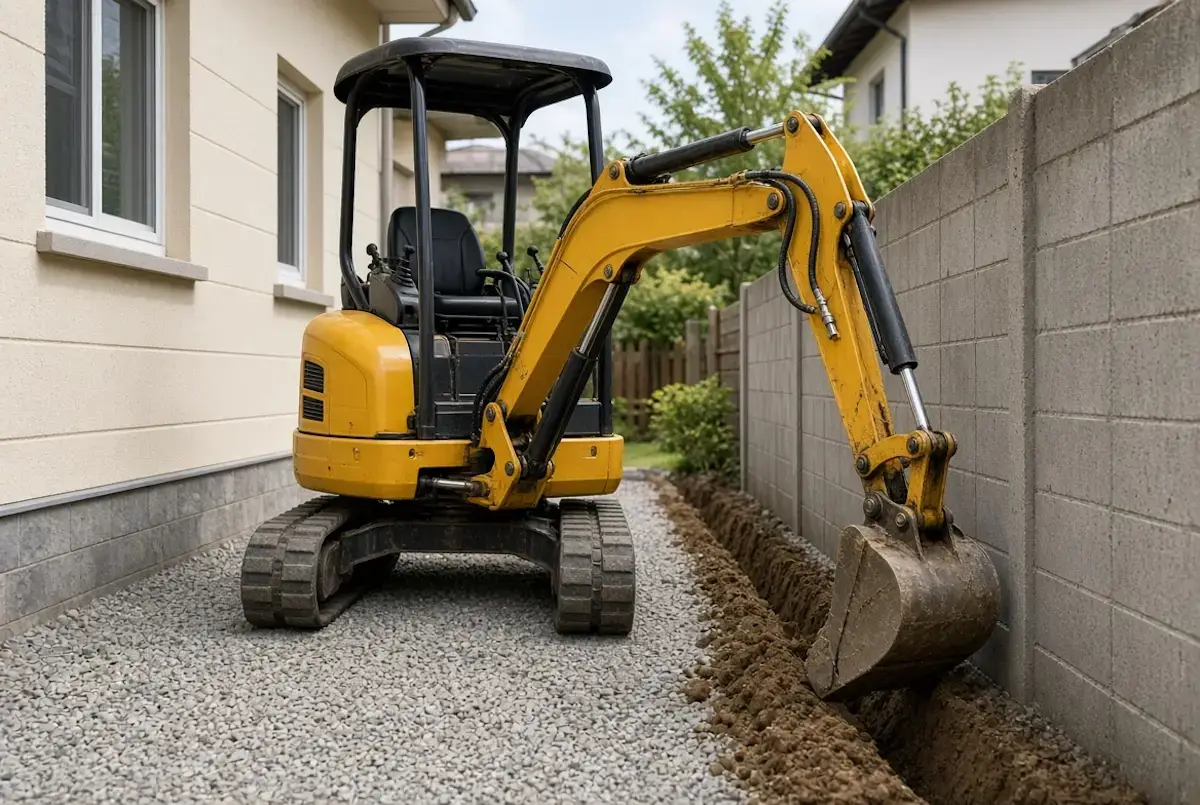
When buyers compare compact excavators, they often focus on width and digging depth first. The mini excavator swing boom is sometimes overlooked, even though it can strongly affect whether the machine can position the digging line along a wall, beside a fence or next to a utility trench without additional repositioning. A swing boom allows the digging line to be offset to one side, which matters when the machine cannot stand directly in front of the trench.
This guide explains what a swing boom actually does, how it differs from upper-structure rotation and tail swing, and what buyers should confirm before ordering a machine with side-swing capability.
Quick Answer: What Is a Mini Excavator Swing Boom?
A swing boom allows the boom assembly to pivot laterally relative to the machine centreline. This helps position the digging line to one side without placing the entire machine directly in line with the excavation. It is relevant where machine position is restricted, the trench is close to an obstacle, or offset digging is required.
A swing boom is not the same as zero tail swing. A machine can have boom swing and still have rear tail overhang. Buyers should confirm both the swing geometry and the tail swing characteristics of the specific model.
Swing Boom vs Upper-Structure Rotation vs Tail Swing
These features are often confused. They describe different movements and different clearance requirements.
| Feature | What Moves | What It Helps With | What It Does Not Tell You |
|---|---|---|---|
| Swing Boom / Side Swing | The boom assembly pivots laterally relative to the machine centreline | Offset digging beside walls, fences, paths or utility lines | Does not describe rear counterweight clearance or tail swing |
| Upper-Structure Rotation | The upper structure rotates around the slew centre | Positioning the boom and attachment around the machine without moving the undercarriage | Does not describe how far the boom itself can offset sideways |
| Tail Swing | The rear of the upper structure moves around the slew centre during rotation | Understanding rear clearance around walls, fences and other obstacles | Does not describe boom-side offset or classify the machine as zero-tail, reduced-tail or conventional-tail by itself |
| Rotating / Tilting Attachment | The attachment moves at the end of the arm | Angling or rotating the bucket or tool | Does not replace boom swing or upper-structure rotation |
Not every excavator has every feature. Buyers should confirm which features are standard, optional or unavailable on the specific model being quoted.
Why Offset Digging Can Matter on Compact Job Sites
Offset digging matters when the machine cannot stand directly in front of the trench. Practical examples include a trench beside a wall, a pipe run alongside an existing path, drainage near a property boundary, or utility work beside a road edge.
Without suitable offset capability, the machine may need more repositioning, more working clearance, or a different machine orientation. A swing boom can help position the digging line without moving the entire machine into the trench line.
These are practical considerations, not productivity guarantees. Buyers should compare the site geometry against the confirmed swing specification.
Swing Angle Is Not the Same as Usable Digging Offset
Swing angle is an angular specification. Offset is a positional result. The usable digging position also depends on boom geometry, arm position, bucket position, working depth and machine position.
For example, the current ZL-05 specification lists a boom swing angle of 50° left and 50° right, and a bucket offset of 245 mm left and 245 mm right. These are manufacturer specifications for the ZL-05. Buyers should not mathematically derive one from the other or assume that the specified offset applies at every working position.
Machine Width Still Matters
A swing boom does not make the machine physically narrower. The complete excavator still needs enough access width to reach the work area. The current ZL-05 has a transport width of 640 mm. Buyers with narrow gates or alleys should check both the machine width and the working geometry after entering the site.
El Mini Excavator Width Guide explains what dimensions to confirm before selecting a machine for restricted access.
Digging Depth and Reach Still Matter
Side swing changes positioning. It does not automatically increase maximum digging depth or maximum digging radius. The buyer must still verify the complete machine working range.
Current ZHAOLU references include the ZL-05 with 912 mm maximum digging depth and 1962 mm maximum digging radius, the ZL-12 with 1980 mm maximum digging depth and 3100 mm maximum digging radius, and the ZL-15 with 1905 mm maximum digging depth and 3311 mm maximum digging radius. These are model-specific values.
El Mini Excavator Digging Depth Guide explains how to match required excavation depth to machine capability.
Real ZHAOLU Side-Swing References
| Modelo | Commercial Class | Side-Swing Reference | Verified Working Reference | Buyer Decision |
|---|---|---|---|---|
| ZL-05 | Microexcavadora de 0,5 toneladas | 50° Left / 50° Right boom swing; current specification lists 245 mm left / 245 mm right bucket offset | 912 mm maximum digging depth; 640 mm transport width | Evaluate where very compact access and offset positioning are both important |
| ZL-12 | 0.7 Ton Mini Excavator | Optional side-swing configuration listed on current product page | 1980 mm maximum digging depth | Confirm whether the optional side-swing configuration is required and available in the final quotation |
| ZL-15 | Miniexcavadora de 0,85 toneladas | Side Swing listed as Standard | 1905 mm maximum digging depth | Evaluate the complete ZL-15 configuration where side swing and this machine class match the application |
If your project requires digging beside a wall, fence, path or utility line, send ZHAOLU the minimum access width, required trench position, required depth, main application, destination and quantity. ZHAOLU can review which current machine configuration should be evaluated before quotation. Ponte en contacto con ZHAOLU to confirm the requirements.
When Should You Evaluate the ZL-05 Swing-Boom Configuration?
The ZL-05 is a 0.5 Ton Micro Excavator with an operating weight of 420 ± 20 kg, a 640 mm transport width, 50° left / 50° right boom swing, 245 mm left / 245 mm right bucket offset listed in the current specification, 912 mm maximum digging depth and 1962 mm maximum digging radius. It deserves evaluation where very narrow access, light excavation and offset digging position are all relevant.
These specifications alone do not confirm suitability for a specific project. The ZL-05 MICROEXCAVADORA DE 0,5 T product page lists the current configuration.
When Should You Evaluate ZL-12 or ZL-15?
The ZL-12 is a 0.7 Ton Mini Excavator with an operating weight of 720 kg and 1980 mm maximum digging depth. The current product page lists an optional side-swing configuration. Buyers should confirm whether the optional side-swing configuration is required and available in the final quotation. The ZL-12 0.7 Ton Mini Excavator product page lists the current configuration.
The ZL-15 is a 0.85 Ton Mini Excavator with an operating weight of 850 kg, 1905 mm maximum digging depth and 3311 mm maximum digging radius. The current product page lists Side Swing as Standard. The ZL-15 MINIEXCAVADORA DE 0,85 T product page lists the current configuration.
These machines serve different working envelopes and should be compared against the actual project requirements rather than assumed to be interchangeable.
Swing Boom Does Not Replace Tail-Swing Evaluation
The front digging assembly and the rear counterweight create different clearance requirements. Even if the boom can swing to one side, the buyer must still understand how much space the rear of the upper structure needs while rotating.
For the ZL-05, the current specification lists a tail swing radius of 756 mm. That figure describes the rear clearance of the ZL-05 and should not be converted into a zero-tail-swing classification. The Guía de especificaciones de miniexcavadoras explains how to read tail swing and other specifications in context.
Buyers working in confined spaces should also compare zero, reduced and conventional tail swing designs. Our zero tail swing vs conventional mini excavator guide explains rear rotation clearance, machine configuration and the dimensions to verify before ordering.
What Should Buyers Confirm Before Ordering a Swing-Boom Mini Excavator?
| Item to Confirm | What to Ask | Por qué es importante |
|---|---|---|
| Exact excavator model | Model number and commercial class | Establishes the complete machine configuration |
| Swing boom / side swing included? | Is it standard or optional on this model? | Prevents assuming a feature is included when it is not |
| Standard or optional? | Confirm how it appears in the quotation | Affects the final machine configuration and quotation |
| Left swing specification | Angle or offset value where published | Indicates available movement to one side |
| Right swing specification | Angle or offset value where published | Indicates available movement to the other side |
| Offset specification if published | Manufacturer-stated offset value | Provides a reference for usable lateral positioning |
| Machine overall / transport width | Confirmed width for access | The machine still has to reach the site |
| Required digging depth | Typical and deepest regular depth | Ensures the machine can complete the work |
| Required digging radius | Reach needed from the machine position | Depth alone does not confirm the job can be completed |
| Working space beside obstacle | Available room to position and swing | Affects whether offset digging is practical |
| Working position | Where can the machine physically stand relative to the trench or obstacle? | The swing specification is only useful if the machine can be positioned where the required digging geometry can be achieved |
| Tail swing information | Rear clearance during rotation | Prevents surprises near walls or boundaries |
| Requisitos de adjuntar archivos | Any attachment requirements relevant to the job | Helps confirm whether the complete machine configuration matches the application |
| Final quotation configuration | Written confirmation of the agreed setup | Ensures the order matches the requirement |
Information to Send the Supplier for an Offset-Digging Project
To help the supplier identify which machine configuration should be evaluated, buyers should provide the minimum site entrance width, the available working width after entering, the distance from the machine position to any wall, fence or obstacle, the required trench location, the required trench depth, the approximate trench width, the ground condition, the main attachment, the destination country and the quantity.
These values help the supplier understand the required working geometry and identify which machine configurations should be evaluated. They are not a substitute for project-specific engineering or safety planning.
Common Mistakes When Comparing Swing-Boom Mini Excavators
- Comparing swing angle alone without checking actual offset or geometry
- Assuming side swing means zero tail swing
- Ignoring machine width because the boom can swing
- Ignoring required digging depth
- Assuming an optional side-swing configuration is included by default
- Assuming the same swing geometry applies across different models
- Ordering from a product photo without confirming written specifications
Each of these can be resolved by confirming the specific model’s written specification and the configuration in the final quotation.
How to Choose a Mini Excavator for Offset Digging
- Measure site access width
- Define where the machine can physically stand
- Define the required digging line
- Confirm required depth and reach
- Review swing-boom / side-swing geometry
- Put the exact configuration into the final quotation
This sequence keeps the swing boom feature in the context of the complete site and machine requirements.
Confirm the Right Mini Excavator for Offset Digging
If your project involves walls, fences, utility lines, drainage or restricted residential access, send ZHAOLU the site access width, required digging depth, trench position, application, destination and quantity. ZHAOLU can review the requirements against current mini excavator configurations before preparing the quotation.
Los modelos actuales se pueden consultar en la Miniexcavadoras en Venta | 0,5–2,5 t | ZHAOLU page or the Mini Excavator Product Category página.
Frequently Asked Questions About Mini Excavator Swing Booms
What is a swing boom on a mini excavator?
A swing boom allows the boom assembly to pivot laterally relative to the machine centreline. This helps position the digging line to one side without placing the entire machine directly in line with the excavation.
Is swing boom the same as zero tail swing?
No. Swing boom describes lateral movement of the boom assembly. Tail swing describes the rear upper structure and counterweight clearance during rotation. One feature does not prove the other.
Can a swing-boom mini excavator dig beside a wall?
It can help position the digging line closer to an obstacle, but actual suitability depends on machine width, swing geometry, required depth, tail clearance and available working space. The specific model configuration should be confirmed before ordering.
What is the boom swing angle of the ZHAOLU ZL-05?
The current verified ZL-05 specification lists a boom swing of 50° left and 50° right. The same specification lists a bucket offset of 245 mm left and 245 mm right. That offset should not be interpreted beyond the published specification.
What should I confirm before ordering a mini excavator with side swing?
Confirm the exact model, whether side swing is standard or optional, the left and right swing specification, any published offset specification, machine width, required digging depth, tail clearance and the final written quotation.