
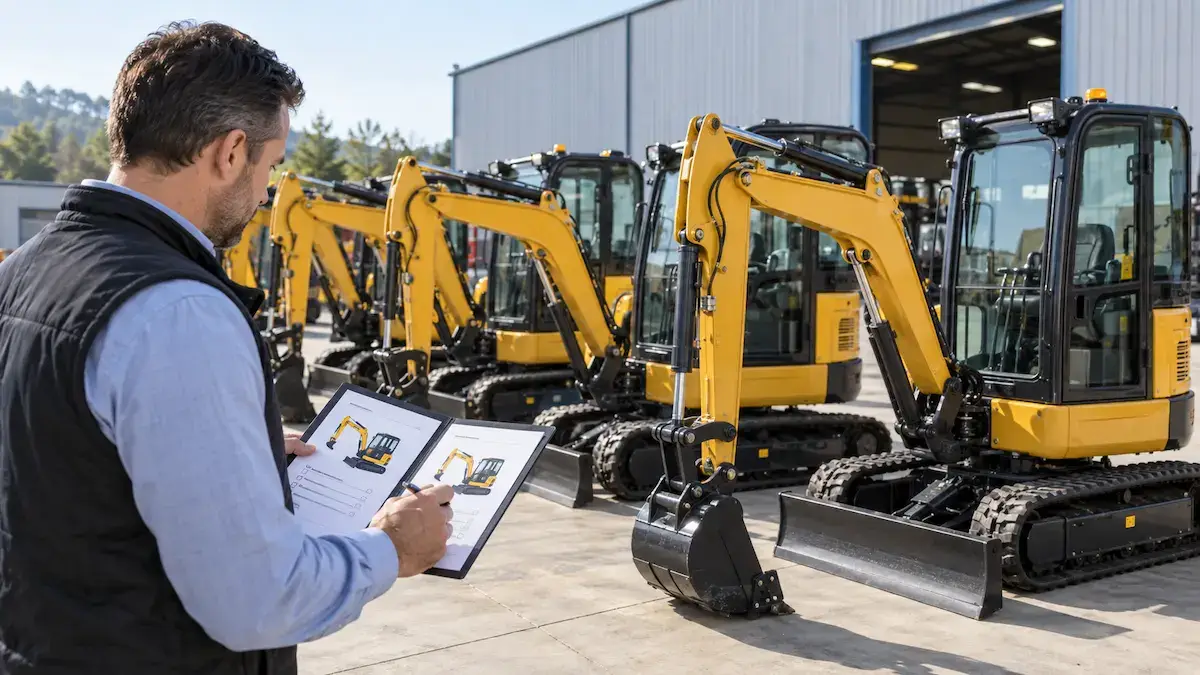
A mini excavator repeat order is not simply a second purchase of the same model. The first order creates the dealer’s baseline. The repeat order tests whether that baseline can be reproduced, or intentionally updated, in a controlled way. A dealer who sends only “send me another ZL-XX” may be assuming that the model name still corresponds to the same configuration, components and parts references as the previous batch.
In practice, configuration details should be reconfirmed before every repeat order. Components may change over time because of supplier availability, technical updates, market requirements or engine availability. This guide focuses on what happens after the first order has already been purchased, received and evaluated. For first-order planning, refer to the Mini Excavator MOQ & First Order Guide, and for parts planning, refer to the Mini Excavator Spare Parts Inventory Guide.
What Should Dealers Confirm Before a Mini Excavator Repeat Order?
Dealers should compare the previous order reference against the new quotation across model, engine, dimensions where relevant, hydraulic configuration, auxiliary hydraulics, bucket, coupler, tracks, controls, attachments, optional equipment, spare-parts implications, quotation scope, inspection requirements and shipping arrangement.
The purpose is not to assume that everything has changed. It is to confirm whether it has remained the same, and to document any change that has occurred before the order is placed.
Use the Previous Order as the Baseline
Repeat-order comparison depends on having a reliable record of what was actually purchased. The first order should already have produced most of the documents needed for this comparison.
Useful records for the baseline:
- Supplier quotation
- Proforma invoice where applicable
- Configuration sheet
- Machine identification record
- Engine information
- Machine photos
- Inspection record
- Packing record
- Parts list
- Attachment list
- Shipping documents
Not every dealer will have every document, and some items may only exist in email or chat history. The more complete the first-order record is, the easier the repeat-order comparison becomes. If the first order record is thin, the repeat order is a good opportunity to build a better one for future reference.
Do Not Reorder by Model Name Alone
Two machines carrying the same model name may still require configuration verification. A model name alone may not capture every configuration detail of a specific machine.
Dealers should reconfirm:
- Engine configuration
- Hydraulic configuration
- Auxiliary hydraulic arrangement
- Bucket specification
- Coupler type
- Controls
- Track configuration
- Attachments
- Optional equipment
This is not a claim that these items typically change. It is a check that the new quotation matches what the dealer already purchased, or that any change is intentional and documented. The Mini Excavator Specifications Guide explains how to read a specification sheet, and the Mini Excavator Hydraulic System Guide explains hydraulic configuration details that may affect attachment planning and parts identification.
Create a Repeat-Order Configuration Record
A repeat-order comparison record is not a specification sheet. It is a working document that puts the previous order and the new order side by side. The purpose is to make any difference visible before the order is confirmed.
| Configuration Area | Previous Order | Repeat Order | Status |
|---|---|---|---|
| Model | Record actual specification | Record actual specification | To Confirm |
| Operating-weight class | Record actual specification | Record actual specification | To Confirm |
| Engine | Record actual specification | Record actual specification | To Confirm |
| Hydraulic configuration | Record actual specification | Record actual specification | To Confirm |
| Auxiliary hydraulics | Record actual specification | Record actual specification | To Confirm |
| Bucket | Record actual specification | Record actual specification | To Confirm |
| Coupler | Record actual specification | Record actual specification | To Confirm |
| Tracks | Record actual specification | Record actual specification | To Confirm |
| Controls | Record actual specification | Record actual specification | To Confirm |
| Attachments | Record actual specification | Record actual specification | To Confirm |
| Optional equipment | Record actual specification | Record actual specification | To Confirm |
| Machine identification method | Record actual specification | Record actual specification | To Confirm |
| Spare-parts reference | Record actual specification | Record actual specification | To Confirm |
| Documentation | Record actual specification | Record actual specification | To Confirm |
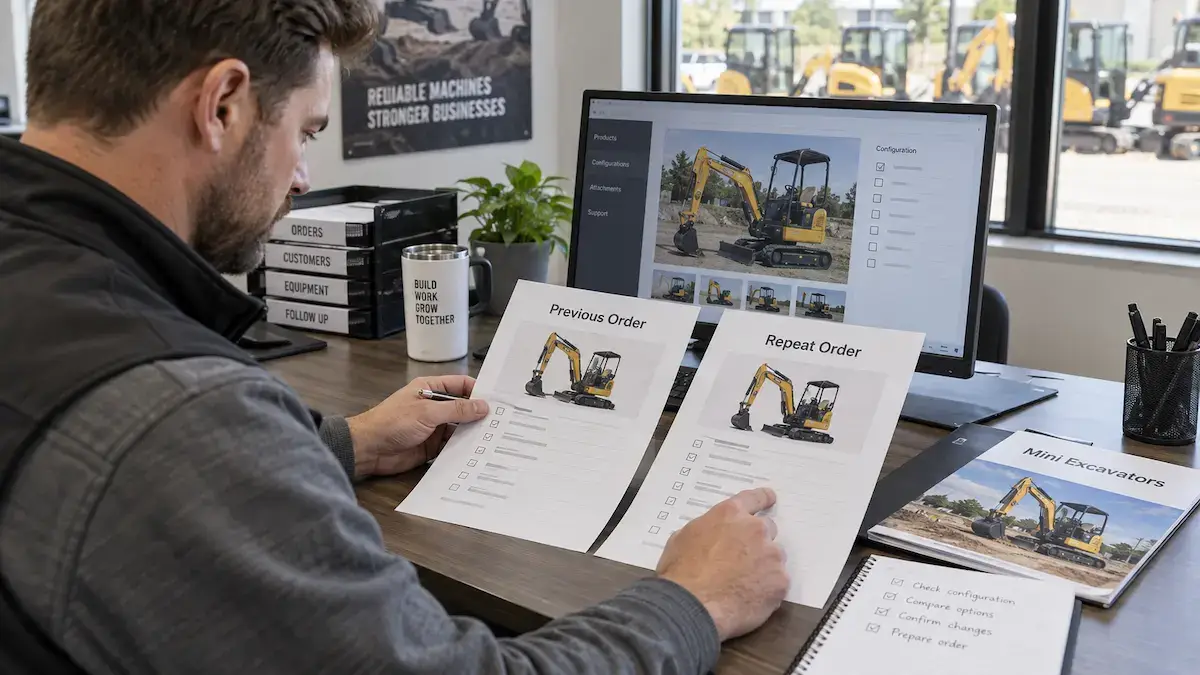
Every status starts at “To Confirm” because the point of the record is to verify, not to assume. The record becomes more useful as it accumulates across multiple repeat orders.
Ask the Supplier What Has Changed
Rather than assuming components have stayed the same, dealers should ask the supplier directly before confirming the repeat order. The supplier should be able to confirm whether anything has changed since the previous batch.
Recommended questions:
- Has the engine configuration changed?
- Have hydraulic components changed?
- Have electrical components changed?
- Has the control layout changed?
- Has the attachment interface changed?
- Have dimensions or operating weight changed?
- Has standard equipment changed?
- Have optional-equipment choices changed?
- Have supplied documents changed?
- Are any replacement parts different from the previous batch?
The purpose is not to imply that changes exist. The purpose is to ask. A documented change may be acceptable if the dealer understands the operational impact on service, spare parts and customer communication. An undocumented change is harder to manage once the machines have been sold.
Check the Spare-Parts Impact of Configuration Changes
If any configuration item has changed, the dealer should check the effect on existing spare-parts stock. A component change may affect:
- Filters
- Hoses and fittings
- Electrical items
- Hydraulic components
- Engine-related parts
- Service documentation
These are possible effects, not automatic outcomes. Dealers should verify with the supplier whether the change affects existing parts stock, and whether the new batch requires different parts references from the previous batch. The Mini Excavator Spare Parts Inventory Guide explains how to record parts demand across different machines, and the Mini Excavator Spare Parts Guide explains general parts identification.
Repeat Orders Should Follow Real Sales Demand
A successful first purchase does not automatically justify a larger repeat order. The repeat order should follow the evidence the dealer has collected since the first machines were placed.
Useful signals to review:
- Units sold from the first order
- Qualified inquiries received
- Quotation activity by model
- Customer applications
- Attachment requests
- Customer feedback on configuration
- Inventory remaining
- Inventory age
- Service issues observed
- Parts demand
- Repeat-customer interest
There is no benchmark conversion rate that applies to every dealer. The repeat order should reflect what has actually happened in the local market since the previous batch arrived.
Reorder the Models That Earn Their Place
Not every model from the first order necessarily deserves to be reordered at the same depth. Some models may justify repeat stock because they:
- Receive consistent qualified inquiries
- Convert into real sales
- Match local applications well
- Are manageable to service
- Fit existing attachment demand
Other models may remain quote-on-request rather than actively stocked. This is a portfolio decision, not a fixed classification for any specific model. Dealers should base the decision on their own market evidence rather than on assumptions about what is popular. The Mini Excavator Wholesale Guide explains how product mix and wholesale planning relate to repeat purchasing.
Compare the New Quotation with the Previous Order
A repeat quotation should be compared with the previous order using the same discipline applied to a first-order quotation. A price difference is difficult to interpret unless the configuration and scope are also compared.
Items to compare:
- Exact model and configuration
- Standard equipment
- Optional equipment
- Attachments
- Spare parts
- Quantity
- Incoterm
- Packing
- Documentation
- Warranty scope
- Quotation validity
The Mini Excavator Quote Guide explains how to prepare an RFQ and compare quotations on the same basis, and the Mini Excavator Price Guide explains how to interpret quoted prices in context.
Do Repeat Orders Still Need Inspection?
Repeat purchasing reduces some uncertainty, but it does not automatically remove the need for verification. The appropriate level of inspection depends on the situation.
Factors that may affect inspection level:
- Configuration changes since the previous order
- Order value
- Previous quality experience with the supplier
- New components
- New attachments
- New model in the range
- Supplier process changes
- Dealer risk tolerance
Possible verification methods:
- Photos of the machines
- Videos of machine function
- Machine identification confirmation
- Function test
- Packing photos
- Loading photos
- Buyer inspection where travel is possible
- Third-party inspection where appropriate
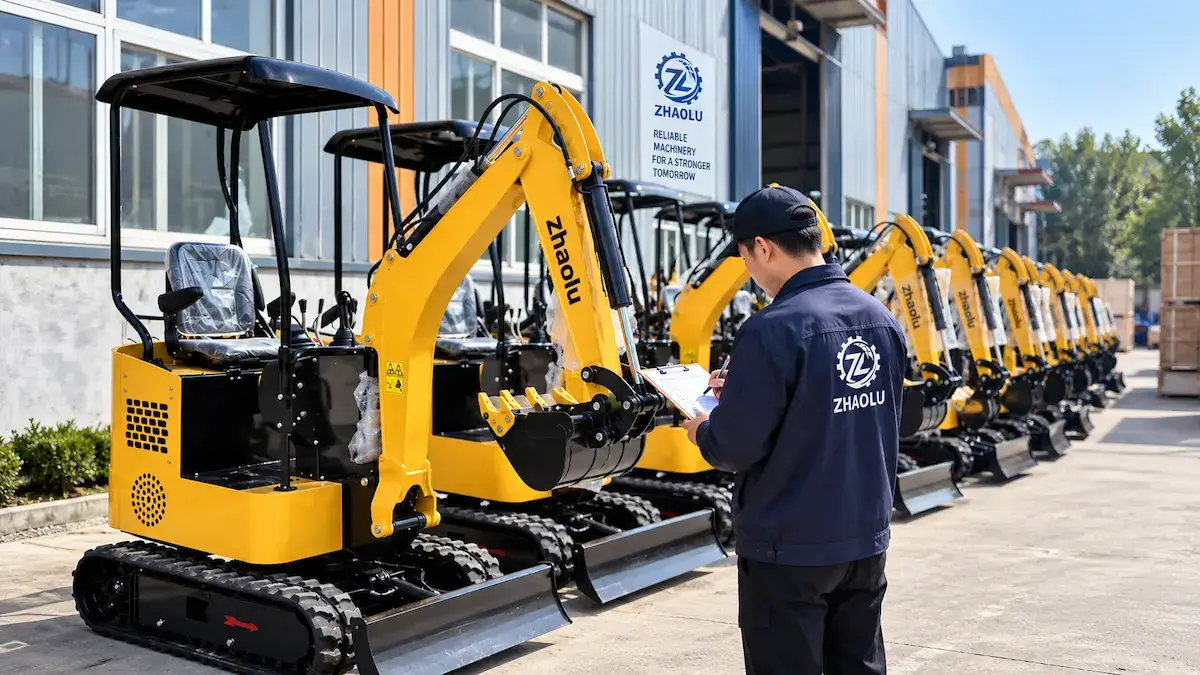
Third-party inspection is not always necessary, and the decision depends on the dealer’s own assessment of risk. The Mini Excavator Factory Inspection Checklist provides a structured approach to both first-order and repeat-order verification.
Update Dealer Records When the Repeat Order Arrives
Repeat-order records should be updated when the new machines arrive, not only when they are sold. Batch-level recordkeeping is what allows the dealer to identify configuration differences later if a customer reports a problem or requests a spare part.
Records to update:
- Installed machine list
- Machine identification
- Configuration records
- Engine records
- Attachments
- Spare-parts references
- Service documentation
- Delivery date
- Customer assignment when sold
Excel, a CRM, an ERP system or another tracking tool can all work as long as the record is consistent across orders. The important point is that the same fields are used for every batch, so comparison remains possible.
How Repeat Orders Affect Dealer Inventory Planning
A repeat order is not just about machines. It also affects the dealer’s wider inventory position. A repeat order may require the dealer to review:
- Machine inventory
- Spare-parts inventory
- Attachment stock
- Service capacity
- Warehouse space
- Capital tied up in inventory
There is no universal inventory level that fits every dealer. The right level depends on sales velocity, service capability and capital position. The Mini Excavator Spare Parts Inventory Guide explains how service records can inform parts inventory decisions.
When Should a Dealer Increase Repeat-Order Volume?
Order volume should increase based on evidence, not on a fixed formula or a supplier’s suggestion alone. Signals that may support a larger repeat order include:
- Consistent sales from the previous batch
- A qualified customer pipeline
- Low inventory age
- Repeat demand from existing customers
- Stable configuration across the fleet
- Manageable service workload
- Parts support working as expected
- A predictable shipping process
Not all signals need to be present. The decision is the dealer’s own and should reflect the specific market, not a fixed percentage increase.
Common Repeat-Order Mistakes Dealers Should Avoid
- Reordering only by model name
- Failing to reference the earlier configuration
- Assuming components have not changed
- Comparing only price between batches
- Ignoring the spare-parts implications of a change
- Increasing quantity without demand evidence
- Skipping inspection automatically because it is a repeat order
- Failing to record the new machine identification
- Mixing undocumented configurations in the local fleet
- Failing to update service and parts records after delivery
These mistakes are usually avoidable with a structured comparison record and clear written confirmation from the supplier.
Mini Excavator Repeat Order Checklist for Dealers
The following checklist can be used to structure the repeat order. Every status starts at “To Confirm” — the purpose is to make sure items are verified rather than assumed.
| Area | What to Compare | Why It Matters | Status |
|---|---|---|---|
| Previous order reference | Order number or reference | Enables direct comparison | To Confirm |
| Model | Model and configuration | Baseline for the new order | To Confirm |
| Engine | Engine model and identification | Affects parts and support | To Confirm |
| Hydraulics | Hydraulic configuration | Affects attachments and service | To Confirm |
| Attachments | Included and compatible attachments | Affects quotation and shipping | To Confirm |
| Standard equipment | Included by default | Prevents unnoticed changes | To Confirm |
| Optional equipment | Any selected options | Affects configuration and parts | To Confirm |
| Spare parts | Parts references and stock impact | Affects after-sales support | To Confirm |
| Quotation | Scope and inclusions | Enables fair comparison | To Confirm |
| Incoterm | Available terms | Affects cost and responsibility | To Confirm |
| Inspection | Verification arrangements | Reduces repeat-order risk | To Confirm |
| Packing | Packing method | Affects protection and handling | To Confirm |
| Shipping | Loading and shipping plan | Affects delivery | To Confirm |
| Documents | Documents supplied | Required for import | To Confirm |
| Machine identification | Identification for the new batch | Supports parts and service records | To Confirm |
| Dealer inventory | Current stock position | Guides quantity decision | To Confirm |
| Market demand | Sales and inquiry evidence | Guides reorder volume | To Confirm |
| Repeat-order records | Updated comparison record | Supports future batches | To Confirm |
Questions to Ask Before Placing a Repeat Order
- Can you reference our previous order?
- Is the quoted machine configuration unchanged?
- Has the engine configuration changed?
- Have hydraulic components changed?
- Has standard equipment changed?
- Are the same attachments compatible?
- Have any parts references changed?
- Will our existing spare-parts stock still match?
- What is included in the new quotation?
- Which Incoterms are available?
- What inspection evidence can be provided?
- Have packing or loading arrangements changed?
- What machine information should we record for this batch?
- How should repeat machines be referenced for future spare-parts requests?
- Are there any configuration changes we should document before ordering?
How ZHAOLU Fits into Repeat-Order Planning
ZHAOLU currently lists mini excavators approximately from 0.5 ton to 2.5 ton. Dealers preparing repeat orders should reconfirm the exact model and configuration rather than rely only on the model name from a previous purchase.
Useful starting points:
- Review the available models on the Mini Excavator Product Category page.
- Review commercial supplier information on the Mini Excavator Supplier page.
- Reference the previous order details when requesting a new quotation.
Dealers should apply the same comparison discipline described in this article to any supplier, including confirming that the new quotation matches or intentionally updates the previous configuration.
Planning a Repeat Mini Excavator Order?
If you are preparing a repeat order for dealership, distribution, rental or resale, provide the previous model or order reference, required configuration, quantity, attachments, spare-parts requirements and destination. ZHAOLU can review the requirements and provide quotation information based on the confirmed configuration.
Frequently Asked Questions About Mini Excavator Repeat Orders
What should dealers confirm before a mini excavator repeat order?
Dealers should confirm the previous order reference, model, engine configuration, hydraulic configuration, attachments, standard and optional equipment, spare-parts references, quotation scope, Incoterm, inspection arrangements and shipping plan. The purpose is to verify whether the new order matches the previous one or intentionally differs.
Can the same mini excavator model change between production batches?
Components may change over time because of supplier availability, technical updates, market requirements or engine availability. This is not automatic, and dealers should not assume that changes have occurred. The correct approach is to ask the supplier directly and confirm the exact configuration in the new quotation.
Should dealers compare repeat orders with the original specification?
Yes. A comparison record helps the dealer identify any change in configuration, equipment or parts references before the order is placed. Without a comparison, changes may only become visible after delivery, when they are harder to manage.
Do repeat mini excavator orders still need inspection?
Repeat purchasing reduces some uncertainty, but it does not automatically remove the need for verification. The appropriate level of inspection depends on configuration changes, order value, previous quality experience and the dealer’s own risk assessment. Photos, videos, function tests or third-party inspection may all be relevant.
How can configuration changes affect spare parts?
A component change may affect filters, hoses, electrical items, hydraulic components or engine-related parts. Dealers should verify with the supplier whether any change affects existing spare-parts stock and whether the new batch requires different parts references.
When should a dealer increase repeat-order quantity?
Repeat-order quantity should increase based on evidence: consistent sales, qualified customer pipeline, low inventory age, repeat demand, stable configuration, manageable service workload and predictable shipping. A larger order should reflect the dealer’s actual market, not a fixed percentage or a supplier recommendation alone.
What records should dealers keep for repeat orders?
Useful records include the previous order reference, configuration comparison, machine identification for each batch, engine and hydraulic details, attachments, spare-parts references, service documentation and delivery records. These records support both future repeat orders and after-sales service.
Should dealers reorder every model from the first purchase?
Not necessarily. Some models may justify repeat stock because they receive qualified inquiries and convert into sales. Others may remain quote-on-request. The decision should reflect the dealer’s own market evidence and service capability, not the first order structure alone.