
Mini excavator MOQ is one of the first commercial questions a dealer asks when preparing a first order from China. But MOQ is only one part of first-order planning. A dealer also needs to decide which models to test, how many configurations to manage, whether a smaller first order is possible, how spare parts will be prepared, how inspection and shipping will work, and how the first order will inform repeat purchases.
The goal of the first order is not to maximize volume. It is to verify whether the machines, supplier process and local market can support repeat business. This guide focuses specifically on the commercial and operational decisions involved in a dealer’s first mini excavator order. For the broader wholesale strategy, refer to the Mini Excavator Wholesale Guide, and for supplier evaluation, refer to How to Choose a Mini Excavator Supplier in China.
What Should Dealers Confirm About Mini Excavator MOQ and First Orders?
Mini excavator MOQ can be calculated in different ways depending on the supplier. It may refer to a minimum quantity per model, a minimum total order quantity, a minimum order value, or a minimum for a specific configuration. Dealers should confirm exactly how the MOQ applies to their intended order.
Before placing a first order, dealers should also confirm whether a smaller first order is available, whether different models can be included in the same order, how the configuration will be documented, what is included in the quotation, how spare parts are planned, and how inspection and shipping will be arranged.
What Does MOQ Mean When Buying Mini Excavators?
MOQ stands for minimum order quantity. In B2B machinery sourcing, MOQ is not always defined the same way by every supplier. It may potentially refer to:
- A minimum quantity per model
- A minimum total order quantity across models
- A minimum order value
- A minimum quantity for a specific configuration
- A minimum quantity for certain customization
These are possibilities, not assumptions. The way MOQ is calculated depends on the supplier and on the specific order structure. Dealers should ask clearly how the MOQ applies to their intended purchase.
Useful questions to ask a supplier about MOQ:
- Does MOQ apply to each model or to the whole order?
- Is the MOQ different for standard and customized configurations?
- Does MOQ change depending on engine or attachment configuration?
- Is there a separate minimum for spare parts or accessories?
- Can the MOQ change for repeat orders?
The answers to these questions affect how a dealer structures the first order. If MOQ applies per model, the dealer may need to consolidate around fewer models. If MOQ applies to the total order, a mixed-model approach may be more practical. Either way, the dealer should confirm the actual rule before planning quantities.
Can Dealers Start with a Small First Order?
A smaller first order can help a dealer evaluate the business model before committing to larger volume. It allows the dealer to observe real customer response, machine quality, configuration suitability, sales cycle, service requirements, parts demand and supplier communication.
A small first order can help test:
- Local customer response to the machine class
- Actual machine quality and finish
- Configuration suitability for local applications
- Sales cycle and customer questions
- Service requirements in practice
- Parts demand and identification process
- Supplier communication during shipment
- Shipping and documentation handling
Whether a supplier accepts a small first order, sample order or trial order must be confirmed directly with the supplier. In construction machinery, the term “sample order” generally refers to a smaller paid commercial order rather than a free sample, although the terminology and order policy vary by supplier. Dealers should ask:
- Is a smaller first order available for this model?
- Is a trial unit available for evaluation?
- Does the minimum order rule change if only one model is ordered?
- Are there any differences in quotation or shipping for a smaller order?
None of these should be assumed. The supplier’s policy on small orders should be confirmed before planning the first purchase.
Single-Model vs Mixed-Model First Orders
A dealer’s first order can be structured as a single-model order or, if the supplier allows it, as a mixed-model order. Each approach has trade-offs.
| Order Approach | Potential Advantages | Potential Challenges | What to Confirm |
|---|---|---|---|
| Single-model order | Simpler training, simpler parts planning, simpler sales message, easier comparison between units | Limited market coverage, more exposure to one size class | Whether MOQ applies per model, and whether a single-model order meets the minimum |
| Mixed-model order | Testing several market segments, broader customer coverage | More configurations, more service complexity, more parts complexity, more sales training | Whether different models can be included in the same order, and how the loading plan would be arranged |
If mixed-model ordering is available, dealers should confirm how the supplier documents each model within the order, how spare parts are identified across models, and how the shipment will be structured. Mixed-model purchasing depends on the supplier, the order structure and the shipping arrangement.
Single-model orders are often easier to manage operationally, especially for a first purchase. Mixed-model orders can test more market segments at once but increase the number of configurations the dealer has to support.
How Should Dealers Choose Models for the First Order?
The first order should follow market demand rather than catalog breadth. A dealer who already understands local customer types can narrow the candidate models quickly.
Useful inputs for model selection:
- Target customer types
- Main local applications
- Access requirements (gate width, indoor work, narrow sites)
- Transport requirements
- Popular local size classes
- Rental demand if applicable
- Attachment demand
- Service capability
ZHAOLU currently lists mini excavators approximately from 0.5 ton to 2.5 ton. Dealers do not need to stock every size. The correct starting point depends on local demand, not on the catalog. The Mini Excavator Size Guide explains how operating weight and dimensions relate to common applications, and the current range can be reviewed on the Mini Excavator Product Category page.
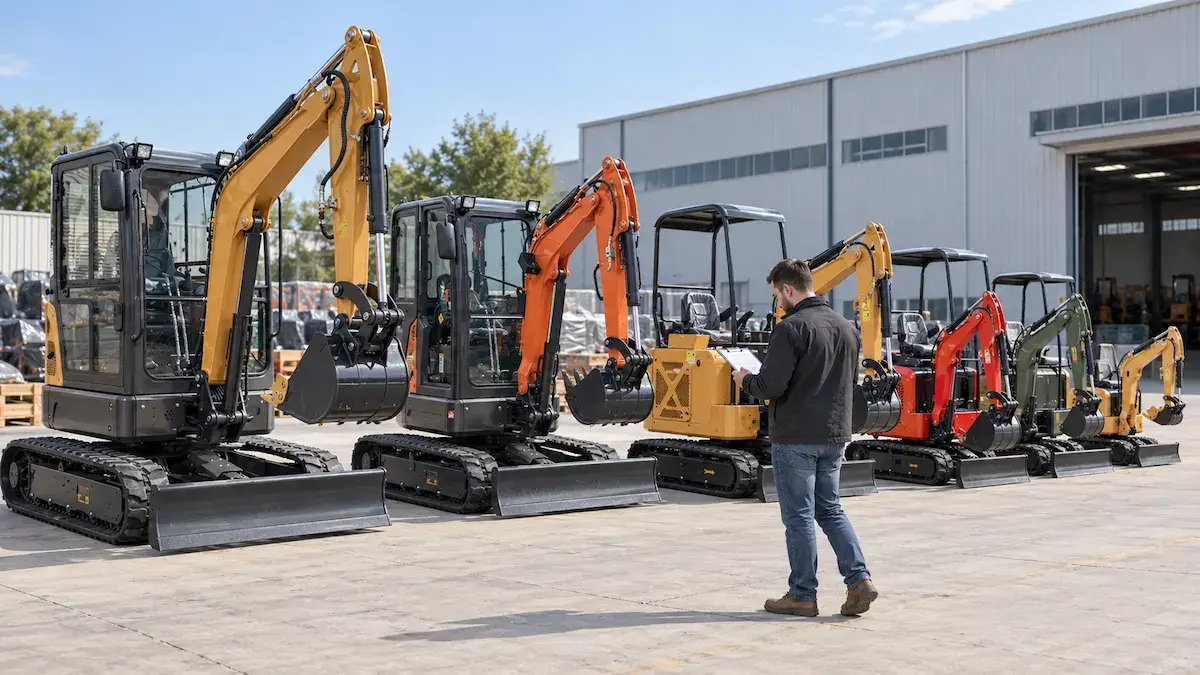
Avoid recommending a fixed number of models for every dealer. Some markets may support two size classes from the start; others may require only one. The right mix depends on the dealer’s own customer base.
Confirm the Exact Configuration Before Ordering
Model name alone is not enough for a first order. The configuration documented at the time of the first purchase becomes the baseline for future repeat orders and for spare-parts identification.
Dealers should confirm in writing:
- Exact model
- Operating weight
- Engine model and rated power
- Machine dimensions
- Hydraulic configuration
- Auxiliary hydraulics where applicable
- Bucket specification
- Attachments included
- Track configuration
- Controls
- Optional equipment
- Included accessories
The Mini Excavator Specifications Guide explains how to read a specification sheet, and the Mini Excavator Hydraulic System Guide explains hydraulic configuration details that matter for attachment planning.
Confirm What Is Included in the First-Order Quotation
Two quotations cannot be compared fairly if the included configuration is different. For a first order, the quotation should clearly state what is and is not included.
Items to confirm:
- Machine model and configuration
- Quantity
- Standard equipment
- Optional equipment
- Attachments
- Spare parts included or quoted separately
- Packaging
- Incoterm
- Documentation
- Quotation validity
- Warranty scope
The Mini Excavator Quote Guide explains how to prepare an RFQ and compare quotations on the same basis, and the Mini Excavator Price Guide explains how to interpret quoted prices in context.
Should Dealers Include Spare Parts in the First Order?
First-order spare-parts planning reduces the risk of downtime once machines are delivered to customers. Dealers should consider service parts and commonly used wear items based on the machine configuration, local usage, expected sales and service capability.
Questions to ask the supplier:
- Which service parts are used on the quoted machine?
- How are parts identified?
- Are part numbers available?
- Which machine information is required when ordering replacements?
- Can spare parts be included in the shipment?
- How are model-specific parts matched?
A planned initial parts set can reduce customer downtime and improve after-sales response. The Mini Excavator Spare Parts Guide explains parts categories and identification requirements. Dealers should not assume that spare parts are included by default — this should be confirmed in the quotation.
Think About Attachments Before the First Order
Attachments can affect customer applications, hydraulic requirements, coupler compatibility, shipping space, quotation value and dealer inventory planning. For a first order, dealers should confirm which attachments are actually required rather than ordering a broad set.
Common attachment examples:
- Standard bucket
- Narrow bucket
- Grading bucket
- Auger
- Breaker
- Ripper
- Grapple
These are examples only. Attachment availability depends on the machine model and configuration. Dealers should confirm compatibility rather than assume it. The Mini Excavator Attachments Guide explains mounting and hydraulic compatibility checks for attachments.
Plan Shipping Before Finalizing the Order
MOQ and order quantity should not be discussed separately from shipping. The order structure affects packing, loading and destination arrangements.
Dealers should confirm:
- Incoterm
- Packing method
- Loading arrangement
- Destination port or address
- Shipping documents
- Whether different models can be shipped together if relevant
- Whether attachments and spare parts affect loading
Available commercial terms may include FOB, CIF or DDP depending on the destination and order structure. Dealers should confirm the available terms rather than assume a specific Incoterm is available for every shipment. The Mini Excavator Shipping from China guide explains Incoterms and shipping cost components in more detail.
How to Control Risk on the First Order
The first order usually deserves additional verification because the dealer does not yet have a history with the machine configuration or the supplier process. Practical risk controls include:
- Written configuration confirmation
- Current machine photos
- Video evidence of machine function
- Engine identification
- Function testing record
- Inspection checklist
- Packing photos
- Loading photos
- Document review before shipment
- Third-party inspection where appropriate
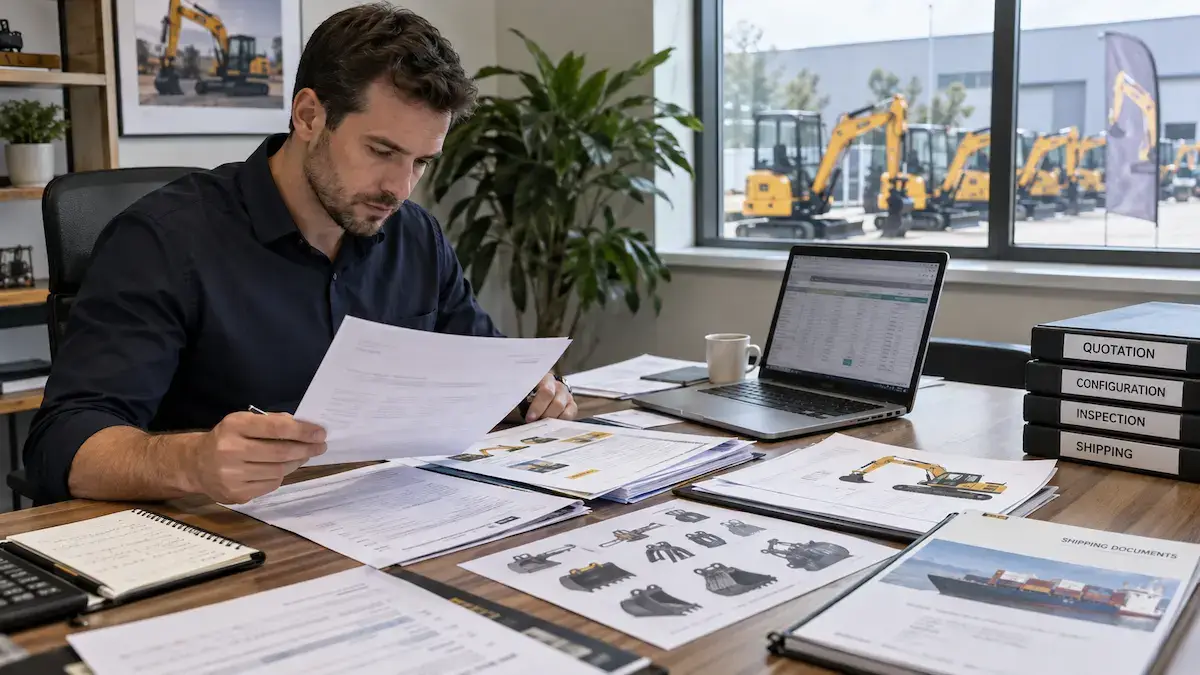
The Mini Excavator Factory Inspection Checklist provides a structured approach for these checks. A dealer who documents the first order carefully can reference those records when placing repeat orders or when requesting spare parts later.
First Order Cost: Look Beyond Unit Price
Dealers should consider the total landed cost of the first order, not only the unit price. Landed cost includes the machine, optional equipment, attachments, spare parts, packing, freight, insurance where applicable, destination charges, customs-related costs and local transport.
A slightly larger order may reduce some unit shipping costs, but a larger inventory also increases capital and inventory risk. The right balance depends on the dealer’s local market and sales capacity, not on a universal quantity rule. The Mini Excavator Price Guide and the Mini Excavator Shipping from China guide explain how to break down the cost structure.
When Should a Dealer Increase Order Volume?
Order volume should increase based on evidence from the first order, not simply because a lower unit price is offered. Dealers can review:
- Sales speed of the first machines
- Qualified customer inquiries
- Which size classes receive interest
- Customer feedback on configuration
- Service issues observed
- Parts consumption
- Attachment demand
- Repeat-customer interest
- Inventory turnover
- Supplier communication quality
- Configuration consistency between units
- After-sales workload
Increase volume when the market and operational evidence support it. The first order is a test of the business model, not a commitment to a fixed future quantity.
Common First-Order Mistakes Dealers Should Avoid
- Ordering based only on the lowest unit price
- Assuming MOQ rules without confirmation
- Buying too many models without a local sales plan
- Using model names without confirming specifications
- Ignoring engine and hydraulic configuration
- Adding attachments without confirming compatibility
- Ignoring spare-parts planning
- Finalizing quantity before reviewing shipping arrangements
- Skipping pre-shipment inspection
- Expanding volume before evaluating the first order
These mistakes are usually avoidable with a structured first-order process and clear written confirmation from the supplier.
Mini Excavator First Order Checklist for Dealers
The following checklist can be used to structure a first order. Every status starts at “To Confirm” — the purpose is to make sure important items are verified rather than assumed.
| Area | What to Confirm | Why It Matters | Status |
|---|---|---|---|
| Target market | Customer types and applications | Drives model selection | To Confirm |
| Machine size | Required operating weight class | Matches demand and access | To Confirm |
| Exact model | Model and configuration | Baseline for repeat orders | To Confirm |
| Engine | Model and identification | Affects parts and support | To Confirm |
| Hydraulics | System and auxiliary configuration | Affects attachments | To Confirm |
| Attachments | Required attachments and compatibility | Affects quotation and shipping | To Confirm |
| MOQ | How MOQ is calculated | Affects order structure | To Confirm |
| Small-order availability | Whether a smaller first order is possible | Affects first-order scale | To Confirm |
| Mixed-model availability | Whether different models can be combined | Affects market coverage | To Confirm |
| Quantity | Confirmed order quantity | Affects quotation and shipping | To Confirm |
| Spare parts | Included or quoted separately | Affects after-sales readiness | To Confirm |
| Quotation scope | What is included | Enables fair comparison | To Confirm |
| Incoterm | Available terms | Affects cost and responsibility | To Confirm |
| Inspection | Pre-shipment inspection arrangement | Reduces first-order risk | To Confirm |
| Documents | Documents supplied | Required for import | To Confirm |
| Shipping | Packing and loading plan | Affects delivery | To Confirm |
| Repeat-order reference | How the first order will be referenced later | Supports configuration consistency | To Confirm |
Questions to Ask Before Placing Your First Mini Excavator Order
- What is the MOQ for this model?
- Does the MOQ apply per model or to the total order?
- Is a smaller first order available?
- Can different models be included in the same order?
- Which engine is included in the quoted configuration?
- What attachments are compatible with this model?
- What is included in the quotation?
- Which Incoterms are available?
- Can spare parts be included?
- What documents will be supplied?
- What tests are performed before shipment?
- Can inspection photos or videos be provided?
- Can third-party inspection be arranged if required?
- How will this configuration be identified for repeat orders?
- What information should I reference when ordering spare parts later?
How ZHAOLU Fits into First-Order Planning
ZHAOLU currently lists mini excavators approximately from 0.5 ton to 2.5 ton. Dealers can review the available models, individual specification pages and supplier information before requesting a quotation.
Suggested starting points:
- Review the available models on the Mini Excavator Product Category page.
- Review the commercial supplier information: Mini Excavator Supplier.
- Prepare the target market, required models, quantity, attachments, spare-parts expectations and destination.
- Request a quotation based on the confirmed configuration.
Dealers planning a first order with ZHAOLU should confirm the same points described in this guide: model, configuration, quantity, attachments, spare-parts requirements, Incoterm, inspection and destination.
Planning Your First Mini Excavator Order?
If you are preparing a first mini excavator order for dealership, distribution, rental or resale, send your target market, required machine sizes, quantity, attachments and destination. ZHAOLU can review the requirements and provide quotation information based on the confirmed configuration.
Frequently Asked Questions About Mini Excavator MOQ and First Orders
What is the MOQ for mini excavators from China?
MOQ depends on the supplier and on how the minimum is calculated. It may apply per model, to the total order, or to a specific configuration. Dealers should confirm the exact MOQ rule with the supplier before planning quantities.
Does mini excavator MOQ apply to each model or the total order?
This varies by supplier. Some suppliers apply MOQ per model, others apply it to the total order. Dealers should ask directly which rule applies, because it affects how the first order can be structured.
Can a dealer start with one mini excavator?
This depends on the supplier’s policy on small first orders. Dealers should ask whether a smaller first order or trial unit is available. In construction machinery, “sample order” usually means a smaller commercial order used to test the product, not a free sample.
Can different mini excavator models be ordered together?
This depends on the supplier, the order structure and the shipping arrangement. Dealers should confirm whether mixed-model orders are permitted and, if so, how the order and loading plan would be arranged.
How many mini excavator models should a dealer order first?
The right number depends on local demand, customer types and service capability. There is no universal recommended number. A narrower first order is often easier to support, while a broader order can test more market segments at higher operational complexity.
Should spare parts be included in the first order?
Spare-parts planning reduces the risk of downtime once machines are delivered. Dealers should confirm which service parts are relevant to the quoted configuration, whether they can be included in the shipment, and how parts are identified. Inclusion in the order should be confirmed in the quotation.
Should the first mini excavator order be inspected before shipment?
Inspection before shipment is useful, especially for a first order. It can include supplier inspection with photo and video evidence, buyer inspection, live video calls or third-party inspection where appropriate. The goal is to confirm that the machine matches the agreed configuration.
When should a dealer increase order quantity?
Order volume should increase based on evidence from the first order: sales speed, customer response, service workload, parts consumption and supplier reliability. Increasing volume simply because a lower unit price is offered does not by itself justify a larger order.