
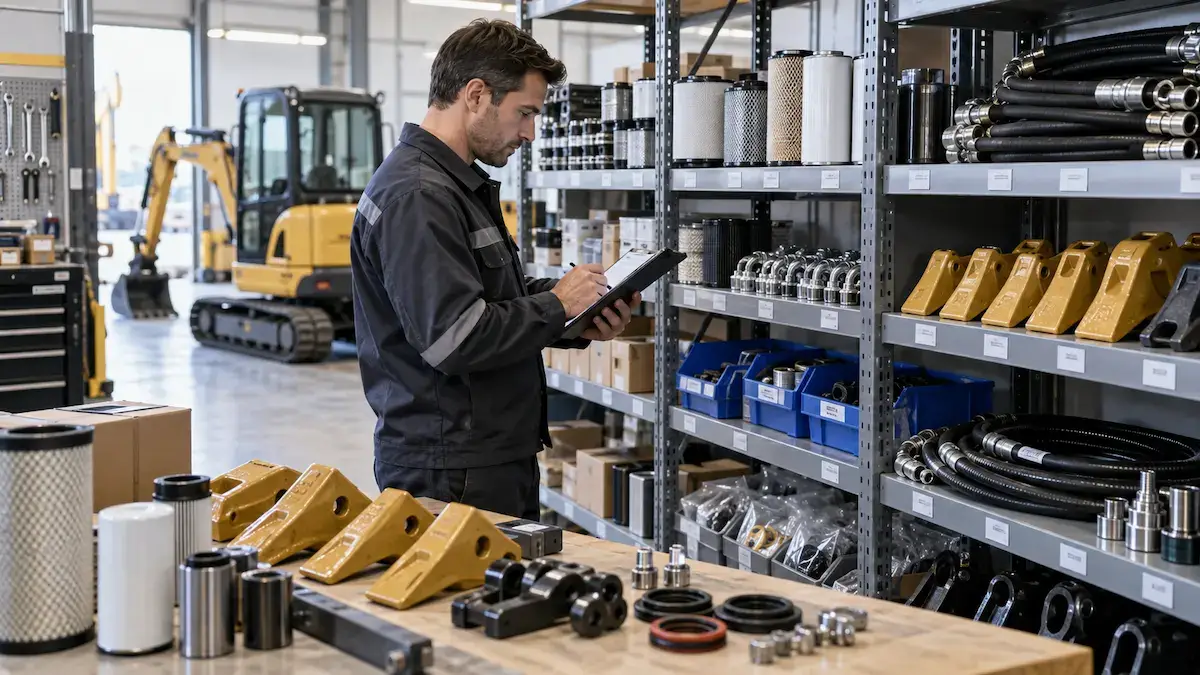
A mini excavator spare parts inventory is not a product catalog copied into a warehouse. Once a dealer begins selling machines, product planning shifts into support planning. Every machine placed with a customer creates future requirements for parts identification, maintenance support, wear items, service records, technical information and replacement-part ordering. The parts inventory should reflect the machines the dealer actually supports, not the largest parts catalog the supplier offers.
A large parts stock is not automatically a good after-sales system. The dealer first needs accurate machine records and a method for deciding what deserves local inventory, what should be ordered on demand, and what should be identified only when a real service request arrives. This guide is written for dealers, distributors and importers managing spare-parts operations after machines are in the field. For general spare-parts sourcing, refer to the Mini Excavator Spare Parts Guide.
How Should Dealers Plan Mini Excavator Spare Parts Inventory?
Dealers should base inventory planning on the machines actually sold, their exact configurations, the installed population by model, service requirements, real parts consumption, part criticality, supplier replacement lead time, capital tied up in stock, and customer downtime risk.
There is no universal stocking quantity. The right inventory depends on the dealer’s machine mix, service capability and local market. The purpose of the inventory is to support real service demand efficiently, not to hold every possible part.
Start with the Installed Machine Base
The parts inventory should reflect the machines the dealer actually supports. A dealer who has sold three units of one model has a different parts situation than one who has sold fifteen units across five configurations. Inventory planning should start with the installed base, not with the supplier’s parts list.
Useful records to maintain per machine:
- Model
- Machine identification number
- Engine configuration
- Hydraulic configuration
- Attachments and couplers
- Delivery date
- Customer details
- Service history
- Parts requests to date
A dealer supporting several configurations of the same model may have greater parts complexity than the model count alone suggests. Two machines of the same model with different engines or hydraulic setups may not share every service item. The installed-base record is what allows the dealer to see this clearly. Configuration records are explained in more detail in the Mini Excavator Specifications Guide.
Create a Machine and Parts Identification System
Parts identification is one of the most important operational capabilities in a dealer after-sales system. Every parts request should identify the exact machine, not just the model family.
Useful information to collect for each parts request:
- Machine model
- Machine serial number or identification number
- Engine model
- Photo of the machine nameplate
- Photo of the old part
- Part number if available
- Parts diagram reference
- Location of the component on the machine
- Symptom or reason for replacement

Vague requests such as “I need a hydraulic hose for the 1-ton excavator” can easily result in the wrong part being ordered. Hose dimensions, thread type, fittings and routing can differ between configurations even when the machine class looks similar.
Dealers should record the confirmed part number for every part they order and install. Over time, this record becomes the basis for accurate repeat ordering and for deciding which parts deserve local stock. The Mini Excavator Hydraulic System Guide explains hydraulic configuration, flow, pressure and auxiliary hydraulic details that can matter when identifying machine-specific hydraulic requirements.
Group Spare Parts by Operational Role
Spare parts can be grouped by their role in machine operation. This helps the dealer decide how much attention each group deserves. The table below groups general categories. Specific parts vary by machine configuration.
| Parts Category | Examples | Dealer Planning Question | Stocking Consideration |
|---|---|---|---|
| Routine service items | Filters and other scheduled-service items | Which service items correspond to the machines in the field? | Usually predictable demand; confirm against the service manual |
| Wear items | Bucket teeth, cutting edges, pins, bushings | Which wear items are consumed fastest in the local application? | Depends on ground conditions and usage; track via service records |
| Hydraulic items | Hoses, fittings, seals, O-rings | Which hydraulic parts are configuration-specific? | Confirm dimensions and thread types; do not assume sharing |
| Electrical items | Relays, switches, sensors, fuses | Which electrical components are common across supported models? | Verify by part number, not by appearance |
| Undercarriage items | Rollers, idlers, sprockets, track components | Which undercarriage parts are specific to each machine class? | Confirm against the machine’s undercarriage configuration |
| Model-specific components | Components unique to a specific model or configuration | Are these parts worth holding, or better ordered when needed? | Depends on demand, value and replacement lead time |
| Attachment-related parts | Breaker hoses, auger teeth, coupler pins, bucket teeth | Which attachment parts do local customers request? | Follow attachment usage; confirm against the attachment manual |
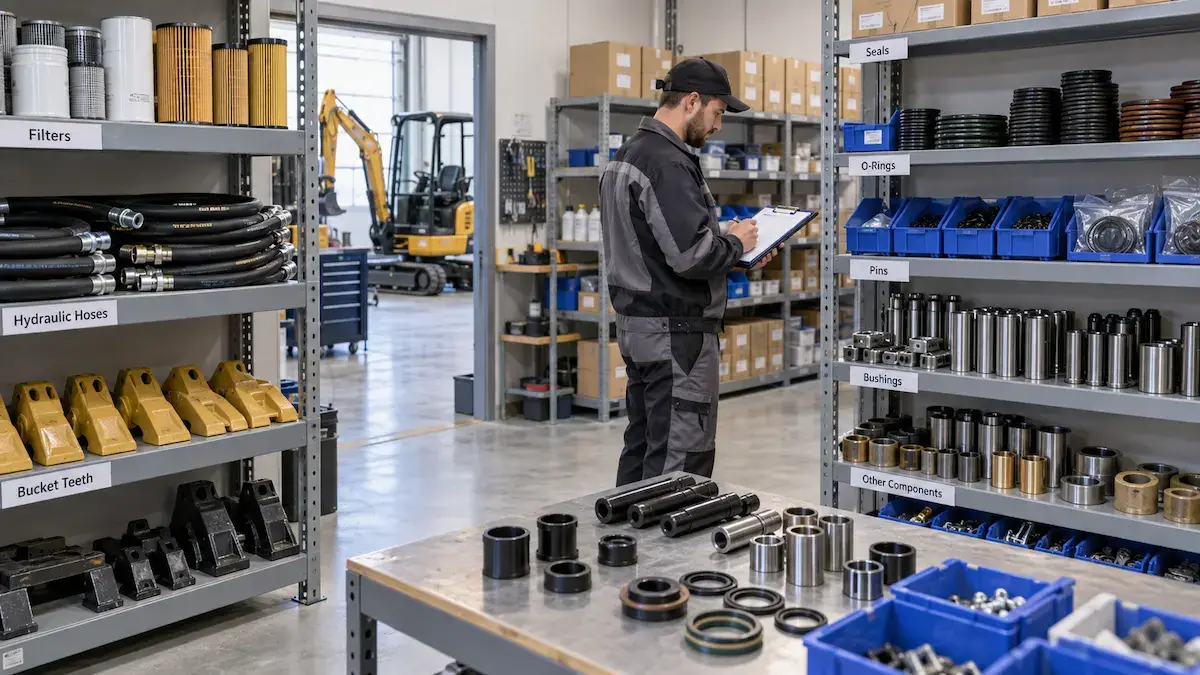
Examples vary by machine configuration. Dealers should confirm the exact part for their machine against the parts book or with the supplier, rather than assuming that similar machines use the same components.
Fast-Moving Parts vs Model-Specific Parts
The distinction between fast-moving parts and model-specific parts is a planning concept, not a fixed classification. A part is “fast-moving” only when the dealer’s own service records show repeated demand. It should not be assumed from the parts category alone.
A part may deserve local stock when:
- It is requested repeatedly across supported machines
- Machine downtime without it is significant for the customer
- Replacement lead time from the supplier is meaningful
- Several supported machines use the same confirmed part
A model-specific component may be better ordered only when required if:
- Demand is rare
- Inventory value is high
- The component differs between configurations
- Storage or handling is complicated
There is no universal stocking rule for either category. The decision depends on the installed base, service history and the dealer’s own experience with customer downtime. The Mini Excavator Spare Parts Guide explains parts categories from the buyer’s perspective.
Do Not Assume Parts Are Shared Between Similar Models
Nearby machine sizes do not automatically use identical components. Even within the same nominal weight class, different models may use different:
- Filters
- Hoses and fittings
- Hydraulic components
- Electrical components
- Undercarriage parts
- Engines
- Attachment mounting interfaces
Dealers should verify shared components using:
- Parts books
- Supplier confirmation
- Machine identification
- Confirmed part numbers
Assuming that similar machines use the same parts can lead to incorrect orders and unnecessary inventory. The Mini Excavator Product Mix Guide explains how product-range decisions affect parts complexity across a dealer’s model lineup.
Plan the First Spare-Parts Order Carefully
The first spare-parts order should follow the machines being purchased, not a generic starter kit. Dealers should confirm which parts correspond to the exact machines on order and which items should be included with the shipment versus ordered later.
Useful questions for the first parts order:
- Which routine service items correspond to the machines being ordered?
- Which wear parts should be considered for the local application?
- Are part numbers or parts diagrams available?
- Can spare parts be included with the machine shipment?
- How will replacement parts be identified later?
- Are any items specific to a particular configuration?
Depending on the machines, local service plan and supplier policy, dealers may consider including selected service items with the initial machine shipment to support early after-sales needs. Dealers should not assume that parts are included by default — this should be confirmed in the quotation. The Mini Excavator MOQ & First Order Guide covers first-order structure and configuration confirmation.
Use Service Records to Adjust Inventory
Inventory planning should improve as the dealer accumulates real service data. As real service records accumulate, the dealer can gradually identify which parts move regularly and which do not.
Useful service-record fields:
- Date of service
- Machine and customer
- Operating hours if available
- Part requested
- Reason for replacement
- Quantity used
- Customer downtime
- Whether the part was in stock
- Order date
- Arrival date
- Whether the request is a repeat
After enough real service records exist, the dealer can identify recurring demand and adjust inventory based on evidence. A single repair should not automatically trigger a large inventory purchase. Patterns over time are what justify a change in stocking policy.
Examples of how records inform decisions:
- If the same service item is requested repeatedly, it may deserve local stock.
- If a part is rarely requested, it may be better ordered on demand.
- If customer downtime is high while waiting for a specific part, that part may need to be reviewed for local stock.
- If parts are consistently available when needed, the current policy may already be working.
Balance Parts Availability Against Overstock
Parts inventory involves a trade-off. Too little stock and too much stock both have costs.
Too little stock can create:
- Longer customer downtime
- Repeat international freight cost for small orders
- Slower dealer response to service requests
- Customer dissatisfaction and lost repeat business
Too much stock can create:
- Capital tied up in slow-moving items
- Obsolete inventory for configurations no longer sold
- Parts that no longer match current machines in the field
- Storage and handling complexity
- Identification errors due to excessive variety
The right balance depends on the dealer’s service commitments and the actual reliability of the parts supply chain. Dealers should prioritize evidence over fear-driven stocking. A planned initial stock combined with reliable on-demand ordering is often more efficient than maximizing local inventory.
Consider Supplier Lead Time — But Measure It
Replacement lead time matters to stock planning. Items with long lead times may deserve local stock, especially if they are critical to machine operation. Items with short lead times can often be ordered on demand.
Rather than assuming a lead time, dealers should record actual times for their own orders:
- Parts quotation response
- Parts confirmation
- Dispatch from the supplier
- International transport
- Customs clearance
- Local delivery
Measuring real lead time over several orders gives the dealer a reliable basis for deciding which critical items deserve local stock. Without measured data, lead-time assumptions can be inaccurate.
Build a Simple Dealer Parts Request Workflow
A clear parts-request workflow reduces errors and speeds up service response. The workflow does not need to be complex — it needs to be consistent.
- Customer identifies the machine.
- Dealer records machine identification and configuration.
- Dealer obtains photo, part number or diagram reference.
- Dealer confirms the required quantity.
- Dealer checks local inventory.
- If unavailable, dealer sends complete request to the supplier.
- Dealer records the confirmed part number.
- Dealer updates the machine service record after installation.
This is a general workflow. The exact process may differ by dealer and supplier. What matters is that each request produces a record that can be used for future orders.
After-Sales Support Is More Than Parts Stock
Dealer after-sales support involves more than having parts on a shelf. It also requires:
- Technical documentation
- Service manuals where available
- Parts diagrams
- Configuration records for each machine
- Customer communication
- Troubleshooting information
- Service history
- Warranty documentation where applicable
Accurate information often prevents incorrect part ordering in the first place. A dealer with strong service records can identify the correct part faster than a dealer relying on memory or vague descriptions. The exact documents available vary by supplier and should be confirmed before ordering machines.
How Product Mix Affects Spare-Parts Complexity
The width of the dealer’s product mix has a direct effect on spare-parts complexity. A broader range may increase:
- Number of part references
- Configuration combinations
- Attachment-related parts
- Training requirements for service staff
- Inventory decisions
However, additional models do not automatically require completely different parts. Some components may be shared, while others are model-specific. The dealer should verify actual component overlap rather than assume it in either direction. The Mini Excavator Product Mix Guide explains how product-range decisions affect operational complexity.
Mini Excavator Spare Parts Inventory Planning Table
The following table can be used to structure the inventory review. Every status starts at “To Review” — the purpose is to make sure important items are examined rather than assumed.
| Planning Area | What to Record | Decision Question | Status |
|---|---|---|---|
| Installed machines | Model, configuration, delivery date, customer | Which machines are in the field? | To Review |
| Machine identification | Serial or identification number | Can each machine be uniquely identified? | To Review |
| Engine configuration | Engine model and identification | Which engine-related parts correspond to each machine? | To Review |
| Hydraulic configuration | Hydraulic setup and auxiliary circuit details | Which hydraulic parts are configuration-specific? | To Review |
| Routine service parts | Filters and scheduled service items | Which service items are consumed regularly? | To Review |
| Wear parts | Bucket teeth, pins, bushings, edges | Which wear items show repeat demand? | To Review |
| Model-specific parts | Components unique to a model or configuration | Should these be stocked or ordered on demand? | To Review |
| Shared parts | Parts used across multiple models | Which parts are confirmed shared? | To Review |
| Parts consumption | Recorded usage from service records | What is actually consumed over time? | To Review |
| Customer downtime | Downtime caused by parts availability | Which parts cause significant downtime? | To Review |
| Current stock | Parts currently held locally | Does current stock match actual demand? | To Review |
| Supplier lead time | Measured lead time by part category | Which parts need local stock due to lead time? | To Review |
| Open parts requests | Requests currently in progress | Are any requests waiting unnecessarily? | To Review |
| Service history | Recorded service events per machine | Does the record show patterns? | To Review |
| Inventory review | Scheduled review of stock decisions | How often should the inventory be reassessed? | To Review |
Questions Dealers Should Ask Their Supplier About Spare Parts
- How are replacement parts identified?
- Are parts books or diagrams available?
- What machine identification should be supplied with a parts request?
- Which service items correspond to the quoted machine?
- Which parts differ between configurations?
- Which parts are confirmed to be shared between models?
- Can part numbers be confirmed before ordering?
- Can spare parts be included with a machine shipment?
- How should photos be supplied when a part number is unknown?
- What information is required for hydraulic parts?
- What information is required for engine-related parts?
- How are attachment replacement parts identified?
- What documentation is available for dealer technicians?
- How should warranty-related parts requests be documented where applicable?
- How should repeat parts orders reference earlier shipments?
How ZHAOLU Fits into Dealer Spare-Parts Planning
ZHAOLU currently lists mini excavators approximately from 0.5 ton to 2.5 ton. Dealers considering the range should confirm spare-parts requirements for the exact machines and configurations they plan to support.
Useful starting points:
- Review the available models on the Mini Excavator Product Category page.
- Review commercial supplier information on the Mini Excavator Supplier page.
- Review the existing Mini Excavator Spare Parts Guide for general parts categories and identification requirements.
Dealers should apply the same planning principles described in this article to any supplier, including confirming parts identification, configuration differences and documentation before ordering.
Planning Spare-Parts Support for Your Mini Excavator Business?
If you are sourcing mini excavators for dealership, distribution, rental or resale, provide the models, configurations, destination and spare-parts requirements you need to confirm. ZHAOLU can provide product and quotation information based on the confirmed requirements.
Frequently Asked Questions About Mini Excavator Spare Parts Inventory
What spare parts should a mini excavator dealer stock?
Dealers should stock parts based on the machines actually supported, their configurations, real service demand and customer downtime risk. Common categories include routine service items, wear parts, and parts with meaningful replacement lead time. There is no universal recommended stock list.
How much mini excavator spare-parts inventory should a dealer keep?
There is no universal quantity. The right inventory depends on the installed machine base, service capability, local market and supplier lead time. Inventory planning should be based on measured consumption and customer downtime risk, not on a fixed rule.
How can dealers identify the correct replacement part?
Dealers should collect the machine model, serial number, engine model, photos of the old part, part number if available, and a parts diagram reference. Clear identification reduces the risk of ordering the wrong component, especially for hydraulic and electrical parts.
Are spare parts shared between different mini excavator models?
Not automatically. Similar machine sizes do not guarantee identical filters, hoses, hydraulic components, electrical components or undercarriage parts. Dealers should confirm shared components using the parts book, supplier confirmation and confirmed part numbers.
Should dealers order spare parts with their first machine order?
Including selected service items with the initial machine shipment can support early after-sales needs, depending on the machines, local service plan and supplier policy. Dealers should confirm which parts correspond to the machines on order and whether spare parts are included in the quotation.
How can dealers avoid overstocking spare parts?
Dealers can avoid overstocking by basing inventory decisions on measured service data, tracking actual parts consumption, reviewing open requests, and confirming shared components before assuming they are common. Fear-driven stocking often leads to slow-moving inventory.
What records should dealers keep for after-sales service?
Useful records include machine identification, configuration details, service history, parts requests, confirmed part numbers, quantities used, customer downtime and supplier lead time for parts orders. These records support both current service and future inventory decisions.
How does product range size affect spare-parts inventory?
A broader product range can increase the number of part references, configuration combinations and attachment-related parts. However, additional models do not automatically require completely different parts. Dealers should verify actual component overlap rather than assume it in either direction.