
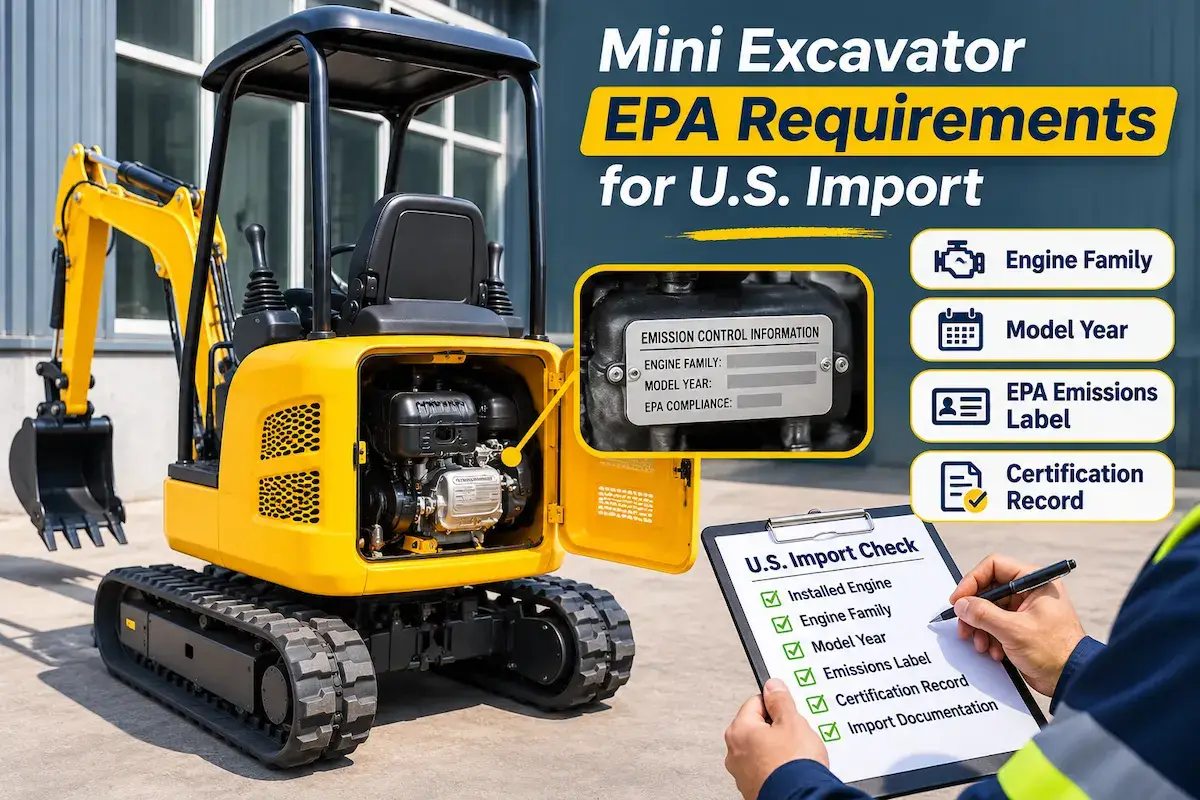
Mini excavator EPA requirements in the United States depend primarily on the engine installed in the machine, its emissions category, model year, engine family and certification status. A supplier showing an EPA certificate is useful evidence, but the buyer still needs to verify that it corresponds to the actual engine installed in the machine being ordered.
This guide is written for U.S. buyers comparing mini excavators from China before placing an order. It focuses on engine-emissions verification, not tariffs, freight or machine quality. For the broader purchasing process, refer to Cómo comprar una miniexcavadora en China.
Quick Answer — Does a Mini Excavator Need EPA Compliance in the USA?
New nonroad engines and equipment imported into the United States may be subject to EPA emissions requirements. The applicable rule depends on the engine type, fuel type, rated power, engine family, model year and certification or import provision. There is no single rule that describes every mini excavator in the same way.
The buyer should identify each item in the table below and confirm it for the exact engine and machine being ordered.
| Artículo | Qué hay que comprobar | Por qué es importante |
|---|---|---|
| Engine manufacturer | Confirm the exact manufacturer name | Establishes the engine-level identity |
| Engine model | Confirm the exact model designation | Distinguishes between variants within the same brand |
| Fuel type | Gasoline or diesel | Helps determine which EPA regulatory framework applies |
| Rated power | Confirm the stated kW or HP figure | Power category can affect the applicable regulatory pathway |
| Engine family | Confirm the EPA engine family name | Certification is tied to an engine family rather than only to a machine model |
| Model year | Confirm the engine’s model year | Certification records are model-year specific |
| EPA emissions label | Confirm the label is present and readable on the engine | Helps connect the physical engine to the certification information |
| Certificate / certification record | Confirm the record matches the engine family and model year | Provides the documented certification reference |
| Importer documentation | Confirm current import filing requirements | Import-side compliance must be verified for the actual shipment |
EPA Certification Applies to the Engine Family, Not Just the Excavator Model Name
A machine model name such as “ZL-05” does not, by itself, establish EPA compliance. The buyer needs to identify the engine installed in the exact unit.
EPA certification is generally organized around engine families, model years and certificates of conformity. The practical buyer-level questions are:
- Which engine is installed?
- Which engine family does it belong to?
- Which model year is it certified for?
- Does the physical emissions label match the documentation?
Two excavators sold under the same machine model name can, in theory, have different engines or engine configurations. That is why machine-model claims are weaker evidence than engine-specific documentation.
What Is an EPA Engine Family?
EPA certification groups engines into defined engine families. The engine family name is a key identifier used in emissions labeling and certification documentation.
Buyers should look for the engine family name on the emissions label or in the certification record. If a supplier provides a certificate but cannot identify which engine family it covers, the buyer has no reliable way to confirm that the certificate applies to the engine in the machine being ordered.
Do not assume that a certificate for one engine family automatically covers a different engine family that may be used in the same excavator model.
Why Model Year Matters
EPA certificates are tied to model-year certification. A certificate issued for one model year should not automatically be assumed to cover an engine associated with another model year.
The buyer should confirm that the certificate model year and engine family correspond to the engine actually installed in the machine. The engine’s manufacture date or build-date information should also be checked separately where applicable. Model year and manufacture date are related identification points, but they should not automatically be treated as the same thing.
What Should Be on the EPA Emissions Label?
The physical engine label is important because it helps connect the certification documentation to the engine actually installed in the machine. Buyers should inspect the label on the engine and compare it with the supplied documents.
Label content varies by engine category, but relevant information can include the engine manufacturer, engine family, model year, manufacture information and applicable emissions-compliance language. Buyers should not assume that every engine uses exactly the same label layout.
Useful evidence to request before shipment includes:
- A clear engine nameplate photo
- A clear EPA emissions-label photo
- The applicable certificate or certification record
- A current machine photo showing the installed engine where practical
These pieces of evidence are more useful when they can be matched to each other than when any one document is viewed in isolation.
EPA Certificate vs Engine Label — Why Buyers Need Both
A certificate or certification record documents certification information for an engine family and model year. A physical emissions label helps establish which engine is actually installed in the machine.
A certificate without matching engine identification is weaker evidence. A label without corresponding certification information may also require additional verification.
The practical goal is to establish a consistent chain between the machine, installed engine, engine family, model year, physical emissions label and certification record.
Gasoline Mini Excavators vs Diesel Mini Excavators
Gasoline and diesel mini excavators do not necessarily follow the same EPA regulatory pathway. This is one of the most important distinctions for a U.S. buyer to understand before using general terms such as “EPA compliant.”
| Tipo de motor | EPA Regulatory Framework | Buyer Focus |
|---|---|---|
| Other nonroad gasoline / spark-ignition engines | Generally 40 CFR Part 1054 for small nonroad SI engines at or below 19 kW. The current EPA Form 3520-21 Category G also describes certain nonroad SI engines at or below 30 kW where total displacement is at or below 1,000 cc. Larger SI engines generally fall under a different framework. | Engine family, model year, rated power, displacement where relevant, emissions label and certification record |
| Nonroad diesel / compression-ignition engines | 40 CFR Part 1039 and related provisions, including applicable Tier standards | Engine family, model year, applicable emissions standard, emissions label and certification record |
Do not describe every mini excavator as a “Tier 4” machine. Tier terminology is associated with the nonroad compression-ignition diesel standards. Small gasoline spark-ignition engines use a different regulatory framework.
Is “EPA Tier 4 Mini Excavator” Always the Right Term?
No. Tier 4 is commonly used in connection with nonroad compression-ignition diesel engine standards. A small gasoline spark-ignition engine should not automatically be described as a Tier 4 engine.
Before using Tier terminology, identify the actual engine type. If the engine is gasoline spark-ignition, its EPA regulatory pathway differs from the diesel Tier 4 framework.
What Should U.S. Buyers Ask the Supplier Before Ordering?
- What exact engine manufacturer is installed?
- What is the exact engine model?
- Is it gasoline or diesel?
- What is the rated power?
- What is the engine model year?
- What is the EPA engine family name?
- Can you provide a clear engine nameplate photo?
- Can you provide a clear EPA emissions-label photo?
- Can you provide the applicable EPA certification record or certificate?
- Does the certificate correspond to this exact engine family and model year?
- Will the same engine shown in the documents be installed in my ordered machine?
- Can the engine configuration change between production batches?
- Which EPA import documentation may be required for my shipment?
- Who is responsible for importer-side compliance and customs documentation?
Engine and machine information should be confirmed with the supplier. Import filing requirements, declaration codes and any exemption questions should also be checked using current U.S. requirements and qualified import advice where needed.
EPA Checks for Different Types of U.S. Buyers
The core EPA verification steps are similar, but the commercial risk changes depending on whether the machine is being imported for personal property work, contracting, resale or rental-fleet use.
| Buyer Type | Main EPA / Import Concern | What to Confirm Before Ordering |
|---|---|---|
| Individual / Farm / Property Owner | Whether the exact engine and documentation are appropriate for the planned U.S. import | Installed engine, engine family, model year, emissions label, certification record and current importer requirements |
| Contractor | Compliance together with machine suitability and service continuity | Engine documentation, final machine configuration, parts support and written warranty terms |
| Dealer / Distributor | Consistency across multiple machines and future production batches | Whether the same documented engine configuration will be supplied across the order and how any engine substitution will be controlled and documented |
| Rental Fleet | Repeatability, maintenance records, parts continuity and machine identification | Engine identification, documentation consistency, spare-parts availability and after-sales process |
For dealers and fleet buyers, one compliant sample machine is not enough to establish that every future machine will use the same engine configuration. Engine substitutions and production changes should be controlled through written order documentation.
What Is EPA Form 3520-21?
EPA Form 3520-21 is used in connection with importing certain heavy-duty highway and nonroad engines, including engines already installed in equipment. It is an import declaration form, not a machine-quality certificate.
The correct category or code depends on the engine category, certification status, exemption status where applicable and the actual import circumstances. Buyers should not assume that every mini excavator uses the same code.
The supplier can provide machine, engine and certification information, but the U.S. importer — including the importer of record where applicable — and its customs broker should confirm the correct declaration code, exemption category if applicable, and current filing requirements for the actual shipment.
Buyers should use the current form rather than relying only on simplified power-category summaries. For example, the current EPA Form 3520-21 describes Category G as certain other nonroad spark-ignition engines at or below 19 kW, or at or below 30 kW where total displacement is at or below 1,000 cc.
What About the Small Spark-Ignition Personal-Use Exemption?
EPA regulations include a limited personal-use provision for certain previously used, nonconforming small nonroad spark-ignition engines. Under 40 CFR 1054.630, an individual may import up to three such engines at one time for purposes other than resale, provided the importer satisfies the applicable conditions, including restrictions related to previous use of the provision.
This provision is not intended for ordinary imports of new mini excavators and should not be treated as a substitute for importing appropriately compliant new equipment. EPA rules specifically address attempts to make a new engine appear previously used merely to qualify for an exemption.
Buyers considering any exemption should verify the current EPA rules, the current EPA Form 3520-21 and their specific import circumstances with EPA and an experienced customs or import professional before shipment.
Why an EPA Certificate Image Alone Is Not Enough
A buyer should not rely only on a cropped certificate screenshot, a generic certificate associated with an engine brand, a certificate without a matching engine-family identifier, a certificate from another model year, or a document with no clear connection to the engine being supplied.
A stronger evidence package connects the current engine model, physical emissions label, engine family, model year, certification record and final machine or order documentation.
The important question is not simply whether a certificate exists. It is whether the documentation corresponds to the engine that will actually arrive in the buyer’s machine.
What About ZL-05 EPA Documentation?
The ZL-05 uses a Rato gasoline engine reference rated at 6.5 HP. This is a small spark-ignition engine reference, not a diesel Tier 4 engine.
ZHAOLU has EPA-related documentation for a Rato engine family used as a reference for the ZL-05. Buyers should verify the engine installed in the exact machine being ordered, including the engine family, model year and emissions label, before relying on the documentation for U.S. import purposes.
The ZL-05 is a 0.5 Ton Micro Excavator with an operating weight of 420 ± 20 kg and a 640 mm transport width. Typical applications include landscaping, planting pits, light trenching, irrigation, orchard work and property maintenance. The full configuration is listed on the ZL-05 MICROEXCAVADORA DE 0,5 T product page.
Importante: Do not rely on a machine-level statement such as “ZL-05 is EPA certified.” EPA compliance should be verified using the engine actually installed in the machine, including its engine family, model year and emissions label, together with the corresponding certification information.
What If the Supplier Changes the Engine?
An engine substitution can affect the emissions category, engine family, certification documentation and other machine details. This matters especially for repeat orders, dealer orders and rental fleets where buyers expect configuration consistency.
The final quotation, proforma invoice or order confirmation should identify the engine manufacturer and model where engine configuration is material to the purchase.
El mini excavator order checklist explains how to confirm the final machine configuration and documentation before paying a deposit.
EPA Compliance vs Shipping and Customs — Different Issues
EPA emissions compliance is not the same as HTS classification, tariff rate, ocean freight, port charges or customs brokerage. A machine can have appropriate engine documentation while still requiring separate import, customs and logistics planning.
This article focuses on emissions verification and does not provide current tariff rates or freight calculations. For international shipping and logistics, refer to shipping a mini excavator from China.
EPA Compliance vs Machine Quality — Also Different
EPA certification addresses applicable emissions requirements. It does not prove hydraulic quality, welding quality, digging performance, durability, assembly quality or after-sales support.
Buyers evaluating a Chinese mini excavator should therefore treat emissions compliance as one part of a broader machine and supplier evaluation. The what buyers should check before ordering a Chinese mini excavator guide explains supplier credibility, machine quality and purchasing risk in more detail.
Pre-Order EPA Verification Checklist
| Check | Evidence to Request | Status |
|---|---|---|
| Engine manufacturer | Nameplate photo or written order specification | To Confirm |
| Engine model | Nameplate photo or written order specification | To Confirm |
| Fuel type | Gasoline or diesel confirmed in writing | To Confirm |
| Rated power | kW or HP figure in the engine or machine specification | To Confirm |
| Engine displacement where relevant | Manufacturer or engine specification | To Confirm |
| Model year | Engine model-year information | To Confirm |
| Engine family | Engine family name on the emissions label or certification documentation | To Confirm |
| Engine nameplate | Clear photo of the physical engine nameplate | To Confirm |
| EPA emissions label | Clear photo of the label associated with the supplied engine | To Confirm |
| Certification record | Applicable certificate or certification information | To Confirm |
| Match between documentation and engine | Engine family and model-year consistency | To Confirm |
| Final engine written on order | Engine manufacturer and model in quotation, PI or order confirmation | To Confirm |
| Importer documentation reviewed | Current declaration and import requirements confirmed by the importer | To Confirm |
Red Flags When Reviewing EPA Documentation
These patterns justify additional verification. None automatically proves that the machine is noncompliant, but each should prompt a written question before shipment.
- The supplier only says “EPA” without providing supporting documentation
- The certification document does not identify the relevant engine family
- The certification model year does not correspond to the supplied engine documentation
- The engine emissions label is missing, unreadable or cannot be connected to the actual machine
- The engine manufacturer or model differs from the quotation
- The supplier provides a label photo from another machine without confirming the ordered unit
- “EPA Tier 4” is used for a small gasoline engine without explaining the actual regulatory category
- The engine may change after the order without a corresponding documentation update
- Only a generic brand-level certificate is supplied
- The seller refuses to provide clear engine identification before shipment
Official EPA References U.S. Buyers Should Check
U.S. emissions rules, certification records and import forms can change. Buyers should verify current requirements before shipment rather than relying only on a supplier article, an old form or an older certificate copy.
Important official sources include U.S. EPA information covering small nonroad spark-ignition engines and equipment, nonroad compression-ignition engines, EPA engine certification, and the current EPA Form 3520-21 for applicable engine and equipment imports.
Relevant regulatory frameworks discussed in this guide include 40 CFR Part 1054 for small nonroad spark-ignition engines, 40 CFR Part 1039 for nonroad compression-ignition engines, related general compliance provisions under Part 1068, and evaporative-emissions requirements where applicable under Part 1060.
Compliance note: This guide is intended as a pre-purchase verification framework. It does not replace current EPA regulations, importer-specific compliance review, U.S. Customs requirements or advice from a qualified customs broker.
Final Answer — What Should You Verify Before Importing a Mini Excavator to the USA?
Do not rely only on terms such as “EPA certified” or “EPA engine.” Verify the exact installed engine, fuel and regulatory category, engine family, model year, emissions label, applicable certification information, final order documentation and current importer requirements.
For small gasoline engines, the relevant framework is different from the diesel Tier 4 framework. For diesel engines, the certification pathway and applicable standards are different again. The correct verification path therefore starts with the engine installed in the specific machine.
For dealers, distributors and rental fleets, also confirm that the engine and documentation remain consistent across the machines and production batches being purchased.
Buying a Mini Excavator for the U.S. Market?
Send ZHAOLU the intended application, machine size, attachments, destination state or ZIP, required access width, digging requirements and quantity.
Ask for the current machine configuration, engine information, quotation and available EPA-related documentation for the exact engine configuration being considered.
Review the ZL-05 MICROEXCAVADORA DE 0,5 T product page or the Miniexcavadoras en Venta | 0,5–2,5 t | ZHAOLU página.
Frequently Asked Questions About Mini Excavator EPA Requirements
Does a mini excavator need EPA certification in the USA?
New nonroad engines and equipment imported into the United States may be subject to EPA emissions requirements. The applicable requirements depend on the engine type, fuel type, power category, engine family, model year, certification status and applicable import provision. Buyers should verify the specific engine installed in the machine.
Is EPA certification for the excavator or the engine?
EPA engine certification is generally organized around engine families and model years. The excavator model name alone does not establish that the engine installed in a particular machine is covered. Buyers should verify the actual engine family, model year, emissions label and certification information.
What is an EPA engine family?
An EPA engine family is a defined group of engines covered by certification information for a particular regulatory program and model year. The engine family identifier is an important link between the physical emissions label and the certification record.
Does the EPA certificate need to match the model year?
The certificate and certification information should correspond to the applicable engine family and model year. Buyers should not assume that certification information from another model year automatically covers the engine being imported.
Is an EPA label required on a mini excavator engine?
Emission-labeling requirements depend on the engine category and compliance pathway. For a certified engine, the physical emissions label is important evidence connecting the engine to its certification information. Buyers should request clear engine-identification and emissions-label photos before shipment.
Are gasoline mini excavators EPA Tier 4?
No, not as a general rule. Tier 4 terminology is associated with nonroad compression-ignition diesel engine standards. Small gasoline spark-ignition engines use a different EPA regulatory framework.
Are diesel mini excavators subject to EPA rules?
Nonroad diesel, or compression-ignition, engines may be subject to EPA requirements under the applicable nonroad compression-ignition framework, including applicable Tier standards. The exact requirements depend on the engine family, model year, power category and engine configuration.
What is EPA Form 3520-21?
EPA Form 3520-21 is used in connection with importing certain heavy-duty highway and nonroad engines, including applicable engines already installed in equipment. The correct category and declaration code depend on the actual engine and import circumstances and should be confirmed using the current form.
Who should decide which EPA import code to use?
The equipment supplier can provide machine, engine and certification information, but the U.S. importer and its customs broker should confirm the appropriate import declaration code, exemption category if applicable, and current filing requirements for the actual shipment.
Is the ZL-05 EPA certified?
The ZL-05 uses a Rato gasoline engine reference. EPA-related documentation should be verified against the exact installed engine, engine family, model year and emissions label. Buyers should not rely on a machine-model claim alone and should request engine-specific documentation for the machine being ordered.