
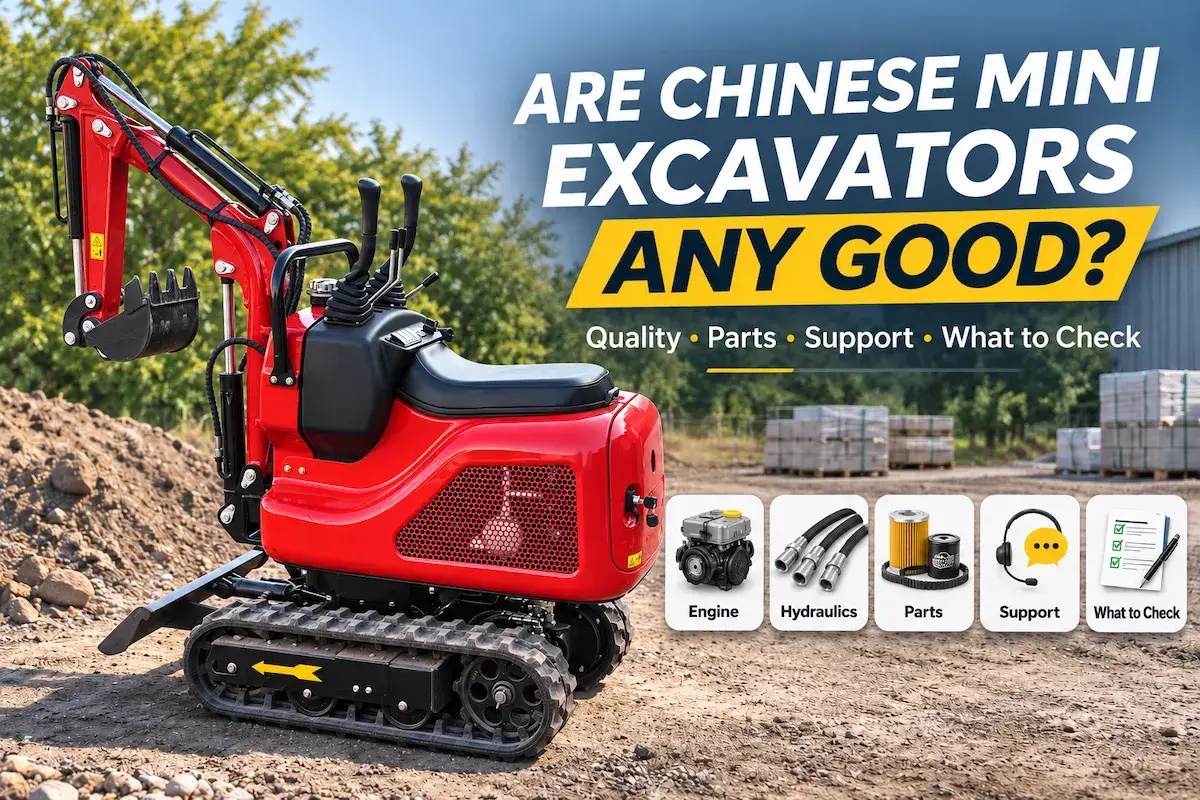
Are Chinese mini excavators any good? The honest answer is that some are good value and some are not. Chinese mini excavator quality varies substantially by manufacturer, model, component selection and supplier support. Buyers should evaluate the exact machine rather than judge it only by its country of origin or purchase price.
This guide is written for buyers who are seriously considering a Chinese mini excavator and want a practical evaluation framework. It acknowledges real trade-offs rather than hiding them. For the wider purchasing process, refer to Cómo comprar una miniexcavadora en China.
Quick Answer — Are Chinese Mini Excavators Any Good?
There is no honest universal yes or no. Some Chinese mini excavators can make sense for the right buyer and application, and some may fall short on component selection, assembly quality, documentation, parts continuity or warranty execution.
The decision should be based on the exact machine, the exact components, the exact supplier, the support system, the documentation and the intended workload, not on the country of manufacture alone.
| Chinese Mini Excavators May Make Sense When | They May Be a Poor Choice When |
|---|---|
| The intended workload fits the machine’s capability | Immediate dealer field service is essential for every job |
| The exact specifications can be verified | Downtime cannot be tolerated under any circumstance |
| Parts availability and identification can be confirmed | The application is extremely intensive or highly specialized |
| Engine and components can be supported | Resale value is a top business priority |
| The supplier provides real, verifiable documentation | Parts and technical support cannot be confirmed before purchase |
| Warranty terms and process are clear in writing | The buyer needs an established local service network |
| The buyer understands import and support limitations | The buyer cannot obtain meaningful verification before final payment or shipment |
Why Chinese Mini Excavator Quality Varies So Much
“Chinese mini excavator” describes a manufacturing origin, not one standardized product. Different suppliers may build machines with very different engineering, components and support levels.
Relevant differences include engines, hydraulic pumps and valves, travel motors, hose specification, cylinder condition, electrical systems, steel fabrication and welding, assembly standards, quality-control process, attachments and documentation.
Machines that look similar in photographs can have different components or support behind them. That is why buyers should compare exact configurations rather than comparing brands or category names.
Why Are Chinese Mini Excavators Often Less Expensive?
Lower acquisition cost can come from several structural factors, not only from quality differences. Possible factors include direct manufacturing, lower dealer or distribution overhead, simpler machine designs, less brand premium, lower marketing expense, different standard equipment, different service-network structure and different resale expectations in the destination market.
A lower price does not automatically mean a lower-quality machine, and it does not automatically mean an equivalent one. The cost structure is genuinely different, and the buyer needs to understand what that difference means for their work.
Chinese Mini Excavator Pros and Cons
| Potential Advantage | What the Buyer Must Still Verify |
|---|---|
| Lower acquisition cost | Actual delivered cost, duty, shipping, attachment scope and total ownership cost |
| Compact machine options | Exact dimensions and access fit for the site |
| Configuration flexibility | Whether the configuration is repeatable and documented |
| Factory sourcing | Supplier identity, factory capability and responsibility |
| Simple mechanical layout | Parts availability and local technician familiarity |
| Attachment options | Hydraulic and mounting compatibility for the specific model |
| Potential Limitation | Por qué es importante |
|---|---|
| Local dealer coverage | Field service access may be limited compared with an established brand dealer |
| Parts lead time | International dispatch and customs can create downtime if parts are not planned |
| Warranty execution | The claim process must be practical, not only written |
| Documentation consistency | Spec sheets, manuals and engine documents should match the exact machine |
| Valor de reventa | Local resale recognition may be weaker than established brand names |
| Configuration variation | Similar-looking machines may differ in components and support |
| Finish quality | Cosmetic finish is not the main concern, but it can signal assembly consistency |
| Local technician familiarity | Some service work may require information or parts the local technician does not have |
Are Chinese Mini Excavators Reliable?
Reliability cannot be judged from country of origin alone. It depends on the specific machine, its component selection, its assembly, its quality-control process, the maintenance it receives, the workload it is used for, cooling, hydraulic cleanliness, parts availability and supplier support.
A well-built and well-maintained machine can provide dependable service for its intended workload. A poorly built or poorly supported machine may create more issues. This is true regardless of country of origin.
El Lista de comprobación para la inspección en fábrica de miniexcavadoras explains the verification process before shipment, and the How Long Do Mini Excavators Last? guide explains how hours and condition relate to service life.
Verify the Exact Engine, Not Just the Brand Name
Engine choice is one important purchasing decision, but the buyer should verify the exact engine configuration rather than only the brand name.
Useful information to request: exact engine manufacturer, exact engine model, nameplate photograph, engine family where relevant, fuel type, service information and parts availability.
A well-known engine brand does not automatically guarantee reliability of the complete machine, and an unfamiliar brand does not automatically mean a poor engine. Engine, hydraulic system, assembly quality and after-sales support all contribute to overall reliability. The Mini Excavator Engine Guide explains engine verification in more detail.
U.S. buyers should go one step further and verify the EPA engine documentation, including the engine family, model year, emissions label and applicable certification information for the exact engine being supplied.
For reference, the ZL-05 currently uses a Rato gasoline engine rated at 6.5 HP. That statement describes the current engine reference and power figure. It is not a reliability claim about the engine or the machine.
Hydraulic System — What Buyers Should Check
Hydraulic-system condition is an important factor in long-term machine reliability and ownership cost. Buyers should check hose routing, visible hose protection, leak inspection, cylinder condition, filtration, cooling where applicable, auxiliary hydraulic requirements and service access to hydraulic components.
The buyer should confirm whether the machine’s hydraulic configuration matches the intended work, especially where powered attachments will be used. The Guía del sistema hidráulico de las miniexcavadoras explica los conceptos de caudal, presión y sistema hidráulico auxiliar desde el punto de vista del comprador.
Cooling and Overheating — Why It Deserves Attention
Buyers should ask what cooling system the exact model uses, whether the machine is appropriate for the expected workload and climate, how the radiator or oil cooler is accessed and cleaned, and whether operating instructions define maintenance procedures.
Overheating is not unique to any manufacturing origin. It can occur on machines of any brand if the cooling system is not suitable for the workload or is not maintained correctly. The evaluation should focus on whether the specific machine’s cooling design and maintenance access are appropriate for the buyer’s working conditions.
Spare Parts Can Make or Break the Ownership Experience
A low purchase price loses value quickly if a basic part cannot be obtained. Before ordering, buyers should ask which wear parts are kept in regular supply, which parts are proprietary to the model, what the typical dispatch process is, how parts are identified, whether parts diagrams or manuals are available, whether urgent parts can be shipped internationally and whether common service parts can be sourced locally.
El Guía de recambios para miniexcavadoras explains parts categories and the information needed for accurate parts identification. Buyers should not assume parts will always be easy or difficult to obtain without confirming the specific machine.
What Does “Warranty” Actually Mean When Buying from China?
“One-year warranty” or a similar short statement is not enough information. Buyers should confirm in writing: warranty period, covered parts, exclusions, labour responsibility, diagnosis process, evidence required for a claim, replacement-parts process, freight responsibility and response channel.
Before ordering, buyers should review the mini excavator warranty terms in detail, including the coverage period, hour limits, covered components, parts and labor responsibility, freight costs, maintenance obligations and exclusions.
A warranty document is only useful if the claim process is practical. The Mini Excavator Warranty Claim Guide explains how to prepare a warranty-related request and what supporting information is required.
Can You Service a Chinese Mini Excavator Locally?
Sometimes yes, but this depends on the exact machine and components. Factors include engine familiarity, common filters, hose and fitting standards, hydraulic component availability, manuals, wiring diagrams, diagnostic complexity and local technician willingness.
The buyer should not assume that every local mechanic can service every Chinese mini excavator, and should not assume the reverse. The correct approach is to confirm the components and documentation for the exact machine before purchase.
Are Chinese Mini Excavators Suitable for Commercial Work?
There is no universal yes or no. Suitability depends on the workload and the buyer’s support expectations.
Potentially suitable for landscaping, farms and orchards, property maintenance, light trenching, small utility work, occasional contracting and businesses that can manage their own maintenance and support.
Potentially less suitable where downtime is extremely expensive, immediate dealer field service is mandatory, machine utilization is exceptionally intensive, resale value is a major business requirement, or procurement rules mandate specific brands or dealer networks.
Chinese Mini Excavator vs Premium Dealer Brand
| Factor | Chinese Mini Excavator | Premium Dealer Brand |
|---|---|---|
| Purchase cost | May be lower, especially with direct sourcing; delivered cost should still be compared | Generally higher, with established market pricing |
| Dealer network | Varies widely; may be limited depending on the supplier and destination market | Established dealer coverage in many markets |
| Parts access | Depends on the supplier and the exact model | Established local parts channels for supported models |
| Service response | Depends on the supplier and the buyer’s local capability | Supported by established service infrastructure |
| Configuration flexibility | Can be higher on some direct factory orders | Depends on the dealer and regional product range |
| Resale recognition | Varies by market and machine | Generally higher recognition |
| Direct factory communication | Possible when sourcing direct | Usually through the dealer network |
| Documentación | Depends on the supplier; must be verified | Typically standardized through the brand |
| Buyer responsibility | Higher, especially for import and support planning | Often lower for import and service coordination because more support is handled locally |
The correct choice depends on the buyer’s use, service expectations, budget and downtime tolerance. There is no universal winner.
Factory vs Trading Company vs Local Importer / Dealer
Direct factory: possible benefits include direct technical communication, factory configuration and factory pricing structure. Possible limitations include the buyer handling more logistics, remote service and less local infrastructure.
Trading company: possible benefits include multiple products and export experience. Possible limitations include technical information passing through another layer.
Local importer / dealer: possible benefits include local stock, local communication, potential local service and simpler delivery. Possible limitations may include a higher purchase price and less direct factory access.
No route is automatically better. The correct choice depends on the buyer’s experience, support expectations and destination market. The Cómo comprar una miniexcavadora en China guide covers the sourcing process in more detail.
What About Buying a Mini Excavator on Alibaba?
Alibaba is a marketplace, not proof of manufacturing capability. Buyers should independently verify company identity, manufacturing capability, the exact machine, engine configuration, specifications, documents, inspection arrangements, warranty terms and payment terms.
Marketplace trade-assurance programs may cover some commercial aspects of the transaction, but they are not a guarantee of machine quality. The evaluation of the machine and the supplier should follow the same verification process regardless of where the initial contact was made.
U.S. Engine Emissions — Verify the Exact Engine
For U.S.-bound machines, emissions compliance should be verified against the exact installed engine. EPA Certificates of Conformity apply to certified engine families and model years, so buyers should match the engine family and identification label to the applicable documentation.
An engine certificate should not be described as certification of the complete excavator. The document scope, engine family, model year and on-machine nameplate should all line up before the buyer relies on the certificate for U.S. import or emissions-compliance purposes.
Buyers should confirm the applicable requirements for the specific machine and destination and verify the exact engine model, engine family and model year for the unit being shipped.
EU Machinery Conformity — Verify the Exact Machine and Engine
For machinery placed on the EU market before 20 January 2027, Machinery Directive 2006/42/EC applies. Machinery Regulation (EU) 2023/1230 becomes mandatory from 20 January 2027.
Buyers should therefore verify which machinery requirements apply at the time the machine is placed on the EU market and ensure that the applicable Declaration of Conformity, CE marking and technical documentation correspond to the exact machine configuration.
A CE logo or a PDF is not by itself proof that the applicable conformity requirements have been met. The manufacturer or responsible economic operator, model or product scope, conformity documentation and the specific machine configuration should be consistent with the applicable requirements.
Engine-emissions compliance is a separate issue. Excavators fall within the EU’s non-road mobile machinery category, and internal-combustion engines used in such machinery are subject to applicable requirements under Regulation (EU) 2016/1628. Buyers should therefore verify both machinery conformity and the applicable engine type-approval or emissions documentation for the exact engine being supplied.
What Should Buyers Inspect Before Final Payment or Shipment?
Where the agreed payment terms permit, buyers should complete the agreed inspection before final balance payment and shipment. The scope depends on the transaction, but useful checks include:
- Exact machine identification against the quotation
- Engine nameplate and configuration
- Hydraulic hose routing and visible leaks
- Cylinder condition
- Undercarriage condition
- Structure, welds and bolt condition
- Function test of boom, arm, bucket, swing and travel
- Packing and loading evidence
- Documentation matching the quoted configuration
El Lista de comprobación para la inspección en fábrica de miniexcavadoras explains the full verification process. Buyers should ask for current photos, videos and any agreed third-party inspection.
Red Flags When Buying a Chinese Mini Excavator
These patterns justify additional verification before payment. None of them automatically proves a problem, but each should prompt a clear written clarification.
- Specifications change between messages without explanation
- Engine model or engine family is not clearly identified
- Product photos do not match the quoted configuration
- Quotation scope or Incoterm is unclear
- Supplier avoids written confirmation and prefers verbal assurances
- Attachment compatibility is assumed rather than confirmed
- No clear parts identification or documentation process
- Warranty terms are vague or only verbal
- Documents are discussed only after payment
- Payment instructions or beneficiary details change unexpectedly
- Supplier cannot or will not explain which engine is installed
- Inspection is refused or avoided when the buyer requests it
If any of these appear, the correct response is to clarify the discrepancy in writing before final payment.
Green Flags of a More Credible Supplier
These patterns are positive signals. They do not prove quality on their own, but they support a more confident evaluation.
- The supplier can provide the exact specification sheet for the quoted model
- The engine manufacturer, model and nameplate can be confirmed
- Quotation, configuration and documentation are consistent across messages
- Parts identification and standard service items are explained clearly
- Warranty terms are provided in writing with a defined claim process
- The supplier can provide current machine photos and function video
- Inspection arrangements can be agreed before final payment
- Payment stages and beneficiary details are stated clearly
- Repeat-order and configuration records can be referenced
- The supplier can explain which documents are available for the destination market
Credibility is built on consistent written evidence, not on repeated reassurance.
Do Real Customer Orders Matter?
Yes, when the evidence is verifiable. Real production photos, current machine videos, shipment records and configuration documentation tell the buyer more than reassurance alone.
The buyer should ask for evidence that corresponds to the actual order, not only general promotional material. Useful evidence includes current machine photos, production or packing photos, and configuration records that match the quotation. The purpose is not to prove that the supplier is the largest or the best; it is to confirm that the supplier is actually building and shipping the machine being ordered.
Machine-specific pages such as the ZL-05 MICROEXCAVADORA DE 0,5 T page are a useful starting point for confirming the current model configuration, and the supplier can provide additional order-specific evidence on request.
What Should Be Written on the Proforma Invoice or Order Confirmation?
The final written document should match what was discussed. Useful items to confirm include:
- Buyer and seller identity
- Document number and date
- Modelo y configuración exactos
- Engine manufacturer and model
- Cantidad
- Unit price and total price
- Currency
- Included attachments and optional equipment
- Incoterm and named port or destination
- Payment stages and amounts
- Document validity
- Documents to be supplied
- Agreed inspection arrangement where applicable
The document should be reviewed carefully before payment. If a field is missing or unclear, the buyer should request clarification in writing rather than rely on messages from earlier in the conversation.
El Mini Excavator Order Checklist explains how to confirm the final configuration before paying a deposit.
Questions to Ask the Supplier Before Ordering
- What is the exact model and current specification for this machine?
- What engine is currently fitted, and can you provide a nameplate photo?
- What is included in the quotation, and what is optional?
- Which hydraulic configuration is supplied?
- Which wear parts and service parts are available, and how are they identified?
- What are the written warranty terms and the claim process?
- What documentation is available for the destination market?
- What inspection evidence can you provide before final payment?
- What is the packing and shipping plan?
- What payment stages apply, and to which verified beneficiary?
Are Chinese Mini Excavators Any Good? Buyer Decision Checklist
| Ámbito de decisión | Lo que debe comprobar el comprador |
|---|---|
| Machine specification | Exact model and configuration documented |
| Engine and hydraulics | Engine identity and hydraulic configuration verified |
| Parts and warranty | Parts identification and written warranty terms confirmed |
| Documentación | Destination-relevant documents confirmed for the exact machine |
| Inspección | Pre-shipment evidence or third-party inspection agreed |
| Local support | Local technician capability or support channel confirmed |
| Supplier identity | Legal identity and responsibility verified |
| Order document | Final written document matches the agreed configuration |
When a Chinese Mini Excavator Is a Sensible Choice
A Chinese mini excavator can be a sensible choice when the buyer has a workload that fits the machine’s capability, access to verified specifications and engine information, a realistic understanding of parts and support limitations, the ability to plan maintenance and service, a destination market where the machine can be imported and operated legally, and a clear support channel for parts and technical questions.
It is often a good fit for buyers whose work is not dependent on immediate local dealer response, who can plan around parts lead times, and who are willing to verify the machine before purchase.
When a Local Premium Dealer May Be the Better Choice
A local premium dealer may be the better choice when immediate field service is essential, downtime creates significant commercial loss, the application is extremely intensive, resale value is a top business requirement, the buyer needs an established local service network, or procurement rules or customer requirements specify established brands.
This is a practical statement, not a criticism of either category. The right choice depends on the buyer’s operating reality.
How the ZL-05 Fits Into This Decision
The ZL-05 is one current ZHAOLU model that buyers can use as a real reference when evaluating whether a Chinese micro excavator fits their work. Current verified specifications include:
| Especificaciones | ZL-05 Reference |
|---|---|
| Peso en servicio | 420 ± 20 kg |
| Ancho de transporte | 640 mm |
| Transport Height | 1101 mm with handles removed |
| Profundidad máxima de excavación | 912 mm |
| Maximum Digging Radius | 1962 mm |
| Boom Swing | 50° left / 50° right |
| Desplazamiento de la cuchara | 245 mm left / 245 mm right |
| Referencia del motor | Rato gasoline engine |
| Potencia del motor | 6,5 HP |
| Maximum System Flow | 12 l/min |
The ZL-05 is intended for compact, light-duty applications. It may be less suitable for buyers whose operations require immediate local dealer field service, very high utilization or a larger machine class.
For U.S.-bound buyers, the applicable engine emissions documentation must be verified against the exact installed engine, engine family and model year. The full configuration is listed on the ZL-05 MICROEXCAVADORA DE 0,5 T product page.
Final Answer — Are Chinese Mini Excavators Any Good?
There is no universal yes or no. Chinese mini excavator quality varies significantly by machine, component selection, assembly and supplier support. Some machines can offer strong value for the right buyer and workload. Others may fall short on documentation, parts continuity or warranty execution.
The right decision depends on the exact machine, the exact supplier, the destination market and the buyer’s tolerance for the trade-offs that come with direct sourcing. Buyers who verify the machine, plan support and understand the limitations often have a better ownership experience than buyers who focus only on the purchase price.
El Cómo comprar una miniexcavadora en China guide covers the sourcing process, and the Guía de precios de miniexcavadoras explains pricing factors in more detail.
Evaluating a Chinese Mini Excavator for Your Work?
If you are considering a Chinese mini excavator and want to confirm whether a specific model or class fits your workload, send ZHAOLU the main application, required digging depth, minimum access width, attachments, expected usage pattern, destination country and any documentation requirements already known. ZHAOLU can confirm the current machine configuration and the documentation available for the exact model.
Chinese mini excavators are not automatically the right choice for every buyer. The correct decision depends on the specific machine, the support available for it and the buyer’s workload and risk tolerance.
Review the Miniexcavadoras en Venta | 0,5–2,5 t | ZHAOLU page or the ZL-05 MICROEXCAVADORA DE 0,5 T product page.
Frequently Asked Questions About Chinese Mini Excavators
Are Chinese mini excavators any good?
Some are good value for the right buyer and workload; others may fall short on documentation, parts or support. The decision should be based on the exact machine, the components, the supplier and the support system, not on country of origin alone.
Are Chinese mini excavators reliable?
Reliability depends on the specific machine, its components, assembly, quality control, maintenance and workload. Country of origin alone does not determine reliability.
Why are Chinese mini excavators cheaper?
Lower acquisition cost can come from direct manufacturing, lower dealer or distribution overhead, simpler machine designs, less brand premium, different standard equipment and different service-network structure. A lower price does not automatically mean lower or equal quality.
Can I get spare parts for a Chinese mini excavator?
This depends on the specific machine and supplier. Before ordering, buyers should confirm which wear parts are stocked, how parts are identified, whether parts diagrams are available and how urgent parts are shipped.
Is the warranty on a Chinese mini excavator practical?
It depends on the written terms and the claim process. Buyers should confirm the coverage, exclusions, diagnosis process, evidence requirements, freight responsibility and response channel before ordering.
Can a local mechanic service a Chinese mini excavator?
This depends on the machine and its components. Engine familiarity, hose and fitting standards, manuals and diagnostic complexity all matter. The buyer should not assume every local mechanic can or cannot service the machine without confirming the specific configuration.
Are Chinese mini excavators suitable for commercial work?
Suitability depends on the workload and the buyer’s support expectations. Machines that fit the workload, with confirmed parts and support, can be used commercially. Machines that require immediate dealer field service or operate in very intensive conditions may not be the best fit.
What documents should I request before ordering?
The relevant documents depend on the destination market. Buyers should confirm which documents the supplier can provide for the exact machine, engine configuration and model year, and verify that the documentation matches the specific unit being shipped.
Is buying a mini excavator on Alibaba safe?
Alibaba is a marketplace, not a guarantee of machine quality. Buyers should independently verify the company identity, manufacturing capability, exact machine, engine, documents, inspection arrangements and payment terms.
When should I buy from a local dealer instead?
A local premium dealer may be the better choice when immediate field service is essential, downtime is extremely costly, the application is very intensive or resale value is a top business requirement. The correct choice depends on the buyer’s operating reality.