
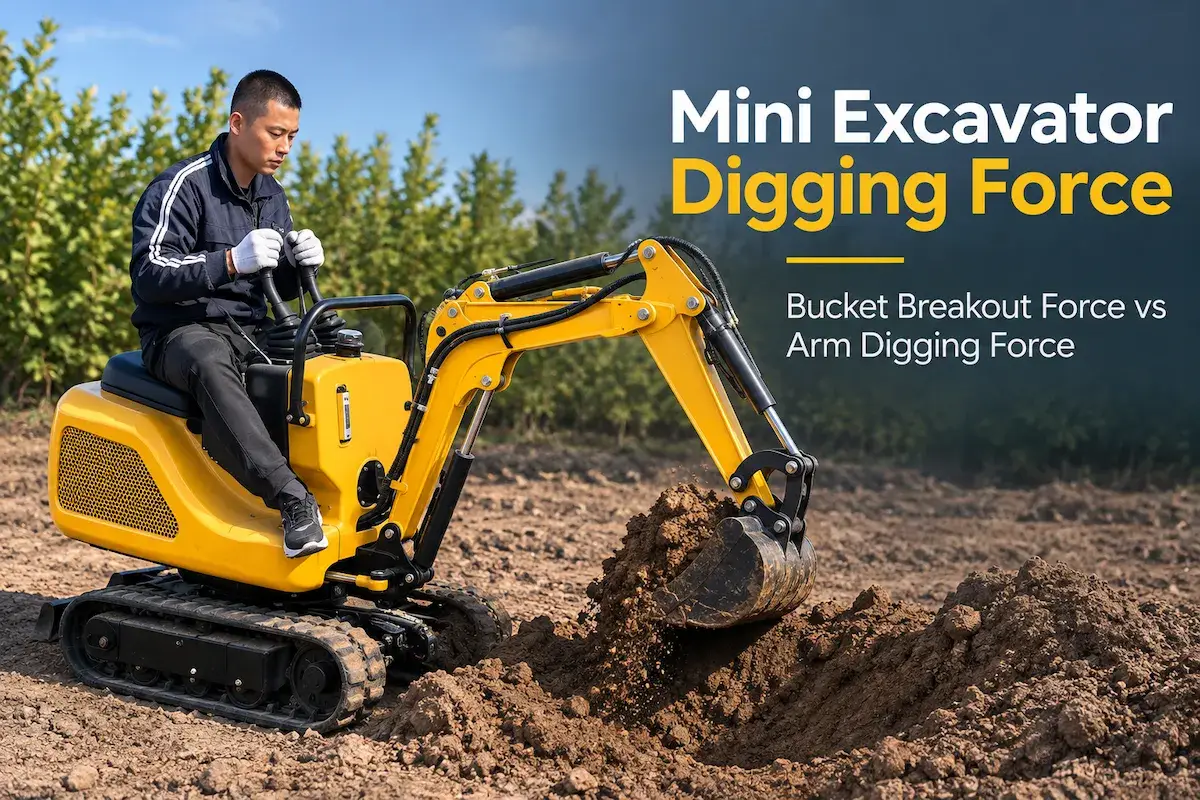
Mini excavator digging force is one of the specifications buyers use to evaluate how strongly the bucket and arm can work against soil or material resistance. On a specification sheet, it usually appears as two separate figures — bucket digging force (or bucket breakout force) and arm digging force (or stick digging force). Those two numbers describe different parts of the digging cycle, and comparing them correctly requires more than picking the larger value.
This guide explains what each figure means, why they differ, how they relate to hydraulic pressure and digging depth, and how buyers should compare two machines using model-specific data rather than category-level assumptions.
Quick Answer: What Is Mini Excavator Digging Force?
Digging force describes the force generated through the digging linkage — the bucket and the arm — when the machine works against soil or material resistance. Specification sheets commonly list two figures: bucket digging force (bucket breakout force) and arm digging force (stick digging force). The two values reflect different movements and different linkage geometry.
A higher digging-force number does not automatically mean a better machine. Digging suitability also depends on machine stability, bucket configuration, hydraulic system, working geometry, ground conditions and the actual job. Buyers should compare model-specific figures and confirm how each value is defined by the manufacturer.
Mini Excavator Digging Force at a Glance
| Term | What It Describes | Why Buyers Check It |
|---|---|---|
| Bucket digging force | Force available at the bucket during the bucket curl / digging action | Helps evaluate bucket performance in soil and material |
| Bucket breakout force | Often used to describe the bucket breakout / curl force; terminology varies by manufacturer | Helps compare bucket digging capability between machines |
| Arm digging force | Force available through the arm (stick) movement during the digging cycle | Helps evaluate pulling and trenching capability |
| Stick digging force | Another common term for arm digging force; usage varies by manufacturer and market | Same role as arm digging force — confirm the manufacturer’s definition |
| Hydraulic pressure | Pressure in the hydraulic circuit | Related to force potential, but not the same as digging force |
| Digging depth | How far the digging geometry can reach below ground level | Related to working envelope, not to force |
Hydraulic pressure and digging depth are related to the digging system, but neither is the same specification as digging force. They are covered separately below.
What Is Bucket Digging Force?
Bucket digging force describes the force available at the bucket during the bucket curl movement. As the bucket cylinder actuates the linkage, the bucket rotates through the material and breaks it loose from the ground. The rated bucket digging force reflects the force available through that linkage under the conditions defined by the manufacturer.
The figure is most directly relevant when the bucket is doing the primary cutting and curling work. Buyers often check it when the work involves compacted soil, clay, roots or material that resists bucket penetration. The exact rating basis may vary by manufacturer, so the figure should be confirmed rather than assumed to be directly comparable across every brand.
What Is Bucket Breakout Force?
“Bucket breakout force” is often used to describe the bucket curl or breakout action, and in many specifications it refers to the same general capability as bucket digging force. However, manufacturers may use different terminology, geometry references or rating standards, so the two terms are not always interchangeable across every specification sheet.
Buyers comparing two machines should confirm how each manufacturer defines the figure. A published value is more useful when its definition, bucket configuration and rating conditions are known. Without that context, a direct kN-to-kN comparison can be misleading.
What Is Arm or Stick Digging Force?
Arm digging force (also called stick digging force) describes the force available through the arm or stick movement during the digging cycle. As the arm cylinder actuates the linkage, the arm draws the bucket through the material. The rated arm digging force reflects the force available through that part of the linkage under the manufacturer’s defined conditions.
Arm digging force is often relevant in trenching and excavation where the machine pulls material toward itself rather than only curling the bucket. It complements bucket digging force rather than replacing it. Neither figure is “more important” in general — they describe different parts of the digging cycle.
Bucket Force vs Arm Force
| Factor | Bucket Digging / Breakout Force | Arm / Stick Digging Force |
|---|---|---|
| Main movement | Bucket curl | Arm / stick pull |
| Typical role | Cutting and curling material into the bucket | Pulling material toward the machine during the digging cycle |
| Specification name | Bucket digging force / bucket breakout force | Arm digging force / stick digging force |
| What it helps buyers evaluate | Bucket performance in soil and material | Reach-side pulling and trenching capability |
| Why values differ | Different cylinder, linkage and lever geometry from the arm | Different cylinder, linkage and lever geometry from the bucket |
The two figures are not directly comparable to each other. They describe different movements and different geometry.
Why Are Bucket and Arm Digging Force Different?
The two values differ because they are generated through different parts of the digging linkage. Relevant factors include:
- Cylinder size and location
- Linkage geometry
- Lever arm length at the bucket and at the arm
- Bucket position through the digging cycle
- Hydraulic pressure available to each circuit
- Overall machine design and balance
Digging force is not determined by one factor alone. A machine with high hydraulic pressure in one circuit may still have a lower rated force at a specific point in the digging cycle because of geometry and linkage design. This is one reason why buyers should not estimate digging force from a single specification.
What Units Are Used for Digging Force?
Digging force is commonly published in one of three units:
- kN — kilonewtons, a metric unit of force
- kgf — kilogram-force, a metric unit of force
- lbf — pound-force, an imperial unit of force
For reference, 1 kN is approximately equal to 101.97 kgf, and 1 kN is approximately equal to 224.81 lbf. These are standard unit conversions, not machine-specific figures.
Buyers should not confuse kg (mass) with kgf (force). They describe different things and should not be treated as interchangeable when comparing specifications.
Does Higher Digging Force Always Mean a Better Mini Excavator?
No. A higher digging-force figure is useful only when the machine can remain stable, reach the work area, and perform the required job efficiently. Digging force is one specification among many, and it should be evaluated with the rest of the machine.
Relevant factors include:
- Operating weight and stability
- Machine geometry and working position
- Bucket size and configuration
- Hydraulic system behavior
- Ground conditions
- Access width and working space
- Required digging depth and reach
- Workload and job duration
- Attachment requirements
A strong bucket-force figure is useful only when the machine can remain stable, reach the work area and perform the required job efficiently. Buyers should not reduce the decision to a single kN value.
Digging Force vs Digging Depth
Digging force and digging depth describe different things. Digging force describes how strongly the machine can work against resistance. Digging depth describes how far the digging geometry can reach vertically below ground level.
A higher digging force does not mean the machine can dig deeper, and a deeper maximum digging depth does not mean the machine has higher digging force. Both specifications matter, but they answer different questions. The Mini Excavator Digging Depth Guide explains how to compare required excavation depth against machine capability.
Digging Force vs Lifting Capacity
Digging force and lifting capacity are also different specifications. Digging force describes the force generated through the bucket and arm linkage during excavation, while lifting capacity describes how much load the machine can safely handle at a particular working position.
A higher bucket or arm digging-force figure does not mean the excavator can safely lift a heavier load. Lifting performance depends on factors such as machine stability, working radius, lift point, undercarriage position and the model-specific data provided by the manufacturer. See the Mini Excavator Lifting Capacity Guide for a separate explanation of lifting performance.
Digging Force vs Hydraulic Pressure
Hydraulic pressure contributes to the force the machine can generate. Higher pressure in the hydraulic circuit can support higher force potential, but digging force is also affected by cylinder area, linkage geometry, mechanical leverage and overall machine design.
This means a higher hydraulic pressure figure does not automatically mean a higher rated digging force. Buyers should not use hydraulic pressure alone to compare digging capability between machines. The Mini Excavator Hydraulic System Guide explains flow, pressure and auxiliary hydraulics in more detail.
Does Hydraulic Flow Increase Digging Force?
Flow and pressure are not the same thing. Flow generally relates more closely to movement speed and actuator speed. Pressure relates more directly to force potential. The two work together, but they are not interchangeable specifications.
Digging force is determined by the complete hydraulic and mechanical system — not by flow alone. A higher flow rate does not automatically increase digging force, and a published flow figure should not be used to estimate a digging-force value. For example, system flow specifications are not a substitute for a rated bucket or arm force figure.
How Bucket Size and Geometry Affect Real-World Digging
Bucket selection affects how the machine behaves in real work. A wider bucket can move more material per pass in suitable loose soil but may encounter greater resistance in dense or compacted material. A narrower bucket reduces the cutting width and may be easier to penetrate into difficult ground. Tooth configuration and bucket geometry also affect penetration and breakout behavior.
The bucket should be matched to the machine and the work. The Mini Excavator Bucket Size Guide explains how width, capacity, bucket weight and mounting dimensions affect bucket selection, while the Mini Excavator Attachments Guide covers broader attachment selection and compatibility.
Hard Soil, Clay, Roots and Rocky Ground
The same digging-force figure can produce very different results depending on ground conditions. Loose soil, clay, compacted ground, roots, gravel and rock all respond differently to the bucket and arm.
This article does not provide a force-to-soil comparison table. A specific kN figure does not guarantee performance in a specific soil type, and buyers should not assume that a given force value will handle rock, roots or compacted clay without testing. The correct approach is to describe the actual ground conditions and confirm the machine and bucket configuration with the supplier.
Machine Stability Matters Too
A digging-force figure does not describe how stable the machine will be during the digging cycle. Machine stability depends on operating weight, undercarriage configuration, machine position, ground conditions, attachment and working radius. If the machine cannot remain stable under load, the rated force is less useful in practice.
Stability is not determined by a single specification. Buyers should consider the complete machine configuration and the actual working position, rather than assuming that a higher digging-force figure means better real-world performance.
How to Compare Two Mini Excavators Correctly
- Bucket digging force
- Arm / stick digging force
- Units used (kN, kgf, lbf)
- Definition / rating basis
- Operating weight
- Digging depth
- Digging radius
- Hydraulic pressure
- Hydraulic flow
- Bucket configuration
- Machine stability
- Actual application
The comparison should not be reduced to a single kN value. Buyers should compare model-specific data and confirm the definitions used by each manufacturer. The Mini Excavator Specifications Guide explains how to read a full specification sheet, and the Mini Excavator Size Guide explains machine class selection.
What Buyers Should Ask the Supplier
When comparing digging-force specifications, buyers should ask specific questions rather than relying on a single value from a marketing sheet.
- What is the bucket digging force or bucket breakout force?
- What is the arm or stick digging force?
- What units are used (kN, kgf, lbf)?
- Does the figure apply to the quoted machine configuration?
- What bucket was used for the reference specification?
- What are the hydraulic pressure and flow specifications?
- Are the published figures current for this production model?
These questions are especially relevant when the machine will be used in demanding ground or compared against another model. A supplier should be able to provide the current model-specific figures and explain how they are defined.
What Should Buyers Check About Digging Force on a Micro Excavator Like the ZL-05?
The ZL-05 is a 0.5 Ton Micro Excavator. Some of its specifications are confirmed, and some digging-related figures are not currently verified. The table below shows both.
| Specification | ZL-05 Confirmed Reference |
|---|---|
| Operating Weight | 420 ± 20 kg |
| Transport Width | 640 mm / 25.2 in |
| Maximum Digging Depth | 912 mm |
| Maximum Digging Radius | 1962 mm |
| Engine Reference | Rato gasoline engine |
| Reference Engine Power | 6.5 HP |
| Maximum System Flow | 12 L/min |
| Bucket Digging Force | Not currently verified |
| Arm Digging Force | Not currently verified |
Important: Engine power, system flow and machine weight should not be used to calculate an unpublished digging-force figure. Digging force depends on cylinder size, linkage geometry and hydraulic pressure in ways that cannot be inferred from these values. Buyers who need digging-force data for the ZL-05 should confirm it from the current model-specific specification before ordering.
Typical ZL-05 applications include narrow-access work, landscaping, planting pits, light trenching, irrigation, orchard work, garden work and property maintenance. The full configuration is listed on the ZL-05 0.5 Ton Micro Excavator product page.
When Should Digging Force Matter Most?
Digging force is especially relevant when the work involves compacted soil, clay, trench excavation in difficult ground, root-heavy ground or repeated excavation cycles in the same conditions. In those situations, the bucket and arm forces describe how effectively the machine can penetrate and move the material.
Digging force is not the only factor in these applications. Ground conditions, bucket choice, machine stability and operator technique also affect performance. The What Can a Mini Excavator Do? guide covers broader machine capability and application fit.
When Should Digging Force Not Be the First Decision Factor?
There are projects where digging force is not the primary consideration:
- Narrow access is the main constraint
- Required digging depth is beyond the machine’s geometry
- Transport weight matters more than digging capability
- The machine must run specific attachments
- The work is light and localized
In these cases, access width, working envelope, attachment compatibility or transport planning may be the deciding factor. Digging force still matters, but it is not the first specification to compare.
Final Answer
Mini excavator digging force describes the force generated through the bucket and arm linkage during the digging cycle. Bucket digging force and arm digging force measure different parts of that cycle, and the two values should not be treated as interchangeable. A higher force figure is useful only when the machine can remain stable, reach the work area and perform the required job efficiently. Buyers should compare model-specific figures, confirm how each value is defined and evaluate the full machine specification before choosing a machine.
Not Sure Which Mini Excavator Fits Your Digging Requirements?
Send ZHAOLU the main application, soil and ground conditions, required digging depth, required reach, access width, planned attachments, expected workload and destination country. ZHAOLU can help confirm which machine class and configuration should be compared for the actual work.
Review the Mini Excavators for Sale page or the ZL-05 0.5 Ton Micro Excavator product page.
Frequently Asked Questions About Mini Excavator Digging Force
What is mini excavator digging force?
Mini excavator digging force describes the force generated through the digging linkage during the bucket and arm movements. Specification sheets commonly list bucket digging force (bucket breakout force) and arm digging force (stick digging force) as two separate figures.
What is bucket breakout force?
Bucket breakout force generally describes the force available at the bucket during the bucket curl or breakout action. Manufacturers may use different terminology, geometry references or rating standards, so buyers should confirm how the published figure is defined.
What is arm digging force?
Arm digging force (also called stick digging force) describes the force available through the arm movement during the digging cycle. It is generated through a different part of the linkage than bucket digging force and is typically listed as a separate specification.
Is bucket force the same as arm force?
No. Bucket digging force and arm digging force describe different movements and different linkage geometry. The two values are not directly comparable to each other and should be evaluated separately.
Does higher hydraulic pressure mean more digging force?
Not automatically. Hydraulic pressure contributes to force potential, but digging force is also affected by cylinder area, linkage geometry, mechanical leverage and machine design. A higher pressure figure does not by itself confirm a higher rated digging force.
Does hydraulic flow affect digging force?
Flow and pressure are not the same thing. Flow generally relates more closely to actuator speed, while pressure relates more directly to force potential. Digging force is determined by the complete hydraulic and mechanical system, not by flow alone.
Is digging force the same as digging depth?
No. Digging force describes how strongly the machine can work against resistance. Digging depth describes how far the digging geometry can reach vertically below ground level. A higher force does not mean the machine can dig deeper, and a deeper digging depth does not mean higher force.
How much digging force does a mini excavator need?
There is no universal required figure. The right digging force depends on the soil, the job, the machine, the bucket, the working geometry and the workload. Buyers should compare model-specific data against the actual project requirements rather than assuming a fixed minimum.