
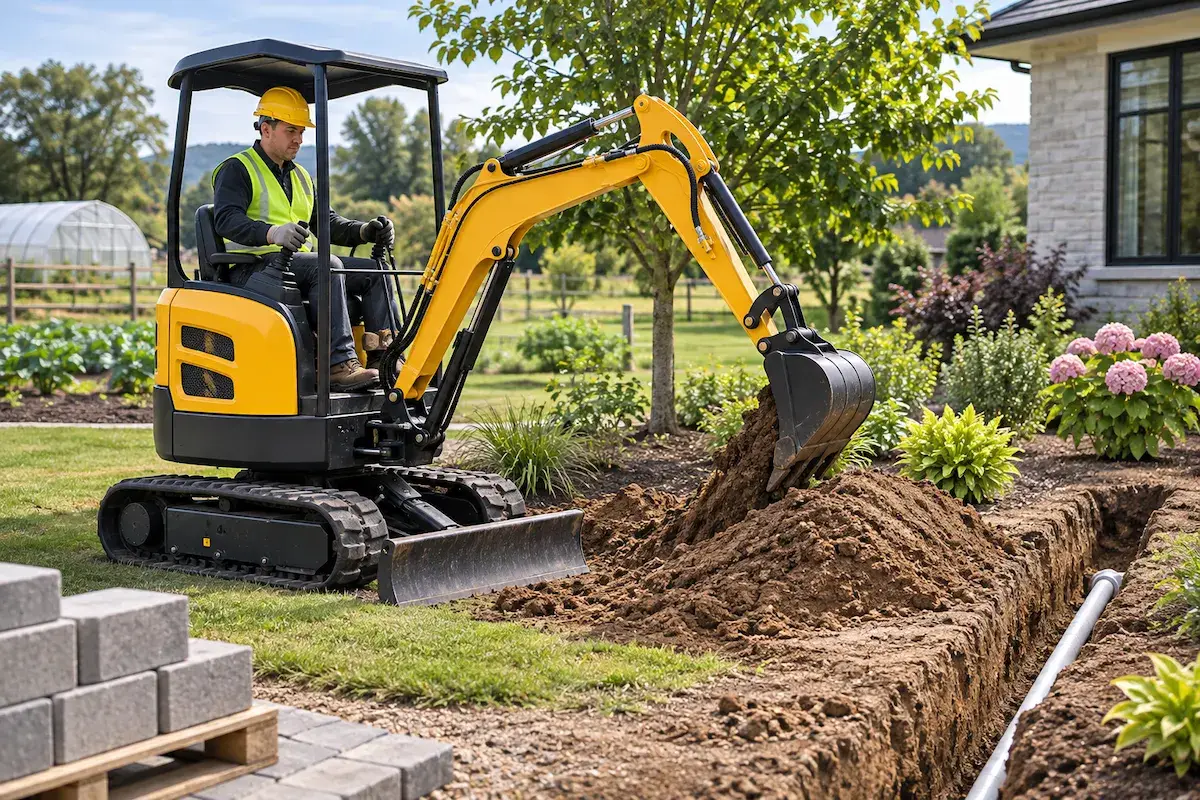
What can a mini excavator do? A mini excavator can handle digging, trenching, landscaping, farm and property work, drainage, light construction and a range of attachment-based jobs. But actual capability depends on the exact machine and job conditions, not only on the machine class. A 0.5 ton micro excavator and a 2.5 ton compact excavator are not interchangeable, even though both are called mini excavators.
This guide explains the common uses, the limits buyers should understand, and how to decide whether a specific machine fits a specific job. It is written for property owners, farm owners, contractors, landscapers and equipment buyers who are comparing machine capability before ordering.
Quick Answer: What Can a Mini Excavator Do?
A mini excavator can dig, trench, excavate small foundations and pits, move soil, prepare planting areas, handle drainage and irrigation work, support farm and property maintenance, and run a range of attachments depending on the machine configuration. It can also handle small material-handling tasks where the load and reach are within the machine’s limits.
Machine size and configuration matter. A micro excavator suits restricted access and light work, while a larger compact excavator may offer greater digging depth, reach and capacity for more demanding work. Buyers should compare the actual machine against the actual job, not against the category name.
Mini Excavator Jobs at a Glance
The table below summarizes common mini excavator uses and the main points buyers should check. It is a decision reference, not a specification table.
| Job Type | What the Machine May Do | What Must Be Checked |
|---|---|---|
| Landscaping | Planting pits, garden excavation, soil removal, small drainage | Access width, digging depth, working space, transport |
| Trenching and drainage | Irrigation lines, drainage routes, cable and pipe preparation | Required depth, trench geometry, soil, obstacles, attachment |
| Farm and orchard | Planting, irrigation maintenance, ditch work, localized digging | Machine size, ground conditions, working frequency, parts |
| Residential work | Site preparation, small excavation, groundwork | Access, machine width, working footprint, job intensity |
| Attachment work | Augers, breakers, grapples and other powered tools | Hydraulic flow, pressure, auxiliary circuit, mounting |
Digging and Excavation
A mini excavator can dig pits, small foundation areas, planting holes and localized excavation. It can also remove soil from a defined area, place spoil nearby or, where dumping height and site geometry allow, load material into a suitable trailer.
The practical limit is not “can a mini excavator dig?” but “which machine class can dig this depth, in this ground, with this access, at this workload?” A micro excavator may complete a shallow planting pit comfortably but may not be the right class for a deeper foundation excavation. A larger compact excavator may handle more depth and reach, but it may not fit through the same access route.
The Mini Excavator Digging Depth Guide explains how to match required excavation depth to machine capability.
Trenching, Drainage and Utility Work
Mini excavators are commonly used for irrigation lines, drainage routes, cable and pipe preparation, and small utility trench work. The machine can dig the trench, place the spoil, open connection pits, and backfill afterward.
For long, straight, narrow and repetitive trench production on a clear route, a dedicated trencher may be the more efficient choice. That is a fair comparison, not a criticism of the mini excavator. The Mini Excavator vs Trencher comparison explains where each category fits.
The Mini Excavator for Utility Work guide covers utility and trenching machine selection in more detail.
Landscaping and Property Work
In landscaping and property work, a mini excavator can dig planting pits, excavate garden beds, remove soil, prepare small drainage runs and handle general property improvement tasks. For compact and micro machines, one important advantage is the ability to reach restricted areas and perform localized excavation where larger equipment may be impractical.
A micro excavator such as the ZL-05 is often relevant here because its compact width and working footprint can be matched to gardens, orchards and narrow property access. The Mini Excavator for Landscaping guide explains landscaping machine selection in more detail.
Farm and Orchard Work
On farms and orchards, a mini excavator can support planting, irrigation maintenance, small drainage work, ditch maintenance and localized digging. It can reduce manual labor for tasks that would otherwise be done by hand or with a larger machine that cannot access the area.
Not every farm job suits every mini excavator. A micro excavator may be practical for orchard rows and planting work but may not be the right class for deeper drainage excavation or heavier ground work. The Mini Excavator for Farm Use guide explains farm and property machine selection in more detail.
Residential and Small Construction Work
In residential and small construction work, a mini excavator can handle site preparation, small excavation, drainage, utility trench preparation and other groundwork tasks. Its size can be an advantage on sites where access is limited and a larger excavator would not fit or would cause unnecessary disruption.
Larger or deeper excavation, heavier site work and higher daily output requirements may point toward a larger machine class. The Mini Excavator for Residential Construction guide explains residential machine selection in more detail.
What Can Mini Excavator Attachments Do?
Attachments expand the types of work a mini excavator can perform beyond the standard bucket. Common categories include different bucket types, augers, hydraulic breakers, grapples and rippers.
Attachment compatibility is not automatic. It depends on hydraulic flow, hydraulic pressure, the auxiliary circuit, machine size, and mounting or coupler compatibility. A machine may be physically able to mount an attachment but still not be suitable for the attachment’s hydraulic or operating requirements.
The Mini Excavator Attachments Guide explains mounting and hydraulic compatibility, and the Mini Excavator Hydraulic System Guide explains flow, pressure and auxiliary hydraulics for powered attachments.
What Can a Micro Excavator Like the ZL-05 Do?
The ZL-05 is a 0.5 Ton Micro Excavator designed for compact, light excavation work. It should be evaluated primarily on access, compactness and light excavation requirements, not on raw digging power.
| Specification | ZL-05 Reference |
|---|---|
| Operating Weight | 420 ± 20 kg |
| Transport Width | 640 mm / 25.2 in |
| Transport Height | 1101 mm with handles removed |
| Maximum Digging Depth | 912 mm |
| Maximum Digging Radius | 1962 mm |
| Boom Swing | 50° left / 50° right |
| Bucket Offset | 245 mm left / 245 mm right |
| Engine Reference | Rato gasoline engine |
| Engine Power | 6.5 HP |
| Maximum System Flow | 12 L/min |
In practice, the ZL-05 is relevant to narrow-access work, gardens, orchards, planting pits, light trenching, irrigation maintenance and property work. Each project still needs to be checked against the actual digging depth, access width and ground conditions. The full configuration is listed on the ZL-05 0.5 Ton Micro Excavator product page.
When Should You Choose a Larger Mini Excavator?
A micro excavator is not the right class for every job. Buyers should compare larger ZHAOLU mini excavator models — such as the ZL-17, ZL-18, ZL-25 or ZL-35 — when the project requires greater digging capability, reach, stability, working capacity or more demanding attachment requirements.
This article does not list specifications for those larger models. Buyers should confirm the current model-specific data from the product pages or the supplier before comparing them for a specific project.
The Mini Excavator Size Guide explains machine class selection across the compact range, and the Mini Excavators for Sale page lists the current range for comparison.
If the job may exceed the practical scope of compact equipment altogether, our mini excavator vs full-size excavator comparison explains when moving beyond the mini excavator category may be justified.
What Can a Mini Excavator NOT Do Well?
A mini excavator can perform many tasks, but capability does not make it the right machine for every job. This section explains the common limits honestly.
Lifting is not the same as excavation. A mini excavator may be able to lift some materials, but it should not be treated as a dedicated crane. Lifting suitability depends on the specific machine configuration, working radius, lift height, direction and blade position. Where the manufacturer provides a lift chart, use that model-specific data rather than estimating lifting capacity from machine weight, digging force or hydraulic specifications. The Mini Excavator Lifting Capacity guide explains this in more detail.
Micro excavators are not universal deep-digging machines. A 0.5 ton machine may be practical for planting pits and light trenching, but it is not a substitute for a larger excavator on deep excavation.
Mini excavators are not the strongest choice for repeated site-wide loading or grading. When the work is dominated by moving material, loading trucks or grading surfaces, a skid steer is often the more natural machine category. The Mini Excavator vs Skid Steer comparison explains the difference.
Long, straight, uniform trenching may suit a dedicated trencher better. The Mini Excavator vs Trencher comparison explains when each category is the stronger starting point.
Horsepower alone does not describe capability. Engine power is one specification among many, and hydraulic configuration, machine weight, geometry and attachments all affect real working capability. Attachment compatibility must be confirmed against the specific machine, not assumed from the model name.
How to Decide Whether a Mini Excavator Can Do Your Job
- Narrowest access width
- Required digging depth
- Required working reach
- Ground conditions
- Required attachments
- Hydraulic requirements for powered attachments
- Work frequency
- Expected daily workload
- Transport requirements
- Job output expectations
Do not start with “what ton mini excavator do I need?” Start by defining the work. Once the access, depth, reach, attachments and workload are clear, the machine class becomes a much easier decision.
Final Answer
Mini excavators are versatile, but there is no universal model that fits every job. The right choice depends on access width, required digging depth, working reach, attachment requirements, workload and site conditions. A machine that can physically perform a task is not automatically the right class for that task, and the smallest machine is not automatically the best choice.
Not Sure Whether a Mini Excavator Fits Your Job?
Send ZHAOLU the main application, required digging depth, narrowest access width, required attachment and destination country. ZHAOLU can help confirm which machine size and configuration should be compared for the actual work.
Review the Mini Excavators for Sale page or the ZL-05 0.5 Ton Micro Excavator product page.
Frequently Asked Questions About What a Mini Excavator Can Do
What can a mini excavator do?
A mini excavator can dig, trench, excavate small foundations and pits, move soil, prepare planting areas, support drainage and irrigation work, handle farm and property maintenance, and run a range of attachments depending on the machine configuration.
What jobs can a mini excavator be used for?
Common jobs include landscaping, trenching and drainage, farm and orchard work, residential site preparation, small construction excavation and attachment-based work. The right machine class depends on access, depth, reach and workload.
Can a mini excavator dig trenches?
Yes. A mini excavator can dig irrigation, drainage and small utility trenches. For long, straight, narrow and repetitive trench production on a clear route, a dedicated trencher may be more efficient. The right choice depends on trench geometry, depth and the rest of the job.
Can a mini excavator be used for landscaping?
Yes. Mini excavators are commonly used for planting pits, garden excavation, small drainage work, soil removal and property improvement. Access width and working space often matter more than raw digging power on landscaping sites.
Can a mini excavator be used on a farm?
Yes. Farms and orchards use mini excavators for planting, irrigation maintenance, small drainage work, ditch maintenance and localized digging. Not every farm job suits every machine class, so the actual depth and ground conditions should be checked.
What can a 0.5 ton mini excavator do?
A 0.5 ton micro excavator is relevant to narrow-access work, gardens, orchards, planting pits, light trenching, irrigation maintenance and property work. As one real reference, the ZL-05 lists a maximum digging depth of 912 mm and a transport width of 640 mm. Each project still needs to be checked against the actual requirements.
When do I need a larger mini excavator?
A larger mini excavator should be compared when the project needs more digging depth, greater reach, more stability, more working capacity or more demanding attachment requirements. Buyers should confirm the current model-specific data before selecting a machine.
Can a mini excavator lift heavy objects?
A mini excavator may be able to lift some materials, but it should not be treated as a dedicated crane. Lifting suitability depends on the specific machine configuration, working radius, lift height, direction and blade position. Where a manufacturer provides a lift chart, use that model-specific information rather than estimating lifting capacity from other specifications.