
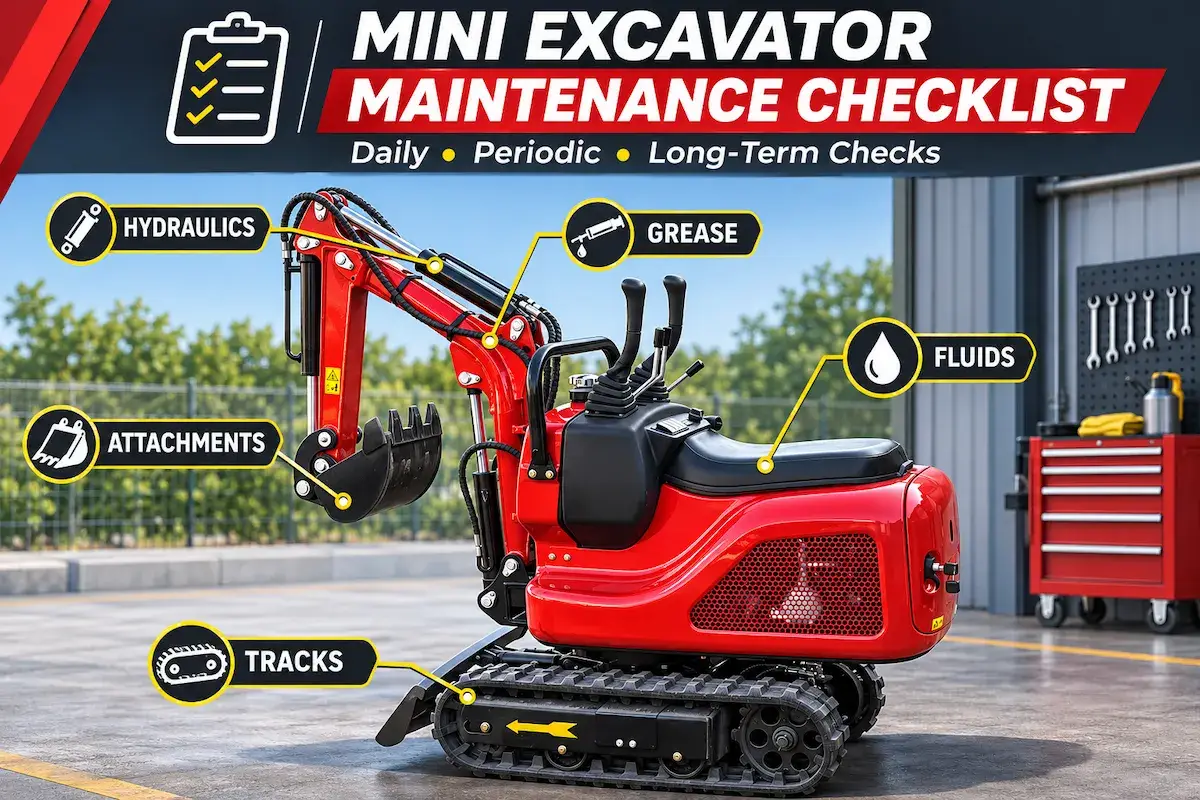
A mini excavator maintenance checklist should start with a visual walk-around, fluid and leak checks, lubrication points, tracks or undercarriage, hoses, cylinders, attachments and safety systems. Exact oil, filter and fluid-change intervals must come from the operation and maintenance manual for the specific machine.
This guide provides a general inspection framework for owners, contractors, landscapers, farm and property users, and rental businesses. It is not a substitute for the manufacturer’s service schedule. Exact maintenance intervals and procedures should always come from the operation and maintenance manual for the specific machine and engine.
Quick Answer — What Should Be on a Mini Excavator Maintenance Checklist?
A practical mini excavator maintenance checklist should include:
- Walk-around inspection
- Fluid levels where applicable
- Visible leaks
- Grease and lubrication points
- Tracks and undercarriage
- Hydraulic hoses and cylinders
- Bucket and attachment condition
- Cooling and airflow areas
- Engine condition
- Electrical system
- Safety controls
- Loose fasteners and visible damage
- Cleaning
- Service records
Exact service intervals differ by model, engine, hydraulic system, workload and operating environment. Always follow the operation and maintenance manual for the exact machine.
Daily Mini Excavator Pre-Start Checklist
Before inspection, park the machine safely, lower the attachment, stop the engine and follow the manufacturer’s procedure for checking hot, pressurized or moving components.
The daily pre-start check is a core routine in mini excavator maintenance. It catches small problems before they become expensive ones.
| Check | What to Look For | Pourquoi est-ce important ? |
|---|---|---|
| Ground beneath machine | Fresh fluid spots, drips or pooling | Early sign of leaks from engine, hydraulics or cooling |
| Fluid leaks | Visible oil, coolant or fuel leaks | Helps identify leaks before fluid loss or secondary damage increases |
| Engine oil level | Level within the correct range, according to the engine instructions | Low oil can accelerate engine wear |
| Hydraulic oil level where applicable | Level checked according to the correct machine position and manual | Low hydraulic oil affects performance and can damage components |
| Coolant where applicable | Level and visible leaks on liquid-cooled machines | Helps identify low-coolant or cooling-system issues |
| Fuel condition and level | Contamination, leaks, water separation where applicable | Supports reliable starting and operation |
| Hydraulic hoses | Wet fittings, abrasion, cracking, bulges | Early hose failure can cause downtime and safety risk |
| Cylindres | Visible leakage, rod damage, loose fittings | Indicates seal condition and potential loss of function |
| Tracks | Cuts, embedded debris, missing material, alignment | Supports safe travel and reduces undercarriage wear |
| Track tension | Checked against the specification for the exact machine | Too tight or too loose increases wear or derailment risk |
| Bucket | Wear, cracks, loose teeth | Affects digging performance and safety |
| Teeth and cutting edge | Excessive wear, missing teeth, damaged edge | Affects productivity and bucket protection |
| Pins and bushings | Visible play, missing grease, damaged seals | Wear can affect boom, arm and attachment behaviour |
| Quick coupler if equipped | Locking function, visible damage | Attachment security is a safety-critical check |
| Dozer blade | Damage, loose mounting, visible wear | Affects grading and stability support |
| Boom and arm | Cracks, repairs, visible damage | Structural condition affects safe operation |
| Air intake | Blocked or restricted airflow | Supports engine breathing and cooling |
| Cooling airflow | Debris on radiator or oil cooler where equipped | Blocked airflow contributes to overheating |
| Battery and wiring | Loose terminals, corrosion, damaged insulation | Helps reduce the risk of electrical faults and starting problems |
| Commandes | Smooth operation, unusual response | Unexpected control behaviour is a safety concern |
| Safety lock | Correct function | Helps reduce the risk of unintended machine movement |
| Horn, alarm or lights if equipped | Functioning correctly | Supports site safety and communication |
Why the Walk-Around Inspection Matters
Many developing problems first appear as small, visible signals: a wet fitting, a loose fastener, a damaged hose, a cut in a track, unusual wear, a damaged tooth, debris around cooling areas or a cracked component.
The purpose of the walk-around is early detection. A small leak noticed at the start of the day is a maintenance task. If a developing leak or damaged component is ignored, continued operation may increase fluid loss, wear or repair requirements. Regular inspection is a practical preventive-maintenance habit that can help identify developing problems early.
Fluid Checks — What Owners Should Monitor
Fluid checks must be performed according to the machine and engine documentation. The following are general principles, not universal specifications.
Engine Oil
Check the level according to the engine instructions. Use the oil type and specification stated for the exact engine in the operation and maintenance manual. Do not assume a universal oil grade applies to every mini excavator.
Hydraulic Oil
Check the hydraulic oil level according to the correct machine position and manual. Do not assume every machine uses the same hydraulic fluid. The correct specification depends on the machine and its hydraulic system.
Coolant
On liquid-cooled machines, check the coolant level and visible leaks according to the manual. Not every mini excavator uses a liquid cooling system, so this check applies only where the machine is equipped with one.
Carburant
Check for contamination, leaks or water-separation systems where applicable. Diesel and gasoline machines have different fuel-system maintenance requirements. Follow the engine manufacturer’s instructions for the specific machine.
Greasing and Lubrication
Lubrication is a core part of mini excavator maintenance. Grease points typically include the boom pins, arm pins, bucket linkage, blade pivots, swing-boom joints and other points specified by the manufacturer.
High-load or dirty applications may require more frequent lubrication, but the exact grease points, grease specification and interval should follow the machine manual. Visible grease fittings vary by machine, so the operator should confirm the locations for the specific model rather than assume a standard layout.
Track and Undercarriage Maintenance
Track and undercarriage checks are especially important on compact machines. Items to inspect include track tension, cuts, embedded debris, missing material, sprocket condition, rollers, idlers, mud or stone buildup, unusual alignment and foreign material.
Track tension must be checked against the specification for the exact machine. Too tight can increase wear, and too loose can increase derailment risk. There is no universal track sag measurement that applies to every mini excavator.
For rubber-tracked machines, inspect the track surface for cuts, embedded objects and missing material. Clean out accumulated mud or stones where they affect alignment or wear. The correct track tension value and inspection method should come from the machine documentation.
Hydraulic Hose and Cylinder Checks
Look for wet fittings, damaged hose outer layers, abrasion, cracking, bulges, damaged guards, cylinder rod damage and visible leakage. These checks are part of routine maintenance, not hydraulic repair.
Safety note: Never use bare hands to search for suspected high-pressure hydraulic leaks. Pressurized hydraulic fluid can penetrate skin and cause serious injury. If a leak is suspected, stop the machine according to the manufacturer’s shutdown procedure and use appropriate inspection methods or qualified service personnel.
Le Guide du système hydraulique des mini-pelles explains flow, pressure and auxiliary hydraulics in more detail.
Bucket, Teeth, Pins and Attachments
Inspect bucket teeth, cutting edge, attachment pins, locking mechanism, coupler if equipped, excessive visible play and attachment damage. Worn teeth reduce digging efficiency and can stress the bucket. Loose or damaged pins affect attachment security.
There are no universal wear limits. The correct replacement point depends on the machine, attachment and application. Attachment compatibility and condition influence both performance and wear, so the operator should confirm the attachment is appropriate for the machine and the job.
Le Guide des accessoires pour mini-pelles explains mounting and hydraulic compatibility.
Cooling and Airflow Maintenance
Cooling and airflow checks depend on the machine and engine design. Dust, leaves, grass, mud, debris and blocked cooling fins can reduce airflow and contribute to excessive operating temperature.
On machines with a radiator or oil cooler, keep the cooling fins and surrounding area clean. On any machine, keep the engine air intake clear. Do not assume every mini excavator uses a radiator, and do not pressure-wash sensitive electrical or cooling components indiscriminately.
Air Filter Maintenance
Dusty work may increase the frequency of air filter inspection. Do not repeatedly blow filters with high-pressure air unless the manufacturer allows it. Follow the engine manufacturer’s filter inspection and replacement instructions for the exact machine.
Engine Maintenance Checks
Routine engine checks include oil level, unusual noise, difficult starting, unusual smoke where relevant, fuel leaks, loose wiring, air intake condition, vibration, temperature warnings and service records.
Do not diagnose an engine fault from a single symptom. A symptom should be evaluated together with the machine’s records, its behaviour when observed, and the condition of related systems. The Mini Excavator Engine Guide explains engine verification and configuration in more detail.
Battery and Electrical Checks
Check terminal condition, cables, visible corrosion, loose wiring, damaged insulation and lights, horn or display where equipped. Do not perform unsafe electrical work. If an electrical fault is suspected, follow the manufacturer’s instructions or use qualified service personnel.
Cleanliness Is Part of Maintenance
Cleaning helps the operator see leaks, cracks, loose fasteners, hose wear and track damage. It also supports cooling and airflow. However, do not pressure-wash sensitive electrical components indiscriminately. Protect electrical connectors, air intake areas, bearings and seals as applicable, and avoid directing water at hot components.
Periodic Maintenance — Follow the Machine Manual
Periodic maintenance tasks typically include engine oil and filter, fuel filter, air filter, hydraulic filter, hydraulic oil, final-drive oil, swing-system lubrication, cooling system checks, belts where applicable, battery condition, undercarriage inspection, fastener checks and pins and bushings.
There are no universal hour figures for these tasks. Different manufacturers specify different intervals, and the correct interval depends on the exact machine and engine. Follow the operation and maintenance manual for the specific model.
| Maintenance Area | Typical Type of Work | Why Exact Interval Must Be Model-Specific |
|---|---|---|
| Engine oil | Level check, oil change | Depends on engine model, load and operating conditions |
| Oil filter | Inspection, replacement | Depends on engine and filtration design |
| Fuel filter | Inspection, replacement | Depends on fuel system and contamination risk |
| Air filter | Inspection, cleaning where permitted, replacement | Depends on dust conditions and engine requirement |
| Hydraulic filter | Inspection, replacement | Depends on hydraulic system and contamination control |
| Hydraulic oil | Level check, condition check, change | Depends on hydraulic system and duty cycle |
| Final-drive oil | Level and condition check | Depends on drive configuration |
| Swing-system lubrication | Greasing, inspection | Depends on machine design and swing system |
| Cooling system | Inspection, cleaning where applicable | Depends on cooling system design and environment |
| Belts where applicable | Condition and tension check | Depends on engine accessory layout |
| Batterie | Terminal and condition check | Depends on battery type and operating environment |
| Train de roulement | Track, roller, sprocket, idler inspection | Depends on undercarriage design and ground conditions |
| Fasteners | Visual and torque check where specified | Depends on machine design and manufacturer torque values |
| Pins and bushings | Wear and play inspection | Depends on machine design and application |
Service schedules may also change under heavy dust, high temperature, breaker use, mud, water exposure or continuous high-load work. The manufacturer’s instructions for severe conditions should be followed where applicable.
Severe-Duty Work May Require More Frequent Checks
Severe-duty conditions may include hydraulic breaker use, demolition, very dusty conditions, rocky excavation, mud, high ambient heat and long continuous shifts. Under these conditions, the manufacturer may require shorter inspection or service intervals.
There is no universal rule to halve all intervals. The correct adjustment depends on the machine, the application and the manufacturer’s guidance for severe conditions. Follow the machine and attachment manufacturer instructions.
Mini Excavator Maintenance After Breaker Use
Breaker use introduces additional vibration and load. After breaker work, inspect attachment pins, hydraulic hoses, fittings, leaks, mounting points, machine structure and hydraulic temperature or warning indicators.
Detailed breaker maintenance procedures should come from the attachment manufacturer’s documentation. This section is limited to general post-use inspection.
What Maintenance Records Should You Keep?
Keeping records supports service planning, warranty evidence, resale, diagnosis of recurring issues and fleet management. Useful records include:
- Date
- Machine hours
- Maintenance performed
- Fluids and filters changed
- Parts replaced
- Observed problems
- Repairs performed
- Technician or service provider
- Photos where useful
Le Guide des demandes de garantie pour les mini-pelles explains how service records and photographic evidence support a warranty-related request.
For owners who also record maintenance, parts and repair expenses, these records can provide real inputs for calculating mini excavator operating cost per hour instead of relying on generic cost assumptions.
Common Mini Excavator Maintenance Mistakes
- Using one generic service interval for every machine
- Skipping the daily walk-around
- Ignoring small leaks
- Over-tightening or under-tightening tracks
- Neglecting grease points
- Using incorrect fluids
- Mixing incompatible fluids
- Ignoring air intake and cooling cleanliness
- Continuing to use damaged hydraulic hoses
- Operating with loose attachment pins
- Waiting for failure before ordering wear parts
- Failing to keep service records
When Should You Stop Operating and Inspect the Machine?
Stop operation and follow the manufacturer’s instructions or seek qualified service when safe operation is uncertain. Examples include:
- Significant fluid leak
- Damaged hydraulic hose
- Abnormal noise
- Overheating warning
- Loss of hydraulic function
- Track damage affecting safe travel
- Loose or damaged attachment locking system
- Structural damage
- Warning lights indicating a serious fault
- Controls behaving abnormally
This is not a repair manual. Diagnosis and repair should follow the manufacturer’s instructions and be performed by qualified service personnel where needed.
Maintenance Checklist for Machines Used Occasionally
Farms, orchards and property owners may use a mini excavator seasonally or occasionally. Even when the machine is not working, maintenance attention is still needed. Items to consider include battery condition, fuel condition, corrosion, moisture, rodents, hoses, seals, track and undercarriage condition, storage environment and periodic operation according to the manufacturer’s recommendations.
Do not assume that low usage means the machine can be ignored between jobs. Idle time can introduce its own issues.
Long-Term Storage Checklist
General long-term storage principles include cleaning the machine, inspecting for damage, storing in a suitable location, protecting exposed components, handling the battery according to the manufacturer’s instructions, following the engine manufacturer’s fuel-system guidance, checking fluids, positioning attachments safely, securing the machine and performing periodic inspection.
Do not add fuel stabiliser unless the engine manufacturer’s instructions call for it. Storage procedures vary by machine and engine.
Mini Excavator Maintenance Checklist Table
| Frequency / Situation | Check | Action |
|---|---|---|
| Before each workday | Walk-around, fluids, leaks, tracks, hoses, attachments, safety controls | Record findings, address issues before operation |
| During operation | Unusual noise, vibration, temperature warnings, control response | Stop and inspect if operation is uncertain |
| After work | Visible leaks, track condition, debris around cooling and undercarriage | Clean and record issues for next service |
| Periodic service | Engine oil, filters, hydraulic oil, undercarriage, lubrication | Follow the machine manual for exact intervals |
| Severe-duty use | Breaker use, dust, heat, mud, continuous load | Adjust inspection frequency according to manufacturer guidance |
| Before long storage | Clean, inspect, protect, battery handling, fluids | Follow machine and engine documentation |
| After long storage | Battery, fluids, hoses, tracks, controls, leaks | Inspect before returning to work |
Maintenance Considerations for the ZL-05 Micro Excavator
The ZL-05 is a compact micro excavator. Its size means close inspection around the tracks, undercarriage and narrow components is practical and important. The operator should pay particular attention to rubber-track condition, visible joints around the boom-side-swing mechanism, bucket linkage and visible hose routing.
Verified ZL-05 reference data includes:
| Caractéristiques techniques | ZL-05 Reference |
|---|---|
| Poids en ordre de marche | 420 ± 20 kg |
| Largeur de transport | 640 mm |
| Transport Height | 1101 mm with handles removed |
| Maximum Digging Depth | 912 mm |
| Maximum Vertical Digging Depth | 594 mm |
| Maximum Digging Radius | 1 962 mm |
| Maximum Digging Height | 1 837 mm |
| Hauteur maximale de déversement | 1 320 mm |
| Boom Swing | 50° left / 50° right |
| Décalage du godet | 245 mm left / 245 mm right |
| Référence moteur | Rato gasoline engine |
| Puissance du moteur | 6,5 HP |
| Maximum System Flow | 12 L/min |
Typical applications include small-scale landscaping, tree planting pits, light trenching, small utility trenches, irrigation maintenance, orchard work, garden soil removal and ditch or property maintenance.
For the ZL-05, routine checks should follow the same general principles outlined above, while exact fluid specifications, lubrication points and service intervals should be confirmed from the current machine and engine documentation supplied for the specific configuration.
The full configuration is listed on the Micro-pelle ZL-05 de 0,5 tonne product page.
Why Preventive Maintenance Matters
Regular inspection and maintenance can help identify developing wear, reduce avoidable downtime and detect problems before they contribute to secondary damage.
For a detailed discussion of operating hours, machine condition and long-term service life, see How Long Do Mini Excavators Last?.
Final Mini Excavator Maintenance Checklist
- Inspect before use.
- Monitor fluids and leaks.
- Keep lubrication points serviced according to the manual.
- Inspect tracks and undercarriage.
- Watch hydraulic hoses and cylinders.
- Keep cooling and air-intake areas clean.
- Inspect attachments and locking systems.
- Follow model-specific fluid and filter service intervals.
- Adjust maintenance for severe duty.
- Keep records.
The best maintenance schedule is not the most aggressive one — it is the correct schedule for the exact machine, engine and operating conditions.
Planning Long-Term Mini Excavator Ownership?
If you are evaluating a mini excavator for long-term ownership, send ZHAOLU the intended application, expected operating frequency, destination country, machine size, required attachments, access width and digging-depth requirement. ZHAOLU can help confirm the current machine configuration, available service information and commonly requested spare parts for the selected model.
Review the Mini-pelles à vendre page, the Micro-pelle ZL-05 de 0,5 tonne product page, or the Guide des pièces détachées pour mini-pelles.
Frequently Asked Questions About Mini Excavator Maintenance
What maintenance does a mini excavator need?
A mini excavator needs daily walk-around inspection, fluid and leak checks, lubrication of grease points, track and undercarriage inspection, hydraulic hose and cylinder checks, attachment inspection, cooling and airflow cleaning, and periodic service according to the machine manual.
What should I check on a mini excavator every day?
Check for fluid leaks, engine oil level, hydraulic oil level where applicable, coolant where applicable, fuel condition, hydraulic hoses, cylinders, tracks, track tension, bucket and teeth, pins and bushings, quick coupler if equipped, controls and safety lock.
How often should a mini excavator be serviced?
Service intervals vary by manufacturer, engine, model and operating conditions. Follow the operation and maintenance manual for the exact machine. There is no universal interval that applies to every mini excavator.
How often should you grease a mini excavator?
Greasing intervals depend on the machine, application and manufacturer instructions. High-load or dirty applications may require more frequent lubrication. Follow the machine manual for the exact grease points, grease specification and interval.
How often should hydraulic oil be changed on a mini excavator?
Hydraulic oil change intervals vary by machine and operating conditions. Follow the operation and maintenance manual for the exact interval and specification. Do not apply a universal interval to every machine.
How often should engine oil be changed?
Engine oil change intervals depend on the engine model, load and operating conditions. Follow the engine manufacturer’s instructions for the exact machine and operating environment.
How do you maintain mini excavator tracks?
Inspect tracks for cuts, embedded debris, missing material and alignment. Check track tension against the specification for the exact machine. Clean out accumulated mud or stones where they affect wear or alignment.
What causes premature mini excavator wear?
Common causes include poor lubrication, contaminated hydraulic oil, overheating, incorrect track tension, harsh ground conditions, heavy breaker use, delayed repairs and inadequate cleaning.
Does breaker use require more maintenance?
Breaker use introduces additional vibration and load. After breaker work, inspect attachment pins, hydraulic hoses, fittings, leaks and mounting points. Follow the attachment manufacturer’s maintenance instructions.
What maintenance records should I keep?
Record the date, machine hours, maintenance performed, fluids and filters changed, parts replaced, observed problems, repairs, technician or service provider and photos where useful. These records support service planning, warranty evidence, resale and fleet management.