
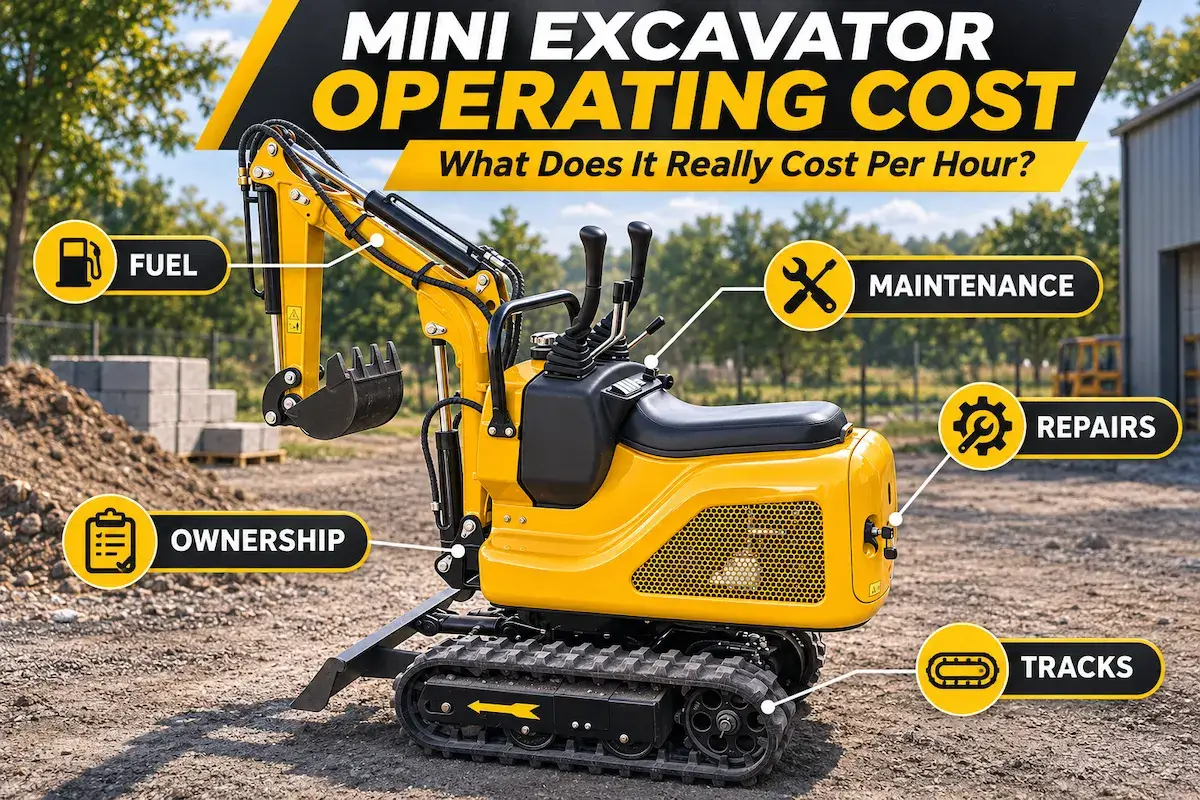
Mini excavator operating cost per hour is not one fixed number. It should be calculated from fuel, maintenance, wear, repairs and ownership costs divided by realistic machine hours. A single hourly figure copied from another market, machine class or workload will rarely describe your own machine accurately.
This guide explains how to build the calculation from your own inputs. It is written for buyers, contractors, landscapers, farm and property users, rental businesses and fleet managers who need a practical cost framework, not a universal benchmark.
Quick Answer — How Do You Calculate Mini Excavator Operating Cost per Hour?
The basic formula is:
Hourly Machine Cost = (Annual Ownership Costs + Annual Operating Costs) ÷ Annual Machine Hours
Some businesses prefer to track only direct operating costs, such as fuel and maintenance. Others include a fully burdened cost that includes depreciation, financing, insurance and storage. Both approaches can be useful, but they answer different questions and should not be compared directly.
| Cost Category | Fixed or Variable | Examples |
|---|---|---|
| Carburant | Variable | Diesel or gasoline consumed during work |
| Maintenance | Variable / semi-fixed | Oil, filters, greasing, scheduled service parts |
| Wear parts | Variable | Bucket teeth, cutting edges, pins, bushings, hoses |
| Tracks and undercarriage | Variable reserve | Rubber tracks, rollers, sprockets, idlers |
| Repair reserve | Reserve | Unexpected repairs and component replacement |
| Depreciation | Ownership | Purchase cost minus expected resale value |
| Financing / cost of capital | Ownership | Interest, finance charges or capital tied up |
| Insurance and storage | Ownership | Policy premiums, yard, security |
Operating Cost vs Ownership Cost — What Is the Difference?
Operating costs are the costs of actually using the machine. Ownership costs are the costs of having the machine available, whether it works or not.
| Operating Costs | Ownership Costs |
|---|---|
| Carburant | Depreciation |
| Lubricants | Financing or cost of capital |
| Routine maintenance | Insurance |
| Wear parts | Storage |
| Tracks / undercarriage reserve | Fixed overhead |
| Repairs | |
| Attachment wear |
Buyers often underestimate total ownership cost when they calculate only fuel and routine maintenance. Fuel matters, but it is rarely the whole picture. The initial mini excavator purchase price is only the starting point of ownership economics.
Fuel Cost per Hour
The formula is simple:
Fuel Cost per Hour = Fuel Consumption per Hour × Fuel Price
Fuel consumption depends on engine size, machine size, soil conditions, digging load, idle time, hydraulic attachment use, operator habits and engine condition. Two machines in the same class can use different amounts of fuel in the same job if the working method differs.
There is no universal liters-per-hour or gallons-per-hour figure that applies to every mini excavator. The buyer should use the fuel consumption observed on the specific machine, at the local fuel price. For a detailed explanation of how to measure and compare actual fuel use, see our mini excavator fuel consumption guide. This article focuses on how fuel cost fits into the broader hourly operating-cost calculation.
Maintenance Cost per Hour
The formula is:
Maintenance Cost per Hour = Annual Maintenance Cost ÷ Annual Machine Hours
Maintenance items may include engine oil, filters, hydraulic service, grease, routine service labour and scheduled service parts. The exact interval and specification should follow the machine and engine documentation for the specific model.
Many owners track maintenance as a simple annual budget rather than a per-hour figure. Either approach works, as long as the annual cost is divided by realistic annual hours. The mini excavator maintenance checklist explains what should be inspected and maintained, and this article treats maintenance as a cost category rather than a checklist.
Track and Undercarriage Cost
Track and undercarriage costs can be significant over the life of a machine. Relevant items include rubber tracks, rollers, sprockets, idlers, track tension and related wear components.
The reserve concept is:
Track / Undercarriage Reserve per Hour = Expected Replacement Cost ÷ Expected Service Hours
There is no universal track lifespan that applies to every machine, and no universal replacement cost that applies to every market. Travel distance, ground conditions, turning habits and track tension all affect how quickly these components wear. The buyer should base the reserve on the expected replacement cost in their own market and the expected service hours for their own conditions.
Wear Parts and Attachments
Wear parts include bucket teeth, cutting edges, pins, bushings, hoses, quick coupler wear and attachment-specific items such as auger teeth or breaker tools. Attachment-intensive work may change hourly operating cost because more wear parts are consumed per productive hour.
Wear parts costs are usually small per item but accumulate across the year. Tracking them separately from routine maintenance helps the owner see which work types consume more wear. The mini excavator attachments guide explains attachment selection and compatibility in more detail.
Repair Reserve — Why It Should Be Included
Not every repair occurs predictably. A repair reserve allows the owner to spread expected repair costs across the year rather than treating each repair as an unexpected loss.
The reserve concept is:
Repair Reserve per Hour = Annual Repair Reserve ÷ Annual Machine Hours
There is no universal repair percentage that applies to every machine. New machines, older machines, high-hour machines and severe-duty machines may have different repair-risk profiles. The reserve should be based on the owner’s own experience, the machine condition and the workload severity.
Depreciation per Hour
Depreciation is a real cost of ownership, even though it is not paid as a separate invoice. The framework is:
Depreciable Amount = Purchase Cost − Expected Resale Value
Hourly Depreciation = Depreciable Amount ÷ Expected Ownership Hours
This is a cost-planning framework, not tax or accounting advice. The correct depreciation treatment for tax purposes depends on the local tax rules and the owner’s accounting approach.
Depreciation, repair reserve and purchase cost may differ significantly between new and used machines. The New vs Used Mini Excavator guide explains those differences in more detail.
Financing and Cost of Capital
A financed machine may have interest or finance charges. A cash-purchased machine still ties up capital that could have been used elsewhere. Some businesses therefore include interest, finance charges or an internal cost-of-capital figure in the hourly calculation.
This is a management accounting choice, not tax or investment advice. The correct treatment depends on how the owner’s business manages capital.
Insurance, Storage and Fixed Costs
Insurance, yard or storage, security, compliance costs where applicable and other fixed machine-related costs continue even when the machine is not producing revenue. That is why utilization is central to the cost-per-hour calculation.
Fixed costs do not disappear when a machine sits idle. They are absorbed by the productive hours the machine actually generates.
Why Utilization Rate Changes Cost per Hour
This is one of the most commercially important points in the cost calculation. Many annual fixed ownership costs do not change directly with utilization over a given period. The fixed cost allocated to each machine hour, however, changes as annual utilization changes.
| Annual Fixed Ownership Cost | Annual Operating Hours | Fixed Cost per Hour |
|---|---|---|
| $6,000 | 300 | $20.00 |
| $6,000 | 600 | $10.00 |
| $6,000 | 1,000 | $6.00 |
Illustrative Example — Not a Universal Cost Benchmark. The figures above are round numbers used to demonstrate the mathematical relationship between fixed cost and utilization. They are not market rates and do not describe any specific machine.
Same annual fixed cost. Different annual utilization. Different fixed cost per machine hour. A machine that is used regularly spreads its fixed cost across more productive hours than a machine that is used occasionally.
Productive Hour vs Engine Hour
An engine hour is a period when the engine is running. A productive hour is a period when the machine is actively producing useful work. Idling consumes fuel and adds engine hours but may not generate equivalent useful output.
Choose one denominator and use it consistently. Engine hours can be useful when maintenance and usage records are based on the hour meter, while productive hours can help evaluate job productivity. Do not mix engine hours and productive hours within the same cost calculation. For job pricing, you can calculate machine cost on one consistent basis and separately compare that cost with productive output.
There is no universal acceptable idle percentage that applies to every machine or site.
Transport Cost — Should It Be Included?
Transport may be allocated per job, per mobilization, per workday or into the hourly machine cost. The correct approach depends on how the owner quotes work and how often the machine moves between sites.
Relevant transport items include the trailer, the truck, delivery and pickup, loading and mobilization time. The mini excavator trailer and transport requirements guide explains trailer payload and tow vehicle planning. International freight is a separate topic and should not be included in this hourly machine cost figure.
Operator Labour — Include It or Not?
Machine operating cost can be calculated separately from operator labour. For estimating a customer job, the total job cost may include machine cost, operator labour, transport, overhead and profit.
This means the customer billing rate is not the same as the machine operating cost. A contractor may charge a customer rate that includes labour, overhead and profit on top of the machine cost. The two figures serve different purposes and should not be compared directly.
A Practical Mini Excavator Cost-per-Hour Formula
A useful structure is:
Hourly Machine Cost = Fuel Cost per Hour + Maintenance Cost per Hour + Wear Cost per Hour + Repair Reserve per Hour + Track / Undercarriage Reserve per Hour + (Annual Ownership Costs ÷ Annual Machine Hours)
Annual ownership costs may include depreciation, financing or cost of capital, insurance, storage and other fixed machine-related costs. Fuel, maintenance, wear, repair reserve and track reserve are already expressed per hour, so they can be added directly. Ownership costs are annual and must be divided by annual machine hours before they are added.
Do not mix annual and hourly figures without converting them first. This is the most common mathematical error in cost-per-hour calculations.
Illustrative Example — Fictional Mini Excavator Cost Calculation
The following is an illustrative calculation using round fictional numbers. It demonstrates the method only. The figures are not ZHAOLU prices, not current market prices, and not an industry benchmark.
Illustrative Example — Not a Universal Cost Benchmark.
| Input | Illustrative Value |
|---|---|
| Purchase cost | $20,000 |
| Expected resale value after 5 years | $8,000 |
| Expected ownership period | 5 years |
| Annual operating hours | 800 |
| Fuel use per hour | 2 liters |
| Fuel price | $1.50 per liter |
| Annual maintenance | $600 |
| Annual wear parts | $400 |
| Annual track / undercarriage reserve | $400 |
| Annual repair reserve | $500 |
| Annual insurance | $300 |
| Annual storage | $200 |
Illustrative calculation:
- Depreciable amount: $20,000 − $8,000 = $12,000
- Annual depreciation: $12,000 ÷ 5 = $2,400
- Annual fixed cost: $2,400 + $300 + $200 = $2,900
- Fixed cost per hour: $2,900 ÷ 800 = $3.63
- Fuel cost per hour: 2 liters × $1.50 = $3.00
- Maintenance cost per hour: $600 ÷ 800 = $0.75
- Wear cost per hour: $400 ÷ 800 = $0.50
- Track / undercarriage reserve per hour: $400 ÷ 800 = $0.50
- Repair reserve per hour: $500 ÷ 800 = $0.63
- Illustrative hourly machine cost: $3.63 + $3.00 + $0.75 + $0.50 + $0.50 + $0.63 = $9.01
Do not use this illustrative hourly figure as a purchasing, bidding or budgeting benchmark. Replace every input with data from the actual machine and operating environment.
The point is not the final number. The point is the structure. Replace every input with the owner’s own data, and the same structure produces a meaningful hourly machine cost for the specific machine and workload.
Why a Smaller Mini Excavator Is Not Always Cheaper per Productive Hour
A smaller machine may have a lower purchase cost, may be easier to transport and may require less fuel in some applications. But if it is undersized for the job, cycle time may increase, the total job may take more hours, and the cost per completed job may rise even when the cost per machine hour looks lower.
The important distinction is between cost per machine hour and cost per completed job. A larger machine with a higher hourly cost may complete a job in fewer hours and produce a lower cost per completed job. This is one reason to choose the right mini excavator size before comparing hourly costs.
When the workload is large enough that the equipment category itself becomes part of the cost decision, buyers should also compare a mini excavator with a full-size excavator before focusing on hourly machine cost alone.
How Working Conditions Change Operating Cost
Working conditions change fuel use, wear, maintenance and productivity. Relevant conditions include rock, abrasive soil, mud, dust, slopes, breaker work, frequent travel, tight turning, high ambient temperatures and restricted access.
Each condition can affect the machine differently. Abrasive soil accelerates wear. Rock and breaker work increase vibration and structural load. Mud increases undercarriage strain and reduces productivity. This section explains the categories; it does not provide universal percentages because the effects depend on the machine, the site and the working method.
How Operator Behaviour Affects Cost
Operating practices affect cost. Excessive idling, unnecessary travel, aggressive turning, ignoring track tension, poor attachment selection and skipped inspections all tend to increase cost over time.
This is not about blaming operators. It is about identifying practices that can be adjusted to reduce wear, fuel use and downtime. Training and clear maintenance expectations are usually more effective than reacting to failures after they occur.
Mini Excavator Operating Cost for Rental Businesses
Rental operators need to know true hourly machine cost, utilization, downtime, transport, maintenance reserve and repair reserve before setting rental rates. A rental rate that does not cover these costs may produce revenue without producing profit.
Le mini excavator rental business guide covers the business model in more detail. This article focuses on the machine-level cost calculation that supports that business model.
Mini Excavator Operating Cost for Owners and Contractors
Owners and contractors can use the cost calculation for job estimates, machine replacement planning, fleet comparison, rent vs buy a mini excavator decisions, attachment decisions and maintenance budgeting.
The same calculation can also support replacement planning. When the repair reserve, downtime and maintenance cost of an older machine rise above the fixed cost of a newer machine, the economic balance may shift. This is an individual business decision based on the owner’s own numbers.
Cost Factors Buyers Should Ask About Before Purchase
- Fuel type
- Engine service parts
- Filtres
- Track availability
- Hydraulic components
- Attachment compatibility
- Warranty process
- Parts dispatch
- Local service capability
- Expected maintenance requirements
Le Guide des pièces détachées pour mini-pelles explains parts identification and availability, and the Mini Excavator Engine Guide explains engine configuration and verification. These factors affect the long-term operating cost even though they are not fuel or maintenance costs themselves.
What About the ZL-05 Operating Cost?
The ZL-05 is a 0.5 Ton Micro Excavator with an operating weight of 420 ± 20 kg, a 640 mm transport width, a Rato gasoline engine rated at 6.5 HP and a maximum system flow of 12 L/min. Typical applications include small landscaping, tree planting pits, light trenching, orchards, irrigation and property maintenance.
The ZL-05’s actual operating cost should be calculated using the buyer’s local fuel price, actual fuel consumption, maintenance records, parts costs and annual utilization. This article does not provide a ZL-05 fuel consumption figure, maintenance cost figure, track lifespan or depreciation figure, because those values depend on the buyer’s own market and workload.
Compact size may influence transport requirements, application suitability and capital tied up. It does not, by itself, prove a lower operating cost than another machine. The full configuration is listed on the Micro-pelle ZL-05 de 0,5 tonne product page.
Mini Excavator Operating Cost Calculator Template
| Input | Your Value |
|---|---|
| Purchase price | |
| Expected resale value | |
| Expected ownership years | |
| Annual operating hours | |
| Fuel use per hour | |
| Fuel price | |
| Annual maintenance | |
| Annual wear parts | |
| Annual repair reserve | |
| Annual track / undercarriage reserve | |
| Annual insurance | |
| Annual storage | |
| Annual financing cost | |
| Other annual fixed costs |
Then apply:
- Depreciable amount = Purchase price − Expected resale value
- Annual depreciation = Depreciable amount ÷ Expected ownership years
- Annual fixed cost = Annual depreciation + Insurance + Storage + Financing + Other fixed costs
- Fixed cost per hour = Annual fixed cost ÷ Annual operating hours
- Fuel cost per hour = Fuel use per hour × Fuel price
- Maintenance cost per hour = Annual maintenance ÷ Annual operating hours
- Wear cost per hour = Annual wear parts ÷ Annual operating hours
- Repair reserve per hour = Annual repair reserve ÷ Annual operating hours
- Track reserve per hour = Annual track reserve ÷ Annual operating hours
- Hourly machine cost = Fixed cost per hour + Fuel cost per hour + Maintenance cost per hour + Wear cost per hour + Repair reserve per hour + Track reserve per hour
Common Costing Mistakes
- Counting only fuel
- Ignoring depreciation
- Ignoring tracks
- Ignoring wear parts
- Ignoring downtime
- Mixing rental rate with machine cost
- Forgetting transport
- Ignoring idle hours
- Using unrealistic annual utilization
- Assuming maintenance cost never changes
- Comparing different machine sizes only by hourly cost
- Ignoring productivity per completed job
Final Answer — How Much Does a Mini Excavator Cost per Hour to Operate?
There is no single correct number. The correct answer is calculated from fuel, maintenance, wear, repairs, ownership and fixed costs, divided by realistic operating hours. Different machines, markets, workloads and utilization levels produce different hourly costs, and those numbers should not be compared without checking what is included.
For purchase decisions, compare both cost per machine hour and cost per completed job. A machine with a lower hourly cost may still produce a higher cost per completed job if it is undersized for the work. The right calculation is the one built from the owner’s own data and the actual work the machine performs.
Comparing Mini Excavator Ownership Costs?
If you are comparing mini excavator ownership costs, send ZHAOLU the intended application, expected annual hours, machine size, required attachments, destination country, access width and digging-depth requirement. ZHAOLU can help confirm the current machine configuration and the support information relevant to your own operating cost calculation.
Review the Mini-pelles à vendre page or the Micro-pelle ZL-05 de 0,5 tonne product page.
Frequently Asked Questions About Mini Excavator Operating Cost per Hour
How much does a mini excavator cost per hour to operate?
There is no universal figure. The hourly cost depends on fuel, maintenance, wear, repairs, ownership costs and utilization. The correct number must be calculated from the owner’s own data.
What is included in mini excavator operating cost?
Operating cost usually includes fuel, lubricants, routine maintenance, wear parts, tracks, repairs and attachment wear. A fully burdened cost also includes depreciation, financing, insurance and storage.
How do you calculate excavator cost per hour?
Divide annual ownership and operating costs by realistic annual machine hours. Fuel, maintenance, wear and repair reserve can be calculated per hour directly, while ownership costs are annual and must be divided before they are added.
How much fuel does a mini excavator use per hour?
Fuel use depends on the machine, engine, workload, soil and operator behaviour. There is no universal liters-per-hour figure. Use the fuel consumption observed on the specific machine in its actual working conditions.
Is fuel the biggest mini excavator operating cost?
Not necessarily. Fuel is one part of the cost. Depreciation, tracks, repairs and maintenance can be significant over the life of the machine, especially at high utilization or in severe-duty work.
How much should I budget for mini excavator maintenance?
Maintenance cost depends on the machine, hours, workload and local parts prices. Budgeting from the machine and engine service documentation and from the owner’s own maintenance history is more useful than applying a universal percentage.
How do track costs affect operating cost?
Tracks and undercarriage are wear components. Owners can allocate a track reserve by dividing the expected replacement cost by the expected service hours. Track life depends on ground conditions, travel distance, turning habits and track tension.
Should depreciation be included in hourly cost?
Depreciation is a real cost of ownership and can be included in a fully burdened hourly cost. Whether to include it depends on the purpose of the calculation. Tax treatment is separate and depends on local rules.
Does idling increase mini excavator operating cost?
Idling consumes fuel and adds engine hours without producing equivalent useful output. Reducing unnecessary idle time can lower fuel cost and reduce hours that do not contribute to job output.
Is a smaller mini excavator always cheaper to operate?
Not always. A smaller machine may use less fuel and cost less to purchase, but if it is undersized for the job it may take longer to complete the work, which can raise the cost per completed job even when the cost per machine hour looks lower.