
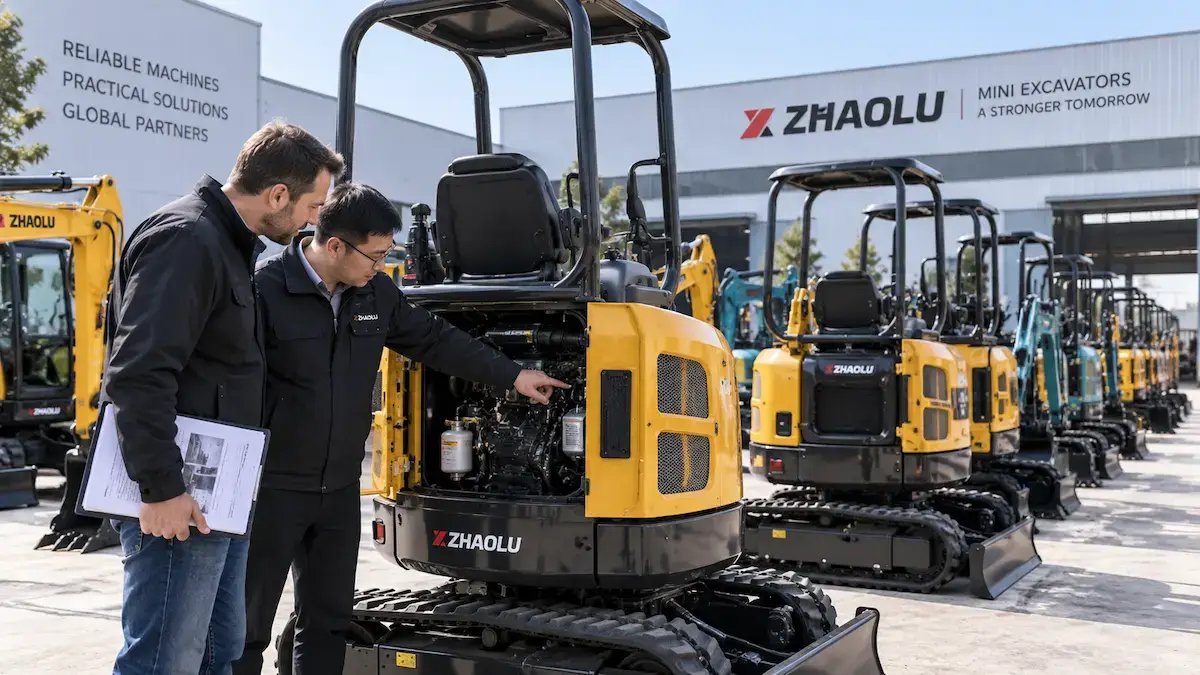
Choosing a mini excavator supplier in China for a single machine is one exercise. Choosing a supplier for a dealership, distribution business or repeat purchasing program is a different one. A dealer needs to know whether the supplier can provide accurate specifications, repeat agreed configurations, support parts identification, communicate clearly, supply shipment documentation and remain usable after the first order has been delivered.
The central question is not “who offers the lowest unit price” but “can this supplier support my business after the first machine has been sold.” This guide focuses on supplier evaluation for dealers: what to check, what evidence to request, what questions to ask and what signals suggest additional verification is needed. For the product-mix and first-order side of wholesale purchasing, refer to the Guide de vente en gros des mini-pelles.
What Should Dealers Check When Choosing a Mini Excavator Supplier in China?
Dealers evaluating a supplier should review the product range, specification transparency, configuration consistency, real machine evidence, quality-control process, quotation clarity, communication, spare-parts support, technical support, inspection arrangements, export documentation and repeat-order capability.
The evaluation should be based on evidence the supplier can actually provide, not on marketing statements. Where information cannot be confirmed, it should be treated as unverified until clarified in writing.
Start with Your Dealership Requirements
Supplier evaluation only makes sense against the dealer’s own market. Before comparing suppliers, define the business you are actually building.
Useful items to define before contacting suppliers:
- Target customer groups
- Required machine size classes
- Main applications in your market
- Pièces jointes obligatoires
- Destination country and import conditions
- Engine or emissions requirements if applicable
- Expected order pattern (single unit, small fleet, repeat stocking)
- Service and spare-parts expectations
- Documentation requirements for customs and registration
A supplier can only be evaluated properly against these requirements. A supplier that fits one dealer’s market may not fit another’s. The Guide de vente en gros des mini-pelles covers how to build a product mix and plan a first order, while this article focuses on how to evaluate the supplier behind that plan. The Guide des tailles des mini-pelles can help clarify size class selection.
Check Whether the Product Range Matches Your Market
A large catalog does not automatically mean a better supplier. What matters is whether the available models match the applications your customers actually have.
Dealers should evaluate:
- Whether relevant size classes are available
- Whether specifications are clearly stated
- Whether model differences are understandable
- Whether configurations fit local applications
- Whether future product expansion is practical
ZHAOLU currently lists mini excavators approximately from 0.5 ton to 2.5 ton. Not every dealer needs every model. A narrow, well-defined range that matches local demand is usually easier to support and easier to repeat than a broad catalog with unclear boundaries. The current range can be reviewed on the Catégorie de produits : mini-pelles page.
Evaluate Specification Transparency
Specification transparency is one of the clearest indicators of how a supplier operates. A dealer needs to know exactly what machine is being quoted, not just the model name.
Important parameters to request include:
- Poids en ordre de marche
- Overall dimensions
- Digging depth and digging radius
- Modèle du moteur et puissance nominale
- Configuration hydraulique
- Auxiliary hydraulics (if applicable)
- Bucket configuration
- Track dimensions
- Attachment mounting information
Dealers should be cautious when:
- Model names are used instead of actual specifications
- Different sales documents contain conflicting figures
- Engine information is vague or changes between messages
- Attachment compatibility is assumed rather than confirmed
Le Guide des caractéristiques techniques des mini-pelles explique comment lire une fiche technique, et la Guide du système hydraulique des mini-pelles explains hydraulic and auxiliary hydraulic details that matter for attachment planning.
Can the Supplier Repeat the Same Configuration?
Repeatability is one of the most important supplier evaluation criteria for a dealer. A dealer may need future machines to match earlier units in areas such as:
- Configuration du moteur
- Hydraulic setup
- Filtres
- Electrical components
- Bucket mounting
- Couplers
- Hoses and fittings
- Commandes
- Service components
If configurations change without explanation between orders, the consequences for a dealer can include:
- Parts complexity across the fleet
- Service confusion for technicians
- Customer complaints about inconsistent machines
- Training differences between units
- Documentation errors
Dealers should ask the supplier directly how configurations are documented, how repeat orders reference earlier machines, and how any production changes are communicated. This is something buyers should verify, not assume.
Request Real Product Evidence
Catalog photos alone are not enough to evaluate a supplier. Dealers can request evidence that corresponds to the machine or configuration being discussed.
Useful evidence items include:
- Current machine photos from multiple angles
- Walk-around video
- Engine identification or nameplate
- Operator controls
- Hydraulic lines and connections
- Pièces jointes
- Startup video
- Travel test video
- Boom and bucket operation
- Photos de l'emballage
- Chargement des photos
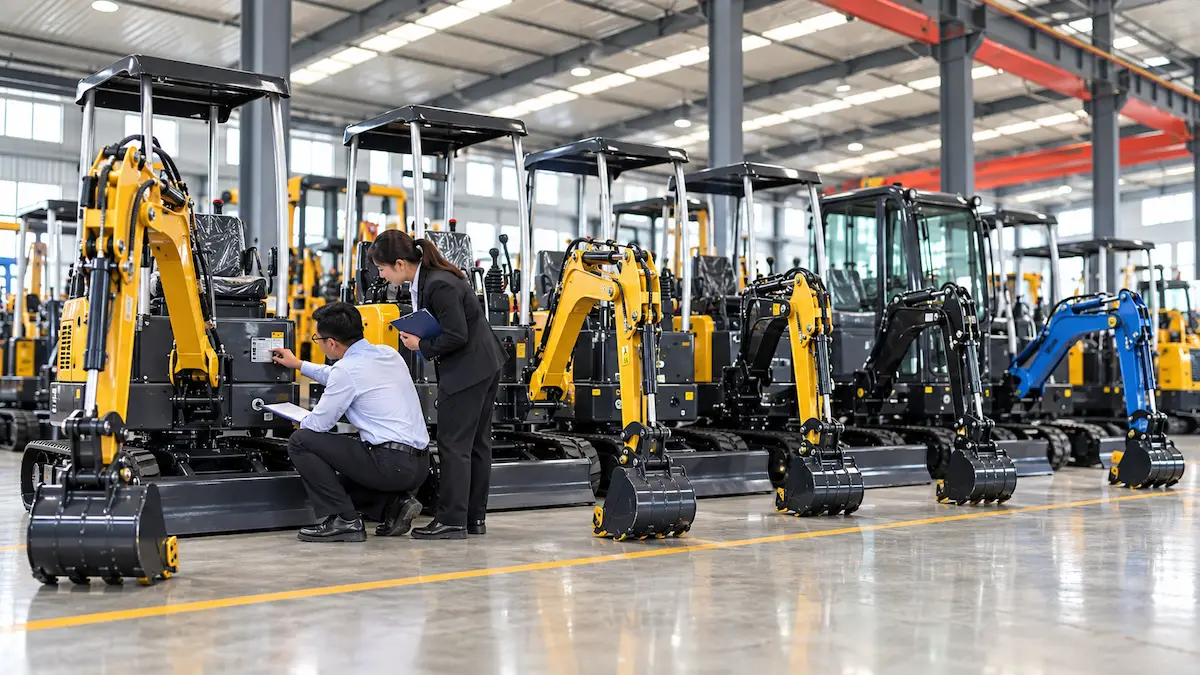
Not every supplier provides every item automatically. The point is whether the supplier can produce evidence when asked, and whether that evidence matches the configuration being quoted.
Ask How Quality Control Is Performed
There is a difference between marketing claims about quality and a QC process the supplier can actually explain. Dealers should ask what is checked before shipment and how that is documented.
Questions can include:
- What is checked before shipment?
- Is the engine started and tested?
- Are travel and swing functions checked?
- Are hydraulic leaks checked?
- Are attachment functions checked?
- Are bolts, hoses and fittings inspected?
- Are machine identification details verified?
- Est-il possible de fournir des photos ou des vidéos de l'inspection ?
Le Liste de contrôle pour l'inspection en usine des mini-pelles provides a structured checklist that dealers can use for both supplier evaluation and first-order inspection.
Evaluate Communication Before You Evaluate the Price
Clear communication is often underrated in supplier evaluation, but for a dealer it is directly tied to operational risk. A supplier that cannot clearly confirm what is included in an order is difficult to work with over time.
Useful communication indicators include:
- Clear answers to technical and commercial questions
- Written confirmation of configuration
- Consistent terminology across documents
- Timely clarification when something changes
- Quotation version control
- Confirmation of agreed options
Potential warning signs include vague answers, changing specifications, unclear inclusions, different answers from different contacts, or pressure to pay before details are confirmed. None of these alone proves a problem, but they justify additional verification.
Compare Quotations on the Same Basis
A transparent quotation is easier to evaluate than a one-line unit price. Dealers should compare quotations on the same basis so that the actual differences are visible.
Items to compare:
- Modèle exact
- Configuration du moteur
- Équipement de série
- Équipements en option
- Pièces jointes
- Quantité
- Incoterm
- Emballage
- Pièces de rechange
- Documentation
- Étendue de la garantie
- Validité du devis

A supplier who clearly states these items is easier to compare with others than a supplier who only provides a headline number. The Guide pour obtenir un devis pour une mini-pelle explains how to prepare an RFQ, and the Guide des prix des mini-pelles explique comment interpréter les cours indiqués en fonction du contexte.
Check Spare Parts Support Before the First Order
Spare parts support is one of the strongest indicators of whether a supplier is set up for dealer relationships rather than one-off sales. A dealer needs to support customers after resale, and parts identification should be predictable.
Questions to ask a supplier:
- How are spare parts identified?
- Les références sont-elles disponibles ?
- What machine identification is required for parts requests?
- Which common service parts should dealers consider stocking?
- Can parts be included with an order?
- How are replacement parts shipped?
- How are model-specific parts identified?
Le Guide des pièces détachées pour mini-pelles explains parts categories and the information needed for accurate parts identification.
Evaluate Technical and After-Sales Support
Dealer support is different from consumer support. A dealer may need help with parts identification, technical questions, hydraulic configuration, attachment compatibility, troubleshooting information and documentation.
Supplier evaluation questions may include:
- Who handles technical questions?
- What information should the dealer provide when requesting support?
- Are manuals or parts diagrams available?
- How are warranty claims handled?
- How are replacement parts arranged?
These are questions for the supplier. The answers vary, and dealers should confirm them before ordering rather than assuming a support model that has not been agreed.
Confirm Export and Shipping Documentation
Export coordination is part of supplier evaluation. Dealers should confirm what documentation the supplier can provide and how it relates to the destination market.
Documents to confirm may include:
- Commercial invoice
- Packing list
- Bill of lading arrangements
- Machine identification information
- User manual
- Destination-specific documents where applicable
Requirements depend on the destination country and the shipment terms. The Expédition de mini-pelles depuis la Chine guide covers Incoterms, container loading and shipping cost components. Dealers should also confirm requirements with their customs broker.
Ask About Inspection Before Shipment
The first order deserves additional verification. Dealers can use a combination of methods depending on the order value and destination:
- Supplier inspection with photo and video evidence
- Buyer inspection if travel is possible
- Live video call during machine testing
- Inspection par un organisme tiers, le cas échéant
The purpose is not to replace engineering verification, but to confirm that the machine being shipped matches the agreed configuration. The Liste de contrôle pour l'inspection en usine des mini-pelles provides a structured approach.
Look Beyond the First Order
A supplier relationship should become easier with repeat orders, not more confusing. This is one of the clearest ways to distinguish a supplier that is set up for dealer business from one that only handles one-off sales.
Useful questions for the supplier:
- Can previous configurations be identified?
- Can future orders reference earlier machines?
- Can spare parts be matched accurately to delivered units?
- Can specifications remain documented over time?
- Can changes between production batches be communicated in advance?
- Can repeat quotations clearly identify what has changed?
Dealers should evaluate how the supplier answers these questions, not just whether the answer is “yes.” A useful supplier can explain how the process works in practice.
Red Flags When Evaluating a Mini Excavator Supplier
Several patterns justify additional verification. None of these automatically proves a problem, but each should prompt a clear written clarification.
- Specifications change without explanation
- Engine model is not clearly identified
- Product photos do not match the quoted configuration
- Quotation scope is unclear
- Supplier avoids written confirmation
- Attachment compatibility is assumed rather than confirmed
- No clear spare-parts identification process
- Documents are discussed only after payment
- Shipping scope is unclear
- Pressure to decide before key details are confirmed
Dealers should treat these as reasons to ask more questions, not as automatic disqualifications. The supplier’s response to the question is often more informative than the original issue.
Supplier Evaluation Checklist for Dealers
The following table can be used to structure supplier evaluation. It is not a scoring system. It is a way to make sure that important items are confirmed rather than assumed.
| Evaluation Area | What to Check | Evidence to Request | Statut |
|---|---|---|---|
| Product range | Relevant size classes available | Current model list and specifications | Pour confirmer |
| Specifications | Clear technical data | Specification sheet for quoted model | Pour confirmer |
| Moteur | Modèle et identification | Engine label or documentation | Pour confirmer |
| Hydraulique | Configuration du système et des composants auxiliaires | Hydraulic configuration details | Pour confirmer |
| Configuration consistency | Repeat orders can match earlier units | Written configuration record | Pour confirmer |
| Pièces jointes | Mounting and hydraulic compatibility | Attachment specification | Pour confirmer |
| Quality control | Pre-shipment checks explained | Inspection record or process description | Pour confirmer |
| Quotation | Clear scope and inclusions | Written quotation with terms | Pour confirmer |
| Pièces de rechange | Identification process and availability | Parts diagram or identification method | Pour confirmer |
| After-sales | Technical support process | Contact and process description | Pour confirmer |
| Documentation | Export documents provided | Document list for the shipment | Pour confirmer |
| Inspection | Modalités d'inspection avant expédition | Photo, video or inspection record | Pour confirmer |
| Livraison | Incoterm and loading plan | Packing and loading information | Pour confirmer |
| Repeat-order support | How future orders reference earlier ones | Written explanation of process | Pour confirmer |
Questions to Ask Before Choosing a Supplier
The following questions are useful when comparing suppliers for a dealer or distribution relationship. They are questions, not standard answers, because the correct response depends on the supplier.
- Can you provide the exact specification for the quoted model?
- Which engine configuration is included?
- What changes between different configurations?
- How do you identify spare parts?
- Can you provide current machine photos or videos?
- Quels contrôles sont effectués avant l'expédition ?
- Qu'est-ce qui est inclus dans le devis ?
- Quels sont les Incoterms disponibles ?
- What documents are supplied?
- How are attachments confirmed for compatibility?
- How are technical questions handled?
- Can future orders reference the same configuration?
- What information is required for a repeat order?
- Est-il possible d'organiser un contrôle par un organisme tiers si nécessaire ?
How ZHAOLU Fits into a Dealer’s Supplier Evaluation
ZHAOLU offers a mini excavator range approximately from 0.5 ton to 2.5 ton. Dealers can review the current product range, individual model pages and commercial supplier information using the same checklist described in this article.
Idées pour commencer :
- Découvrez les modèles disponibles sur le Catégorie de produits : mini-pelles page.
- Review the commercial supplier page for an overview of the range and purchasing support: Fournisseur de mini-pelles.
- Prepare the required model, quantity, attachments, destination and target market.
- Demandez un devis sur la base de la configuration validée.
Dealers evaluating any supplier, including ZHAOLU, should apply the same checklist: confirm specifications, confirm configuration, discuss spare-parts and support requirements, and request a quotation based on the destination market and intended order.
Evaluating a Mini Excavator Supplier for Your Dealership?
If you are comparing mini excavator suppliers for dealership, distribution, rental or resale, send your target market, required machine sizes, quantity, attachments and destination. ZHAOLU can review the requirements and provide information based on the confirmed configuration.
Frequently Asked Questions About Choosing a Mini Excavator Supplier in China
How do I choose a mini excavator supplier in China?
Start by defining your dealership requirements, then evaluate suppliers against those requirements. Check product range, specification transparency, configuration consistency, real product evidence, quality-control process, communication, spare-parts support, documentation and repeat-order capability. Base the decision on evidence rather than marketing statements.
What should a mini excavator dealer ask a supplier?
Dealers should ask for exact specifications, engine configuration, hydraulic details, attachment compatibility, quotation scope, spare-parts identification, technical support process, documentation, inspection arrangements and how repeat orders reference earlier configurations.
How can I verify mini excavator specifications before ordering?
Request a specification sheet for the exact quoted model, confirm the engine identification, and cross-check the figures across documents. If any specification is unclear or inconsistent, ask for written clarification before proceeding.
Why is configuration consistency important for dealers?
Consistent configurations simplify training, service and spare-parts management across the fleet. If configurations change without explanation between orders, dealers can face parts complexity, service confusion and customer complaints.
Should I inspect mini excavators before shipment?
Une inspection avant expédition est utile, en particulier pour une première commande. Elle peut inclure une inspection effectuée par le fournisseur, accompagnée de preuves photographiques et vidéo, une inspection par l'acheteur, des appels vidéo en direct ou, le cas échéant, une inspection par un tiers. L'objectif est de vérifier que la machine correspond bien à la configuration convenue.
What spare-parts support should a dealer ask for?
Dealers should confirm how parts are identified, whether part numbers are available, what machine identification is required, which common service parts to stock, how replacement parts are shipped, and how model-specific parts are identified.
How should I compare different mini excavator suppliers?
Compare suppliers on the same basis: product range, specification transparency, configuration consistency, quotation clarity, spare-parts support, documentation, inspection arrangements and repeat-order process. A transparent supplier is easier to compare than one that only provides a headline price.
Should I choose the lowest-priced mini excavator supplier?
Unit price alone is not enough for a dealer decision. Factors such as configuration accuracy, spare-parts support, documentation, repeat-order reliability and communication all affect the total cost of working with a supplier over time.