
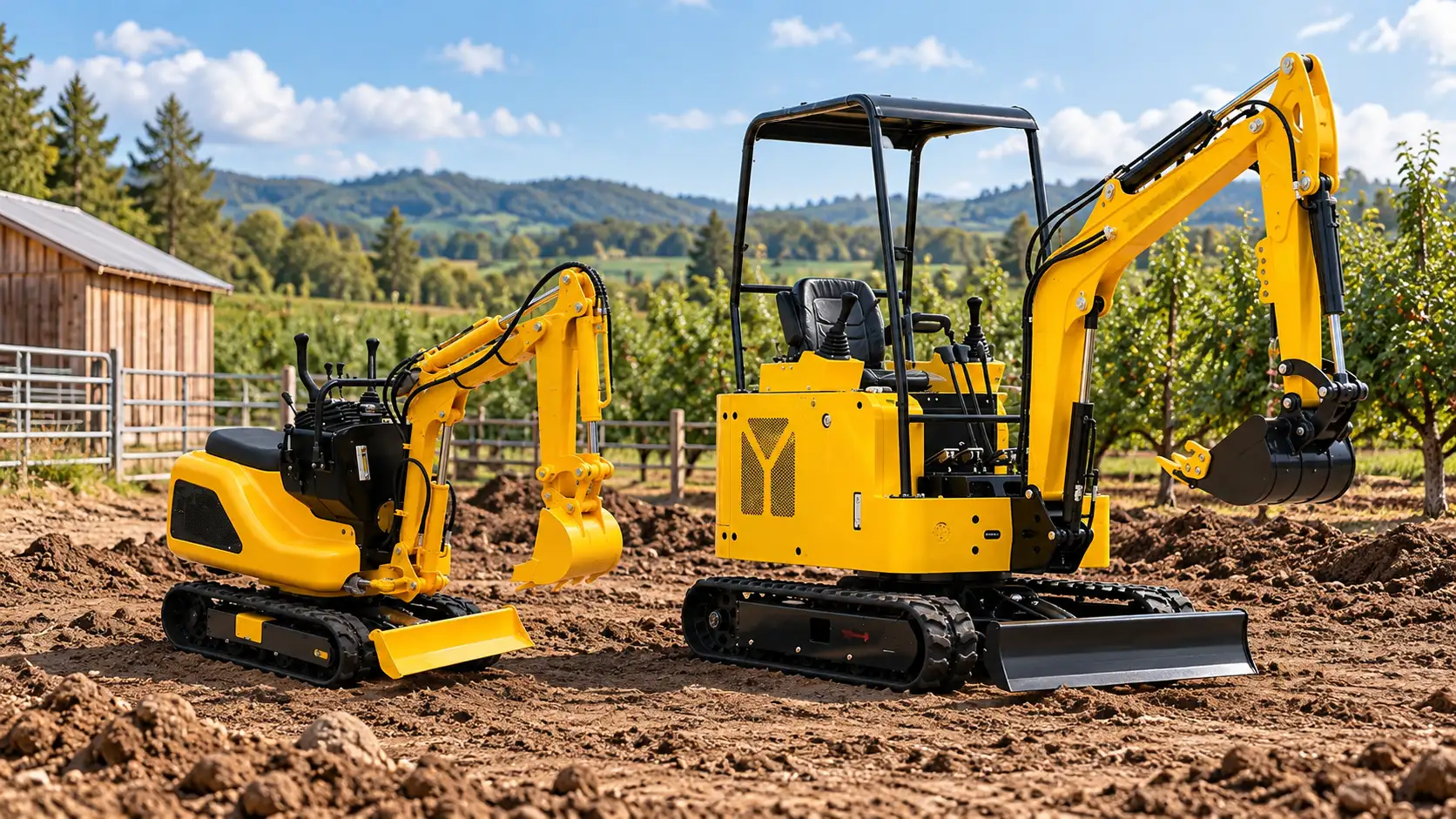
Choosing a mini excavator for farm use usually goes wrong when the buyer starts with tonnage or price and only then tries to match the machine to the work. A farm machine should be selected around the jobs that repeat most often, the access routes the machine has to use, the digging depth the work regularly requires, and the attachments the property actually needs.
This guide is written for farm owners, property managers and buyers sourcing a compact machine for repeated farm, orchard and property-maintenance work. It uses real ZHAOLU model data as a reference while keeping the buying logic applicable to any buyer comparing small excavators for this type of work.
Quick Answer: What Size Mini Excavator Is Best for Farm Use?
There is no universal best size. A compact micro excavator may deserve consideration where access, storage and lighter excavation dominate. A larger class may be justified when regular work requires more digging depth, working radius or digging capability.
As real ZHAOLU references, the ZL-05 lists a 640 mm transport width, 912 mm maximum digging depth and 1962 mm maximum digging radius, while the ZL-17 lists 1940 mm maximum digging depth and 3380 mm maximum digging radius. These are model-specific values, not universal class specifications.
Start With the Farm Jobs You Actually Repeat
The machine should be selected primarily around recurring work rather than an occasional maximum-demand task. At the same time, buyers should consider whether the regular workload may exceed the capability of the smallest machine being evaluated.
Farm and property work categories that may need to be considered include:
- Drainage-related excavation
- Irrigation-related excavation
- Fence or post preparation
- Ditch maintenance
- Planting preparation
- Orchard and property maintenance
- General soil excavation
- Small property improvement work
These are categories, not recommendations. The correct machine depends on the actual depth, reach, access and attachment requirements of the specific work. Buyers should list the jobs performed most often, the deepest regular job, the tightest access, the required working radius, the attachments needed and how frequently the machine will be used.
Farm Gates, Orchard Rows and Property Access Can Limit Machine Size
Access often determines the machine class before digging capability becomes relevant. Farm properties commonly include gates, narrow lanes, orchard rows, fences, buildings and limited turning space. A machine that cannot reach the work area is not useful regardless of its specifications.
As one real reference, the ZL-05 has a transport width of 640 mm and a transport height of 1101 mm with the handle removed. Those figures are useful when evaluating tight entry conditions. However, a machine with a 640 mm transport width should not be assumed to fit through a 640 mm opening. Practical clearance is required for alignment, surface irregularities, operator control and machine movement.
Buyers should measure the full access route rather than only the gate, including corners, side passages and overhead obstacles. The Mini Excavator Width Guide explains what dimensions to confirm before selecting a machine for a restricted site.
How Much Digging Depth Does Your Farm Work Require?
Buyers should define two figures: the typical excavation depth required on most jobs, and the deepest depth the machine will regularly need to reach. Selecting only for the average case can leave the machine short on regular deeper work.
As real ZHAOLU references, the ZL-05 lists a maximum digging depth of 912 mm, while the ZL-17 lists 1940 mm. These values are model-specific and should not be converted into universal rules for any specific farm task. A buyer should not assume that a particular depth automatically matches a particular job without comparing the actual requirement.
Maximum digging depth is a capability reference, not an ideal routine working target. Buyers should avoid selecting a machine whose listed maximum only barely matches the required depth. The Mini Excavator Digging Depth Guide explains how to match required excavation depth to machine capability.
Working Radius Matters Across Larger Properties
Maximum digging radius is another useful reference when the machine cannot stand immediately beside the work area. A machine may reach the required depth at its own position, but the site layout may also require enough horizontal reach to work from where the machine can actually stand.
As real ZHAOLU references, the ZL-05 lists a maximum digging radius of 1962 mm, while the ZL-17 lists 3380 mm. A larger radius can reduce repositioning on some specific jobs, depending on the layout. It does not automatically mean higher productivity in general.
0.5 Ton vs 1.2 Ton for Farm Work: A Real Buying Reference
The table below uses the ZL-05 and ZL-17 as real reference machines. Values are model-specific and should not be generalised to every machine in either class.
| Decision Factor | ZL-05 | ZL-17 | Farm Buying Implication |
|---|---|---|---|
| Product class | Micro-pelle de 0,5 tonne | Mini-pelle de 1,2 tonne | Different working envelope and access profile |
| Transport width | 640 mm | Confirm model-specific dimensions | Check farm and property access separately from working capability |
| Maximum digging depth | 912 mm | 1 940 mm | Compare against the deepest regular excavation requirement |
| Maximum digging radius | 1 962 mm | 3 380 mm | Compare against required reach from the actual machine position |
| Engine reference | Runtong | Laidong 385 | Evaluate as part of the complete machine configuration |
| Engine power | 6,5 HP | 18 kW | Evaluate together with hydraulic setup and intended work |
| Reference FOB price | EUR 2,350–2,550 FOB Qingdao | 3 280 à 3 580 euros FOB Qingdao | Compare additional cost against capability that will be used regularly |
Both price references were confirmed in September 2026 and cover the base machine with a standard bucket. Additional attachments are not included.
When Should You Consider the ZL-05 for Farm or Property Work?
The ZL-05 may deserve evaluation when restricted access is a major constraint and the required excavation remains within the machine’s confirmed capability. Its 640 mm transport width and 1101 mm transport height with the handle removed make it relevant for tight access conditions, while its 912 mm maximum digging depth and 1962 mm maximum digging radius provide real reference points for comparing the machine with the required work.
It may also be worth evaluating for relatively light work in smaller areas where restricted access and compact machine dimensions are important. These are conditional considerations, not universal recommendations. The Micro-pelle ZL-05 de 0,5 tonne product page lists the current configuration, and the Guide d'achat d'une mini-pelle de 0,5 tonne covers the class decision in more detail.
When Should You Consider the ZL-17 for Farm Work?
The ZL-17 may deserve evaluation when the smaller machine repeatedly approaches or falls short of required depth, radius or digging capability. It lists a maximum digging depth of 1940 mm, a maximum digging radius of 3380 mm, a bucket digging force of 11 kN and an 18 kW engine.
Moving to this class is not automatically more productive. Digging force is one factor among several, and soil conditions, bucket choice, machine setup and operator technique also affect real working capability. The additional capability should solve a regular farm requirement rather than simply being higher on paper. The Mini-pelle ZL-17 de 1,2 tonne product page lists the current configuration, and the 1.2 Ton Mini Excavator Buying Guide covers the class decision in more detail.
Which Attachments Should a Farm Buyer Consider?
Farm buyers may evaluate different attachment categories depending on the work, such as different bucket types, an auger or a breaker. Attachment selection should not be assumed from the machine class alone. Every attachment should be confirmed against the machine’s mounting configuration, hydraulic requirements, attachment size and mass, machine capability and the intended application.
A machine may be physically compatible with an attachment but still not suitable for the attachment’s hydraulic or operating requirements. The Guide des accessoires pour mini-pelles explains how to check mounting and hydraulic compatibility before ordering.
Does Paying More for the Larger Machine Make Sense?
ZHAOLU reference prices for the two classes are:
- ZL-05: EUR 2,350–2,550 FOB Qingdao
- ZL-17: 3 280 à 3 580 euros FOB Qingdao
Both references were confirmed in September 2026 and cover the base machine with a standard bucket. Additional attachments are not included. These are reference ranges, not fixed prices, delivered prices, DDP prices or guaranteed future prices.
Rather than asking only which machine is cheaper, farm buyers should ask:
- Will the extra digging depth be used regularly on real farm jobs?
- Will the additional working radius solve recurring layout constraints?
- Can the larger machine access the property and the working areas?
- Will its additional capability reduce limitations in normal work?
- Does the quotation include the configuration the property actually needs?
For a broader explanation of how configuration and commercial terms affect price, refer to the Guide des prix des mini-pelles.
Farm Mini Excavator Buying Checklist
| Farm Buying Question | Éléments à vérifier | Pourquoi est-ce important ? |
|---|---|---|
| Regular farm jobs | The main work categories the machine will handle | Defines the working envelope the machine needs |
| Deepest regular excavation | The deepest depth the machine will regularly need to reach | Prevents selecting only for the average case |
| Required working radius | Horizontal reach needed from where the machine can stand | Depth alone does not confirm the job can be completed |
| Narrowest access | The tightest gate, lane or opening on the access route | Access can eliminate a machine regardless of capability |
| Overhead clearance | Height along the access route and in storage | Affects whether the machine can reach and be stored on site |
| Working space | Available space once the machine has entered the work area | Affects positioning and safe operation |
| Ground / site conditions | Soil type, compaction and expected resistance | Affects how effectively the machine works in practice |
| Pièces jointes | Bucket, auger, breaker or other requirements | May affect configuration and hydraulic setup |
| Frequency of use | How often the machine will be used across the year | Helps determine how much capability and versatility will actually be used |
| Transport / storage | How the machine will be moved and stored on the property | Affects practical machine selection |
| Exact machine configuration | Model, engine and setup being quoted | Configuration affects both capability and price |
| Portée du devis | Éléments inclus vs éléments en option | Empêche la comparaison entre différentes configurations |
| Base de prix | Périmètre et configuration de référence | Permet une comparaison équitable entre les fournisseurs |
What Should You Tell the Supplier Before Requesting a Quote?
To receive a useful recommendation, farm buyers should provide:
- Country and destination
- Farm or property type
- Regular applications
- Typical digging depth
- Deepest regular digging requirement
- Access limitations
- Working-space limitations
- Attachments needed
- Quantité
- Preferred commercial term if known
- Contact information
“I need an excavator for my farm” is not enough information for an accurate machine recommendation. The Guide pour obtenir un devis pour une mini-pelle explains how to prepare an RFQ that a supplier can answer with a useful quotation.
How to Choose a Mini Excavator for Farm Use
- List the farm or property work that is performed regularly
- Measure access, including the narrowest point on the route
- Define typical and deepest regular excavation requirements
- Check the required working radius and available working space
- Confirm attachment requirements and compatibility
- Compare machine capability against the regular work, not the maximum figures alone
- Compare exact quotation configuration and price on the same basis
This sequence treats machine selection as a job-based decision rather than a tonnage-based one. It also keeps access and capability in the same comparison instead of evaluating them separately.
Find the Right Mini Excavator for Your Farm or Property
Send your regular jobs, required digging depth, site access conditions, attachment requirements and destination. ZHAOLU can review the requirements and recommend an appropriate machine class based on the confirmed configuration.
Les modèles actuels peuvent être consultés sur le Mini-pelles à vendre page.
Frequently Asked Questions About Mini Excavators for Farm Use
What size mini excavator is best for farm use?
There is no universal best size. The decision depends on the regular jobs, property access, required digging depth, working radius, attachments and site conditions. A smaller machine may suit restricted access and lighter work, while a larger class may be justified when regular jobs require more capability.
Is a 0.5 ton mini excavator useful for farm work?
It can be, depending on the work. As one real reference, the ZL-05 has a 640 mm transport width, a 912 mm maximum digging depth and a 1962 mm maximum digging radius. Buyers should compare these values against their actual access and excavation requirements rather than assuming the class fits automatically.
When should I consider a 1.2 ton mini excavator for farm work?
A 1.2 ton machine may deserve evaluation when the smaller class repeatedly approaches or falls short of required digging depth, working radius or digging capability. As one real reference, the ZL-17 lists 1940 mm maximum digging depth, 3380 mm maximum digging radius and 11 kN bucket digging force.
What should I measure before buying a mini excavator for a farm?
Measure the narrowest point on the access route, overhead clearance, the working space at the site, and the typical and deepest regular excavation depth. Also confirm the working radius needed from where the machine can actually stand.
What information should I send when requesting a farm excavator quote?
Provide the regular jobs, typical and deepest digging requirements, access limitations, required attachments, destination and quantity. This allows the supplier to recommend a suitable class and prepare a quotation based on the confirmed configuration.