
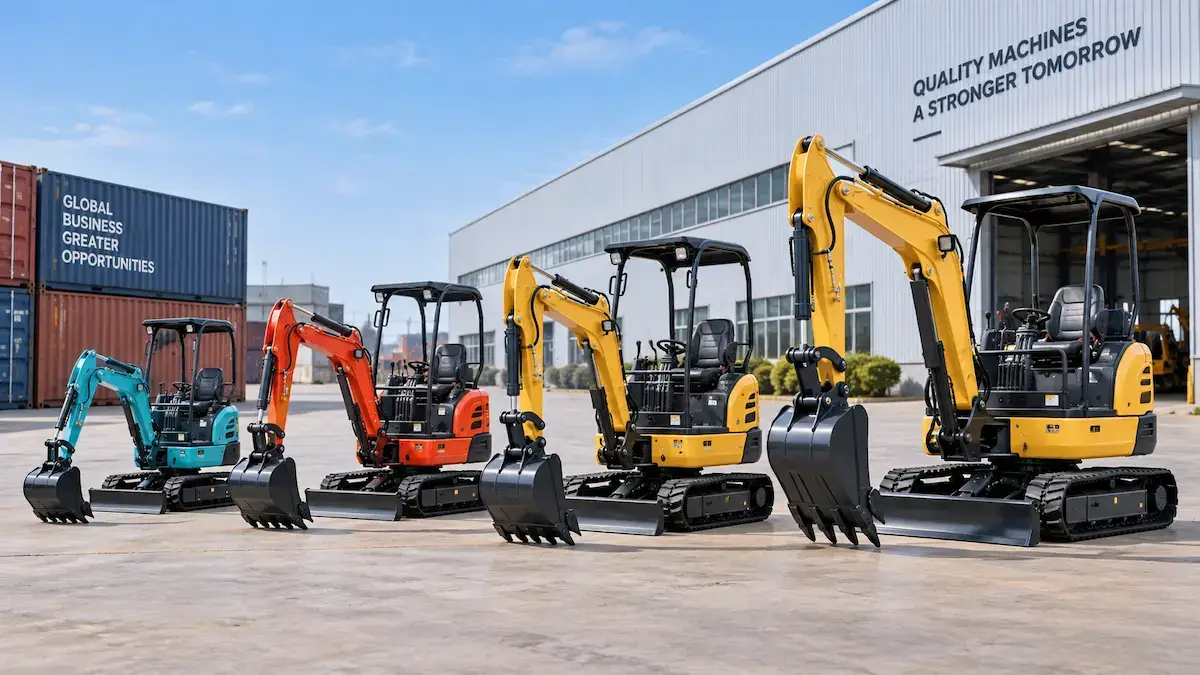
Mini excavator wholesale purchasing is a different exercise from buying one machine for a specific job. A dealer, distributor or importer has to think about what local customers will actually buy, which configurations can be repeated, how spare parts will be supported, how shipping can be consolidated, and how the first order will inform a second. The unit price is only one part of the decision.
This guide is written for dealers, distributors, rental fleet operators and importers evaluating mini excavator wholesale sourcing from China. It focuses on the commercial and operational decisions that matter for resale: product mix, configuration consistency, quotation comparison, shipping efficiency, documentation and after-sales planning. For the general purchasing process, refer to Comment acheter une mini-pelle en Chine.
What Should Dealers Check When Buying Mini Excavators Wholesale?
Dealers sourcing from China should confirm the target customer profile, machine size mix, engine and specification, attachment strategy, quotation scope, shipping arrangement, documentation, spare-parts plan, after-sales process and inspection requirements before committing to a larger order.
A first or sample order can help verify machine quality, configuration, communication and parts identification before scaling. The correct mix depends on local demand, not on stocking every available model.
Wholesale Purchasing Is Different from Buying One Machine
A single end-user purchase usually focuses on one application, one site and one budget. A wholesale or dealer purchase has to cover multiple customers, repeatability and long-term support.
The main differences are:
- Inventory decisions — Which models and configurations are worth stocking, and which should be ordered on demand.
- Multiple customer types — Landscapers, contractors, rental companies and farm operators may all need different machines.
- Repeatability — A configuration that works for one customer should be repeatable for the next order.
- Facilité d'entretien — Machines must be maintainable with locally available or easily sourced parts.
- Disponibilité des pièces — A dealer cannot afford long downtime for a customer’s machine.
- Configuration consistency — Standardized configurations simplify training, service and spare-parts stocking.
- Commercial documentation — Invoices, packing lists, manuals and identification records need to be consistent across orders.
These points affect the choice of supplier as much as the choice of machine. A supplier that can only provide a one-off machine quotation may not be the right partner for a dealer planning repeat orders.
Define Your Local Customer Before Choosing Models
Model selection should start with the local customer base, not with the supplier catalog. A dealer who understands local demand can narrow the required size classes quickly and avoid overstocking models that will not move.
Common customer groups and their typical needs:
- Paysagistes — Small machines for garden work, light trenching and material handling.
- Small contractors — Sub-1-ton to 1.4-ton machines for residential and light construction work.
- Farm operators — Machines for drainage, fencing, planting and general farm maintenance.
- Property maintenance businesses — Compact machines for narrow-access and finish work.
- Sociétés de location — Machines that are easy to operate, easy to service and suitable for a wide range of users.
- Residential contractors — Machines that fit through gates and can work in confined spaces.
Le Guide des tailles des mini-pelles explains how operating weight, dimensions and digging capability relate to these applications.
How Dealers Can Build a Mini Excavator Product Mix
ZHAOLU supplies mini excavators approximately from 0.5 ton to 2.5 ton. Within that range, different machine classes serve different customer needs. The correct mix for a dealer depends on local demand, not on stocking every size.
| Classe de machine | Typical Buyer Type | Utilisation type | Dealer Question to Ask |
|---|---|---|---|
| 0.5 ton | Landscapers, property maintenance | Narrow access, light excavation, garden work | Is there local demand for micro machines? |
| 0.7–0.9 ton | Small contractors, residential work | Light trenching, landscaping, small construction | Which sub-1-ton size fits most local jobs? |
| 1.2–1.4 ton | General contractors, utility work | Broader contractor use, small construction, drainage | Is this the volume size class locally? |
| 2.3–2.5 ton | Contractors, rental fleets | Heavier excavation, larger attachments | Do local customers need the extra capability? |
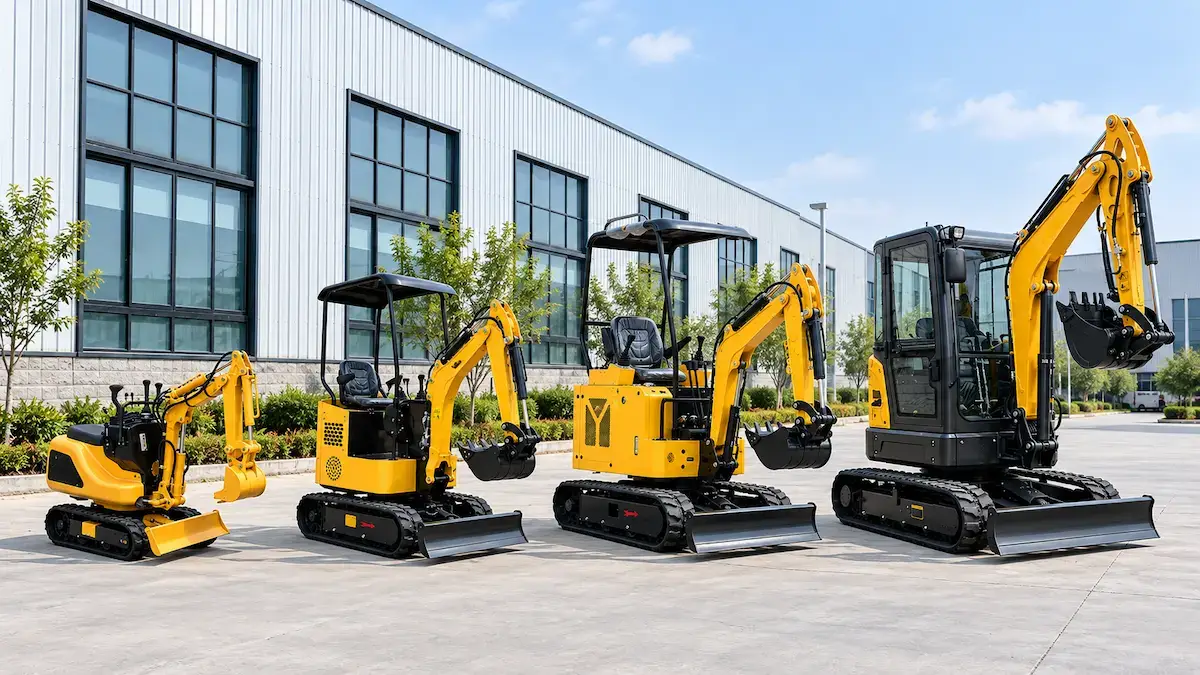
Dealers should not assume that a broader size range automatically produces better sales. A narrow, well-chosen mix that matches local demand is usually easier to support and easier to repeat. The full range can be reviewed on the Catégorie de produits : mini-pelles page.
Should a New Dealer Start with a Sample Order?
Dealers entering a new supplier relationship often consider starting with a smaller first order before committing to a larger repeat order. This approach can reduce risk while still providing real information about the supplier and the machine.
A first order can help verify:
- Qualité et finition réelles de la machine
- Configuration accuracy against the quotation
- Customer response to the machine
- Transport and packaging condition on arrival
- Documentation completeness
- Parts identification and manual availability
- Supplier communication and response to questions
- After-sales process in practice
Dealers should ask the supplier whether a sample or smaller initial order is available, since minimum order requirements vary. A smaller first order may have different freight economics compared with a larger shipment, so the total cost should be evaluated, not just the unit price.
What Should Be Standardized Across Dealer Inventory?
Configuration consistency is one of the most practical advantages a dealer can build into a wholesale program. Standardizing certain items across the fleet simplifies training, service and spare-parts management.
Areas that dealers commonly consider standardizing:
- Configuration du moteur
- Configuration hydraulique
- Bucket mounting and quick coupler system
- Hose connections and fittings
- Filter part numbers
- Common service parts
- Electrical components and controls
- Attachment interface
Standardization benefits:
- Simpler operator training across models
- Simpler spare-parts stocking
- Easier service and troubleshooting
- Clearer customer communication about what is included
Not every configuration can be fully standardized, especially when different size classes require different components. Dealers should confirm with the supplier which items can be kept consistent and which must vary by model.
Engine and Emissions Requirements for Resale Markets
Dealers must consider the destination-market requirements for the machines they intend to resell. Engine and emissions rules vary by country and, in some cases, by region within a country.
Éléments à vérifier :
- Engine identification on the machine
- Applicable emissions rules for the destination market
- Local parts availability and service network for the engine
- Customer expectations around engine brand and support
- Documentation required for import or registration
Do not assume that a configuration that works in one market is suitable for another. Dealers should confirm the exact engine configuration and any applicable requirements with the supplier before ordering. The Guide des caractéristiques techniques des mini-pelles explains how engine and other specifications are described on a specification sheet.
Attachments — Sell What Your Customers Actually Need
Attachments can add value to a dealer’s offering, but they also add inventory complexity. Offering every possible attachment across every machine size can create stock problems without matching real customer demand.
Common attachments in dealer programs:
- Different bucket types
- Marteau hydraulique
- Tarière
- Ripper
- Grappin
- Quick coupler
Dealers should focus on the attachments that local customers actually request, and confirm:
- Local application demand
- Hydraulic compatibility with the machine
- Mounting compatibility
- Availability of replacement wear parts
Attachment selection and hydraulic compatibility are covered in the Guide des accessoires pour mini-pelles et le Guide du système hydraulique des mini-pelles.
How to Compare Wholesale Mini Excavator Quotations
Unit price alone is not enough for a wholesale comparison. Two quotations may look similar on the first line and differ significantly once the configuration and commercial terms are examined.
Items to compare side by side:
- Machine model and operating weight
- Configuration du moteur
- Standard configuration
- Attachments and optional equipment
- Quantité
- Incoterm
- Emballage
- Documentation
- Spare-parts package
- Étendue de la garantie
- Validité du devis
| Article | Supplier A | Supplier B | Supplier C | Dealer Should Confirm |
|---|---|---|---|---|
| Modèle de la machine | — | — | — | Exact model and configuration |
| Poids en ordre de marche | — | — | — | Confirmed specification |
| Moteur | — | — | — | Modèle et identification |
| Standard configuration | — | — | — | What is included by default |
| Pièces jointes | — | — | — | Included vs optional |
| Quantité | — | — | — | Confirmed order volume |
| Incoterm | — | — | — | Available terms, such as FOB, CIF or DDP |
| Emballage | — | — | — | Method and protection |
| Documentation | — | — | — | Invoice, packing list, B/L, manuals |
| Pièces de rechange | — | — | — | Included or available |
| Étendue de la garantie | — | — | — | Coverage and exclusions |
| Validité du devis | — | — | — | Confirmed date range |
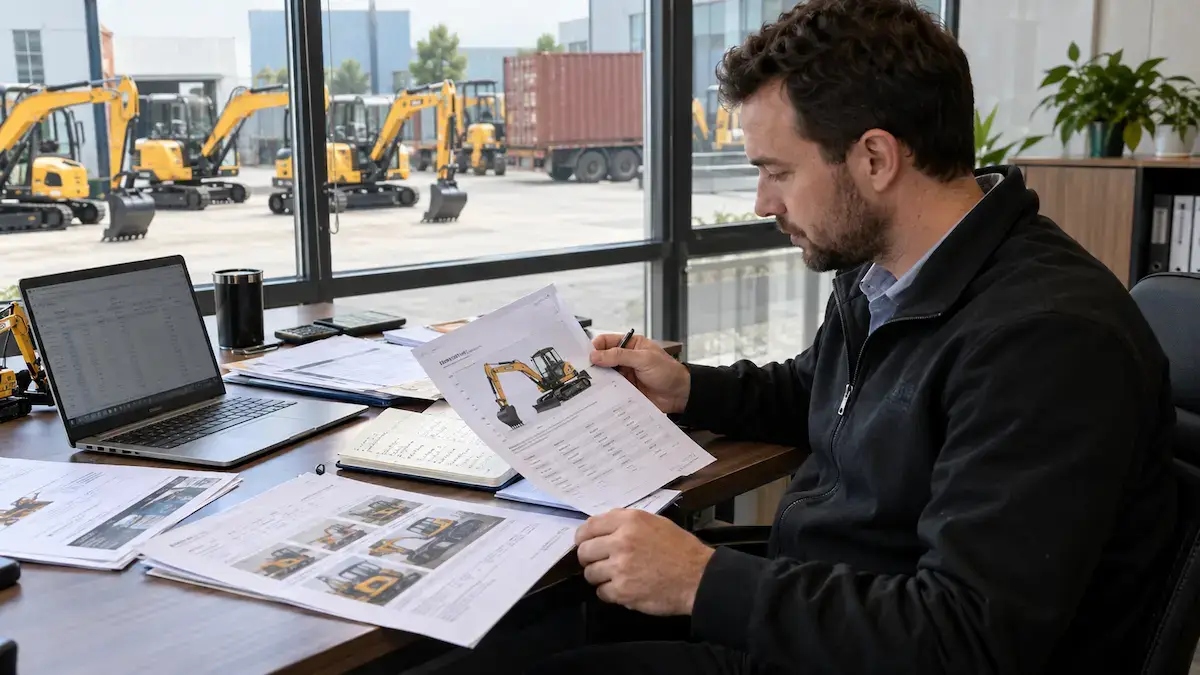
Dealers should not fill in the columns with their own assumptions. If the supplier has not provided a value, the item should remain unconfirmed. The Guide pour obtenir un devis pour une mini-pelle explains how to prepare an RFQ, and the Guide des prix des mini-pelles explique comment interpréter les cours indiqués en fonction du contexte.
FOB, CIF and Landed Cost for Dealers
Wholesale buyers should calculate total landed cost, not just the factory or FOB price. The FOB machine quotation is only one part of the total cost of receiving goods at the dealer’s location.
Cost elements to consider when estimating landed cost:
- Machine price
- Pièces jointes
- Emballage
- International freight
- Insurance
- Destination port charges
- Customs clearance
- Import duty and taxes
- Inland delivery
- Initial spare-parts inventory
Dealers should not assume that the lowest FOB price results in the lowest landed cost. Differences in packaging, freight allocation, Incoterm and destination charges can change the outcome. The Expédition de mini-pelles depuis la Chine Ce guide explique plus en détail les Incoterms et les éléments constitutifs des frais d'expédition.
Shipping Efficiency and Container Planning
Shipping efficiency matters more to a dealer than to a single end user, because a wholesale order often involves multiple machines, attachments and packaging considerations.
Dealers should request the following information before shipment:
- Machine packing dimensions
- Machine dimensions with and without attachments
- Attachment dimensions and weights
- Loading plan for the agreed quantity
- Photos before shipment
- Chargement des photos
Container quantity depends on the exact models, configuration, attachment list and packaging method. There is no universal number of machines per container. Dealers should confirm the loading plan for the specific order rather than assuming a fixed capacity.
Spare Parts Planning for Dealers
Spare parts planning is one of the most important operational decisions a dealer makes. Long equipment downtime can damage customer confidence and repeat business, especially when a dealer cannot provide the parts or support needed to return a machine to service quickly.
Parts categories that dealers commonly consider for initial stock:
- Filters (engine, fuel, air, hydraulic)
- Seals and O-rings for frequently serviced areas
- Hydraulic hoses in common sizes
- Wear parts such as bucket teeth
- Common service components
- Model-specific parts that are difficult to source locally
Benefits of a planned initial parts inventory:
- Reduced customer downtime
- Faster after-sales response
- Better inventory planning for future orders
- Clearer cost control on service work
Dealers should not attempt to stock every possible part in the first order. The right inventory depends on the machine mix, local applications and customer expectations. The Guide des pièces détachées pour mini-pelles explains parts categories and identification requirements.
After-Sales Support Matters More for Dealers Than for One-Time Buyers
A one-time buyer has one machine. A dealer may eventually support multiple machines for multiple customers. This makes after-sales support and parts communication more important for dealers than for a single end user.
Dealers should confirm the following with the supplier before ordering:
- How are spare parts identified?
- What machine identification information is required for parts requests?
- Are parts diagrams or manuals available?
- How are technical questions handled?
- What warranty process applies?
- How are replacement parts shipped?
The answers to these questions indicate how prepared the supplier is to support a dealer relationship over time, not just a single shipment.
Inspect the First Machines Before Scaling Orders
The first order is the best opportunity to verify machine quality, configuration accuracy and documentation before scaling to a larger or repeat order.
Inspection activities can include:
- Photos and videos of the actual machines
- Machine identification and model plate
- Functional test (engine start, travel, swing, digging functions)
- Hydraulic check for leaks and correct function
- Track and undercarriage check
- Attachment compatibility check
- Packing inspection before shipment
- Inspection par un organisme tiers, le cas échéant
Le Liste de contrôle pour l'inspection en usine des mini-pelles provides a structured checklist for these checks.
Documents Dealers Should Confirm Before Shipment
Documentation requirements vary by destination country and by the commercial terms of the order. Dealers should confirm the expected document set before shipment rather than after the container has left the port.
Documents that dealers commonly confirm:
- Commercial invoice
- Packing list
- Bill of lading
- Machine identification information
- User manual
- Documents required by the destination country
Not every shipment uses the same document set. Destination-country regulations, import rules and the machine configuration all affect what is required. Dealers should confirm the applicable documents with the supplier and their customs broker.
Questions to Ask a Mini Excavator Wholesaler or Supplier
The following questions are useful when evaluating a supplier for wholesale or dealer purchasing. They are questions, not standard answers, because the correct response depends on the specific supplier and configuration.
- What models and size classes are available?
- What configurations are available for each model?
- Qu'est-ce qui est inclus dans le devis ?
- What are the minimum order requirements?
- Are smaller initial orders possible?
- Can different models be combined in one order?
- Which attachments are compatible with each machine?
- What documentation is supplied?
- How are spare parts supplied?
- How is technical support handled?
- What inspection is performed before shipment?
- Quels sont les Incoterms disponibles ?
- What is the quotation validity?
- What information is needed for repeat orders?
Common Wholesale Purchasing Mistakes
Several common mistakes can increase cost, reduce resale performance or create operational problems later.
- Ordering too many models initially without confirmed local demand
- Choosing models based on supplier catalog rather than customer data
- Comparing only unit price and ignoring total landed cost
- Ignoring destination-market emissions or documentation requirements
- Ordering attachments without checking hydraulic or mounting compatibility
- Failing to plan spare parts before resale begins
- Ignoring shipping efficiency and container planning
- Not standardizing configurations that could be standardized
- Not inspecting the first order before scaling up
- Not documenting machine configurations for future reference
Dealers can reduce these risks by planning the first order carefully and treating it as a learning step before committing to a larger program.
A Practical First-Order Process for Dealers
The following sequence is a practical starting point for a first wholesale order. It is not the only correct process, but it covers the main decisions in a logical order.
- Define target customers and their main applications
- Select candidate size classes based on local demand
- Confirm specifications for each candidate model
- Decide the initial attachment list
- Request a wholesale quotation with clear commercial terms
- Compare total landed cost, not just unit price
- Confirm documentation requirements for the destination market
- Plan initial spare parts based on the machine mix
- Inspect the first machine or order before shipment
- Review the results before scaling to a larger or repeat order
Planning to Source Mini Excavators for Resale?
If you are evaluating mini excavators for dealership, distribution, rental or resale, provide your target market, required size classes, quantity, attachments and destination. ZHAOLU can review the requirements and prepare a quotation based on the confirmed configuration.
Frequently Asked Questions About Mini Excavator Wholesale
What should I check when buying mini excavators wholesale from China?
Check the target customer profile, machine size mix, engine and specification, attachment strategy, quotation scope, shipping arrangement, documentation, spare-parts plan, after-sales process and inspection requirements. The correct mix depends on local demand, not on stocking every model.
What mini excavator sizes should a dealer stock?
The correct size mix depends on local customer demand. Common categories include 0.5 ton micro machines for narrow access, 0.7–0.9 ton machines for landscaping and light work, 1.2–1.4 ton machines for broader contractor use, and 2.3–2.5 ton machines for heavier work. Dealers should confirm local demand before selecting the mix.
Can dealers start with a small order before buying in bulk?
Dealers should ask the supplier whether a sample or smaller initial order is available, since minimum order requirements vary. A first order can help verify machine quality, configuration, documentation and supplier communication before scaling. Freight economics may differ from a larger shipment.
What affects a wholesale mini excavator quotation?
Machine model, operating weight, engine configuration, standard equipment, attachments, quantity, Incoterm, packaging, documentation, spare-parts scope and quotation validity all affect the quotation. Comparing quotations on the same basis is essential.
Can different mini excavator models be shipped together?
This depends on the supplier and the specific order. Dealers should confirm with the supplier whether different models can be combined in one order and how the container loading plan will be arranged. Container quantity depends on the exact models, configuration and packaging method.
What spare parts should a mini excavator dealer keep in stock?
Common items include filters, seals, hydraulic hoses, bucket teeth and other frequently replaced service parts. The right inventory depends on the machine mix, local applications and customer expectations. Dealers should not attempt to stock every possible part in the first order.
How should dealers compare FOB and CIF quotations?
Under FOB, the seller handles the agreed export-side responsibilities and delivers the machine on board at the named shipment port. Under CIF, the seller arranges and pays freight and insurance to the destination port, but risk transfers once the goods are loaded on board at the port of shipment. Dealers should compare quotations on the same Incoterm and include total landed cost in the evaluation.
What information should I send when requesting a wholesale quotation?
Provide the required machine models or size classes, quantity, target market, application, attachments, destination country and port, preferred Incoterm, documentation requirements, spare-parts expectations and target purchasing timeline. Clear information allows a more accurate and comparable quotation.