
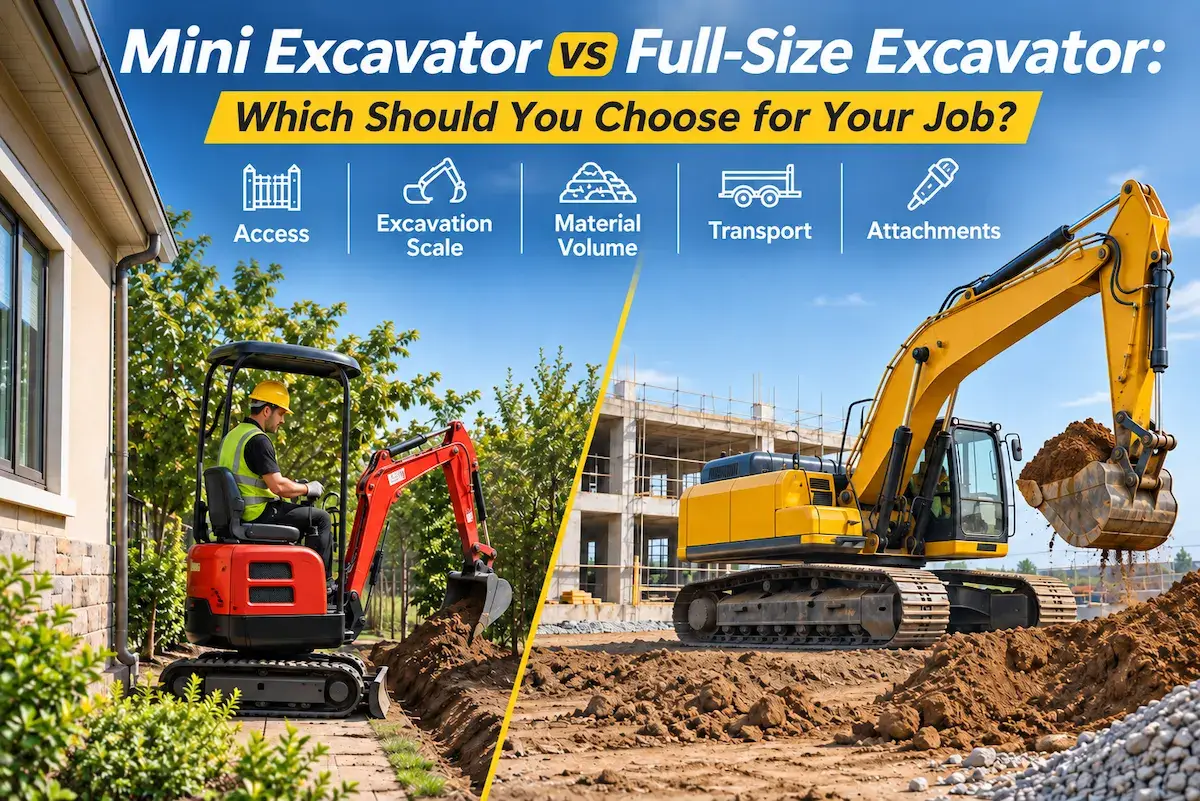
The mini excavator vs full-size excavator decision is not about which machine is “better.” It is about which machine class fits the site, the excavation scale and the workload. A mini excavator may be the right choice for a confined residential site, a landscaping project or a utility trench, while a full-size excavator may be the right choice for bulk excavation, major site preparation or sustained heavy production. Choosing the wrong class in either direction creates real costs — a machine that cannot access the site, or a machine that cannot keep up with the work.
This guide compares the two categories by the factors that actually change the decision: access, working space, digging depth and reach, material volume, workload, transport, attachments and job-site conditions. It is written for contractors, landscapers, farm and property owners, construction companies and equipment buyers who are choosing a machine category before requesting a quote.
Quick Answer: Mini Excavator or Full-Size Excavator?
There is no universally better category. A mini excavator is generally more suitable when access is restricted, the excavation is localized, the material volume is modest, the work is distributed across smaller sites, or frequent transport is required. A full-size excavator is generally more suitable when the project requires bulk excavation, deeper or larger working dimensions, high material volume, sustained heavy workload or greater overall machine capability.
Terms such as mini, compact, standard and full-size excavator are used somewhat differently across manufacturers and markets. In this article, “full-size excavator” refers to machines clearly larger than the compact / mini excavator class and intended for higher-volume, heavier or larger-scale excavation work. Exact capability varies by model and configuration, so buyers should compare the confirmed specifications of the specific machines they are considering.
Mini Excavator vs Full-Size Excavator at a Glance
The table below summarizes the main category-level differences. It is a decision reference, not a specification table.
| Decision Factor | Miniexcavadora | Full-Size Excavator |
|---|---|---|
| Site access | Often suits restricted access, gates, side passages and confined sites | Typically requires wider access and more working space |
| Working footprint | Compact; may work near buildings and boundaries | Larger footprint and greater maneuver space required |
| Excavation scale | Localized excavation, small pits and trenches | Bulk excavation and larger working dimensions |
| Transport complexity | Varies by model; micro and small classes can be easier to move | Typically requires heavier transport planning |
| Material volume | Suited to modest or localized volumes | Suited to high-volume material handling |
| Workload | Light to moderate, or mixed with other tasks | Sustained, heavy or production-oriented workload |
| Attachment scale | Smaller attachments matched to compact machines | Larger attachments matched to larger carriers |
| Typical job environment | Residential, landscaping, property, utility, farm | Commercial construction, major site work, bulk earthmoving |
| Best reason to choose | Access, compactness and job flexibility | Excavation capability and production capacity |
Jobsite Access and Working Space
Access is often the single most important factor in the mini excavator vs full size excavator decision. A full-size excavator may have greater working capability, but that capability has no practical value if the machine cannot reach the work area.
Mini excavators are commonly relevant for gates, residential side passages, gardens, orchards, confined urban sites and work near existing structures. The ability to reach the work area and position the machine without major site disruption can matter more than raw digging capability. The Mini Excavator Width Guide explains access measurement in more detail.
The same logic applies in reverse. If the site is open and the work is large-scale, the access advantage of a compact machine provides little benefit, and the excavation capacity of a larger class becomes the deciding factor.
Digging Depth, Reach and Excavation Scale
Machine size generally affects working capability, but there is no universal tonnage-to-depth table that applies to every manufacturer and configuration. The correct comparison is between the confirmed specifications of the specific machines being considered, not between category labels.
A mini excavator may be sufficient for localized excavation such as pits, planting areas, short trenches and some small foundation-related excavation where the machine’s confirmed depth, reach and working capacity match the project requirements. Larger excavation requirements can justify a larger machine category. The Mini Excavator Digging Depth Guide explains how to compare required excavation depth against machine capability.
The practical question is not “can a mini excavator dig this depth?” but “can the specific mini excavator model being considered dig this depth, in this ground, with this access, at this workload?”
Material Volume and Productivity
This is where category choice often separates more clearly. A machine that can dig a trench is not automatically the right machine for moving a large volume of material.
If the work involves bulk earthmoving, large excavation, major site preparation or high daily material volume, a full-size excavator may be the more appropriate category. That is not a marketing position; it reflects the design intent of the larger machine class.
This article does not provide fixed production figures. Productivity depends on the specific machine, bucket, soil, operator technique, site layout and work organization. Buyers should not compare categories using general speed claims, and should instead compare the actual machines they are considering against the actual work.
Transport and Mobilization
Transport is often cited as a mini excavator advantage, and that can be true — but not universally. Smaller compact machines may be easier to move between small sites, while larger mini excavators can require substantial trailer capacity and tow vehicle capability. The Mini Excavator Trailer Guide explains trailer payload, deck dimensions and tow vehicle planning.
A full-size excavator typically requires heavier transport planning and more mobilization preparation than a compact machine. For buyers whose work is distributed across multiple smaller properties, this difference can be a meaningful factor in the category decision.
Transport complexity should be confirmed against the actual machine weight, dimensions, attachments and local regulations — not assumed from the category name.
Attachments and Hydraulic Requirements
Full-size excavators are generally associated with larger attachment requirements and higher working capacities, but attachment choice must be evaluated against the specific machine. A larger machine does not automatically support every larger attachment, and a smaller machine may support attachments that are fully adequate for its work.
Attachment compatibility depends on hydraulic flow, hydraulic pressure, the auxiliary circuit, machine size and mounting or coupler configuration. The Guía de accesorios para miniexcavadoras explains mounting and hydraulic compatibility, and the Guía del sistema hidráulico de las miniexcavadoras explains flow, pressure and auxiliary hydraulics for powered attachments.
Buyers should compare the attachment requirements of the actual work against the confirmed specifications of the specific machine, not against the category label.
Landscaping and Property Work
Landscaping and property work often favors the mini excavator category. Planting pits, garden excavation, small drainage runs, soil removal and property improvement tasks usually involve localized excavation, restricted access and modest material volumes — conditions where a compact machine is often the more practical choice.
A micro excavator such as the ZL-05 is often relevant here because its compact width and working footprint can be matched to gardens, orchards and narrow property access. The Mini Excavator for Landscaping guide explains landscaping machine selection in more detail, and the What Can a Mini Excavator Do? guide covers broader capability discovery.
Obras de servicios públicos y excavación de zanjas
Mini excavators are commonly used for drainage, irrigation, utility trench preparation and localized trenching. They can dig the trench, place the spoil, open connection pits and backfill with the same machine.
Long-distance, uniform, repetitive trenching may suit a dedicated trencher more than either a mini excavator or a full-size excavator. The Mini Excavator vs Trencher comparison explains that distinction. The Mini Excavator for Utility Work guide covers utility and trenching machine selection in more detail.
Residential and Small Construction Work
Mini excavators are relevant to confined residential sites, renovation work, localized groundwork, drainage and utility preparation. The ability to access the site, position the machine and place spoil without major disruption is often the deciding factor on residential projects.
Larger or deeper excavation, heavier site work and higher daily output requirements may point toward a larger machine class. The Mini Excavator for Residential Construction guide explains residential machine selection in more detail.
Large Construction and Bulk Excavation
A full-size excavator is often the more appropriate category for large excavation volume, commercial construction, deeper excavation requirements, heavier site work, sustained production and large open job sites. These are the conditions the larger machine class is designed for.
This is a fair comparison, not a criticism of the mini excavator. If the work is dominated by bulk excavation and production, the mini excavator may not be the right starting point, regardless of its flexibility.
When Is a Mini Excavator Too Small?
A mini excavator that is too small for the job is not a cost-saving choice. The following signals suggest the mini excavator category may not be sufficient for the work:
- Required depth exceeds the specific machine’s capability
- Required reach exceeds the machine’s working envelope
- Material volume is too high for practical productivity
- The regular workload repeatedly pushes the machine near its limits
- Required attachments exceed the machine’s hydraulic or mounting compatibility
- Stability or working capacity requirements exceed the compact class
- The site is open enough that compactness no longer provides meaningful benefit
There is no universal threshold that applies to every machine or project. The correct evaluation is against the specific machine and the actual work.
When Is a Full-Size Excavator Unnecessary?
A full-size excavator may be unnecessary when access is restricted, the excavation is localized, the material volume is modest, the work is distributed across small sites, surface protection and footprint matter, or transport flexibility matters.
In those conditions, a full-size machine may add footprint, logistics, access limitations and ownership complexity without providing capability the project actually requires. That is a description of project fit, not a claim about the machine itself.
For buyers evaluating the economics of the compact-machine option, our Mini Excavator Operating Cost per Hour guide explains how fuel, maintenance, wear, utilization and ownership factors fit into the broader cost decision.
Many projects sit between the two categories — larger than a micro excavator’s practical scope, but smaller than a full-size machine’s working environment. That is where the larger compact excavator classes matter.
Where Does the ZL-05 Fit?
The ZL-05 is a 0.5 Ton Micro Excavator designed for compact, light excavation work. It is relevant when access is restricted, the work is localized and the material volume is modest — conditions where compactness provides real value.
| Especificaciones | ZL-05 Reference |
|---|---|
| Peso en servicio | 420 ± 20 kg |
| Ancho de transporte | 640 mm / 25.2 in |
| Transport Height | 1101 mm with handles removed |
| Profundidad máxima de excavación | 912 mm |
| Maximum Digging Radius | 1962 mm |
| Boom Swing | 50° left / 50° right |
| Desplazamiento de la cuchara | 245 mm left / 245 mm right |
| Referencia del motor | Rato gasoline engine |
| Potencia del motor | 6,5 HP |
| Maximum System Flow | 12 l/min |
Importante: The ZL-05 should be viewed as an example of the micro end of the mini excavator category, not as a performance benchmark for all mini excavators. Each project still needs to be checked against the actual digging depth, access width and ground conditions.
Typical applications include narrow-access work, gardens, orchards, planting pits, light trenching, irrigation maintenance and property work. The full configuration is listed on the ZL-05 MICROEXCAVADORA DE 0,5 T product page.
When Should You Move Up Within the Mini Excavator Range?
If the limitation is digging depth, reach, stability, working capacity, daily workload or attachment requirements, the next step is not automatically a full-size excavator. ZHAOLU also offers larger compact models — such as the ZL-17, ZL-18, ZL-25 or ZL-35 — that sit between the micro class and full-size equipment.
This article does not list specifications for those larger models. Buyers should compare the current model-specific specifications from the product pages or the supplier before selecting a machine.
El Guía de tamaños de miniexcavadoras explains machine class selection across the compact range, and the Miniexcavadoras en Venta | 0,5–2,5 t | ZHAOLU page lists the current range for comparison.
Mini Excavator or Full-Size Excavator? Decision Checklist
- Narrowest site access width
- Available working space
- Required digging depth
- Required working reach
- Material volume
- Condiciones del terreno
- Documentos adjuntos obligatorios
- Daily workload
- Transport requirements
- Frequency of relocation between sites
- Expected job duration
- Required job output
The checklist is designed to define the work before choosing the machine. It is not a scoring system. Different projects weight these factors differently, and the correct machine class depends on the actual combination.
Final Answer
There is no universal winner in the mini excavator vs full size excavator comparison. The correct machine is not the largest machine available. It is the machine class that can access the site and complete the required work efficiently. A mini excavator that is too small for the job is not a cost-saving choice, and a full-size excavator that cannot reach the site or is oversized for the work is not the practical answer either. Compare the complete job — access, excavation scale, material volume, workload, transport and attachments — before choosing a category.
Not Sure Which Excavator Class Fits Your Job?
Send ZHAOLU the main application, required digging depth, required reach, narrowest access width, required attachments, expected workload and destination country. ZHAOLU can help confirm which machine class should be compared for the actual work.
Review the Miniexcavadoras en Venta | 0,5–2,5 t | ZHAOLU page or the ZL-05 MICROEXCAVADORA DE 0,5 T product page.
Frequently Asked Questions About Mini Excavator vs Full-Size Excavator
What is the difference between a mini excavator and a full-size excavator?
A mini excavator is a compact machine designed for lighter or localized excavation, restricted access and smaller job sites. A full-size excavator is a larger machine designed for bulk excavation, higher material volume and heavier or sustained work. The categories are distinguished by working capability, size, transport requirements and intended application, not by one fixed tonnage figure.
Is a mini excavator powerful enough for construction work?
It depends on the work. Mini excavators are commonly used in construction for site preparation, small excavation, drainage, utility preparation and groundwork. When excavation becomes bulk, deeper or heavier, a larger machine class may be more appropriate. The specific machine and the specific job should be compared.
When is a mini excavator too small?
A mini excavator may be too small when required depth or reach exceeds the machine’s capability, material volume is too high for practical productivity, the regular workload repeatedly pushes the machine near its limits, required attachments exceed compatibility, stability requirements exceed the compact class, or the site is open enough that compactness no longer provides meaningful benefit.
When should I choose a full-size excavator?
A full-size excavator is often the more appropriate category for bulk excavation, commercial construction, deeper or larger excavation requirements, heavier site work, sustained production and large open job sites. These are the conditions the larger machine class is designed for.
Is a mini excavator easier to transport?
It can be, but not universally. Smaller compact machines may be easier to move between small sites. Larger mini excavators can still require substantial trailer capacity and tow vehicle capability. Transport depends on the specific machine weight, dimensions, attachments and local regulations.
Can a mini excavator dig as deep as a full-size excavator?
Not in general. Full-size excavators are designed for larger working dimensions, and mini excavators vary widely across the compact class. The correct comparison is between the confirmed specifications of the specific machines being considered, not between category labels.
What size excavator is best for landscaping?
Landscaping often favors the mini excavator category because planting pits, garden excavation, small drainage runs and property improvement tasks involve localized excavation, restricted access and modest material volumes. The specific machine size should be matched to the access and depth requirements of the actual work.
Should I compare a larger mini excavator before moving to a full-size excavator?
In many projects, it is worth comparing a larger compact machine before moving directly to full-size equipment. If the limitation is depth, reach, stability, working capacity or attachment requirements, the next step is not automatically a full-size excavator. ZHAOLU also offers larger compact models — such as the ZL-17, ZL-18, ZL-25 or ZL-35 — that sit between the micro class and full-size equipment. Buyers should compare the confirmed model-specific specifications against the actual job requirements before choosing.