
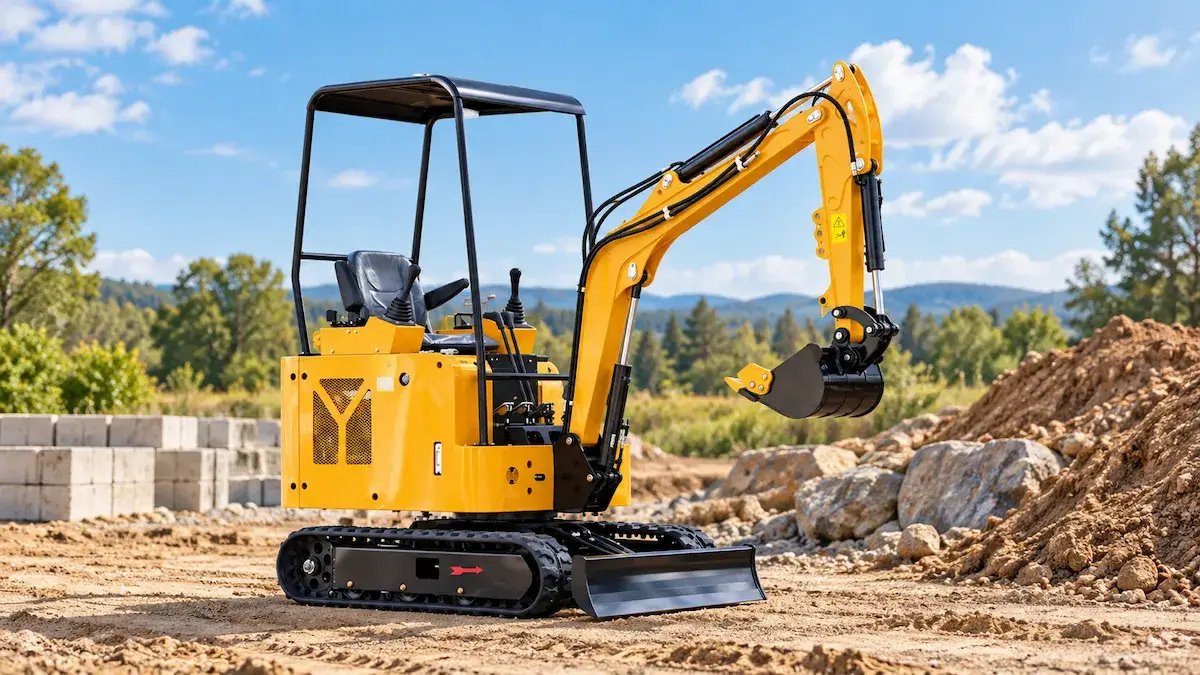
A 1.2 ton mini excavator buying guide helps buyers decide whether this middle size class fits their work — more capability than a micro excavator, but still compact enough for residential and landscaping sites. The real question is not whether 1.2 ton is bigger than 0.5 ton, but whether the extra digging depth and working radius justify the larger machine for the actual job.
This 1.2 ton mini excavator buying guide covers when the 1.2 ton class makes sense, what digging depth and working radius to check, how engine and hydraulic configuration affect the decision, how to interpret price, and what to confirm before requesting a quotation.
Quick Answer: Is a 1.2 Ton Mini Excavator Right for Your Work?
A 1.2 ton machine is commonly considered for landscaping, light utilities, residential construction, small trenching and rental use — situations that need more digging depth and working radius than a micro excavator can offer, but where the site still requires a compact machine.
Buyers should confirm that digging depth, working radius and digging force match the actual job. If access is the dominant constraint, a 0.5 ton machine may still be the right choice.
When Does 1.2 Ton Make More Sense Than a 0.5 Ton Micro Excavator?
The choice between 0.5 ton and 1.2 ton is mainly a trade-off between access and capability. A micro excavator may reach restricted sites where a larger machine is less practical or cannot enter. Moving to the 1.2 ton class typically trades some access flexibility for greater digging depth, working radius and overall working capability.
As a real ZHAOLU reference, the ZL-05 micro excavator lists a maximum digging depth of 912 mm, while the ZL-17 lists 1940 mm. This does not mean every 0.5 ton and 1.2 ton machine follows the same relationship, but it shows why buyers should compare actual working data rather than machine class alone.
Buyers should weigh access width, required digging depth, required working radius, how often the machine will be used, attachment requirements and transport method. For a broader comparison of size classes, refer to the Mini Excavator Size Guide. Buyers evaluating the smallest class can also review the 0.5 Ton Mini Excavator Buying Guide.
Check Digging Depth and Working Radius Before Buying
Rated machine weight alone says very little about actual job capability. Digging depth and working radius are the two figures that most directly determine whether the machine can complete the work.
The ZL-17 has a listed maximum digging depth of 1940 mm and a maximum digging radius of 3380 mm. These figures are useful as job-planning reference values, not simply as marketing specifications.
Buyers should use these values to compare against their own requirements:
- Compare typical required trench depth against the confirmed maximum digging depth
- Compare required working area against the available digging radius
- Leave a practical working margin rather than sizing the machine at the exact limit
Maximum figures are reference values under defined configurations. Actual performance depends on soil, machine setup, bucket and operating position. The Mini Excavator Specifications Guide explains how to interpret these values.
Use Digging Force as One Part of the Capability Check
The ZL-17 has a listed bucket digging force of 11 kN. Digging force is one factor that affects how the excavator interacts with soil, but it should not be treated as a standalone performance indicator.
Soil type, bucket specification, machine setup, operator technique and job conditions also affect real working capability. A machine may perform very differently in soft soil versus compacted ground. Buyers should treat digging force as one input among several, not as the sole basis for machine selection.
Engine and Hydraulic Configuration Should Match the Application
The ZL-17 uses an 18 kW engine, with the Laidong 385 as the current sales configuration reference. Buyers should compare engine and hydraulic configuration, not only machine weight.
Powered attachment compatibility can depend on hydraulic flow and pressure, auxiliary circuit configuration, attachment interface and the machine’s operating limits. Buyers should confirm these factors for the specific attachment and quoted machine configuration rather than assuming compatibility from machine class alone.
For more detail, refer to the Mini Excavator Hydraulic System Guide.
When Should You Consider a Larger Mini Excavator?
A 1.2 ton machine may not be appropriate for every job. A larger mini excavator may be a better fit when:
- Greater digging depth is consistently required
- Working radius is insufficient for the typical layout
- Heavier excavation dominates the workload
- Larger powered attachments are required
- Higher production output matters more than compactness
Buyers who consistently need more capability than the 1.2 ton class provides should compare larger options before finalizing the purchase.
How Much Does a 1.2 Ton Mini Excavator Cost?
The following reference applies to the ZL-17 as a real example of the 1.2 ton class:
| Item | Reference |
|---|---|
| Model | ZL-17 1.2 Ton Mini Excavator |
| Engine Reference | Laidong 385 |
| Engine Power | 18 kW |
| Reference Price | EUR 3,280–3,580 FOB Qingdao |
| Quotation Scope | Base machine with standard bucket |
| Additional Attachments | Not included |
This is a reference range, not a fixed price. It is not a delivered price, DDP price, promotional price or guaranteed future price. Final pricing depends on the confirmed configuration, quantity, attachments, commercial terms and destination.
Buyers who want to compare the current machine configuration with this reference can review the ZL-17 1.2 Ton Mini Excavator product page. For a broader explanation of how configuration and commercial terms affect pricing, refer to the Mini Excavator Price Guide.
How to Compare 1.2 Ton Mini Excavator Quotations
A lower price does not necessarily mean the same machine is being quoted. Two quotations for the 1.2 ton class can differ significantly in configuration and commercial scope.
Buyers should compare model and configuration, engine, standard bucket, attachments, optional equipment, quantity, Incoterm, packing, documentation, destination and quotation validity. The Mini Excavator Quote Guide explains how to prepare an RFQ and compare quotations on the same basis.
1.2 Ton Mini Excavator Buying Guide Checklist
| Decision Area | What the Buyer Should Confirm | Why It Matters |
|---|---|---|
| Application | Main job types and working conditions | Determines whether the class fits |
| Access | Site width, gate, path and working space | Confirms the machine can reach the site |
| Digging depth | Typical required trench depth | Matches machine capability to the work |
| Working radius | Required working area from a fixed position | Affects how the job can be completed |
| Digging force | Listed bucket digging force and typical ground conditions | Helps evaluate digging capability together with soil and bucket conditions |
| Engine configuration | Engine model and rated power | Affects machine configuration and future engine-parts identification |
| Hydraulic requirements | Auxiliary circuit and attachment needs | Helps confirm powered-attachment compatibility |
| Attachments | Breaker, auger, coupler, other requirements | Affects quotation and machine setup |
| Price basis | Reference scope and configuration | Enables fair comparison between suppliers |
| Quotation scope | Included vs optional items | Prevents comparing different configurations |
| Shipping term | FOB, CIF, DDP availability | Affects cost and responsibility |
| Documentation | Required import documents | Affects customs clearance |
| Inspection | Pre-shipment verification arrangement | Reduces purchase risk |
| Supplier contact | Parts and technical support process | Affects long-term support |
ZL-17 as a Real 1.2 Ton Reference
The ZL-17 provides one real reference for buyers evaluating the 1.2 ton class. Its confirmed working data used throughout this guide includes 1940 mm maximum digging depth, 3380 mm maximum digging radius and 11 kN bucket digging force.
For the complete current machine specification and configuration, review the ZL-17 1.2 Ton Mini Excavator product page and confirm the current setup against your specific application.
What Should Buyers Confirm Before Ordering from China?
Once the machine size and configuration are confirmed, buyers should verify the supplier, quotation scope, commercial terms, shipping arrangement, import documentation and pre-shipment evidence. These broader sourcing steps are covered in the How to Buy a Mini Excavator from China guide.
How to Request an Accurate 1.2 Ton Mini Excavator Quote
To receive a useful quotation, buyers should provide country and destination, intended application, required digging depth if known, site and access restrictions, quantity, required attachments, preferred commercial term if known, and contact information.
Current models can be reviewed on the Mini Excavators for Sale page. Quotation requests can be submitted through the Contact page.
Request a 1.2 Ton Mini Excavator Quote
If a 1.2 ton machine matches your application and access requirements, provide your destination, typical working depth, attachments and quantity. ZHAOLU can review the requirements and prepare a quotation based on the confirmed configuration.
Frequently Asked Questions About the 1.2 Ton Mini Excavator
What is a 1.2 ton mini excavator used for?
It is commonly considered for landscaping, light utilities, residential construction, small trenching and rental use, where more digging depth and working radius are needed than a micro excavator can provide, but the site still requires a compact machine.
How deep can a 1.2 ton mini excavator dig?
Digging depth varies by model and configuration. As one real reference, the ZL-17 has a listed maximum digging depth of 1940 mm. Buyers should compare this type of figure against their actual required trench or excavation depth.
How much does a 1.2 ton mini excavator cost?
Price depends on configuration, engine, attachments, quantity, Incoterm and destination. As one reference, ZHAOLU has used a range of EUR 3,280–3,580 FOB Qingdao for the ZL-17 with a Laidong 385 engine and standard bucket. Additional attachments are not included. Final pricing should be confirmed for the exact configuration.
Should I choose 0.5 ton or 1.2 ton?
The decision depends primarily on access versus digging capability. A 0.5 ton machine is often chosen for very narrow sites. A 1.2 ton machine can provide greater digging depth and working radius than a micro excavator while still remaining relatively compact, but the actual difference should be checked using model-specific specifications.
How can I request a ZL-17 quotation?
Provide your destination, application, required digging depth if known, access restrictions, quantity and attachment requirements. ZHAOLU can then prepare a quotation based on the confirmed configuration. Requests can be submitted through the Contact page.