
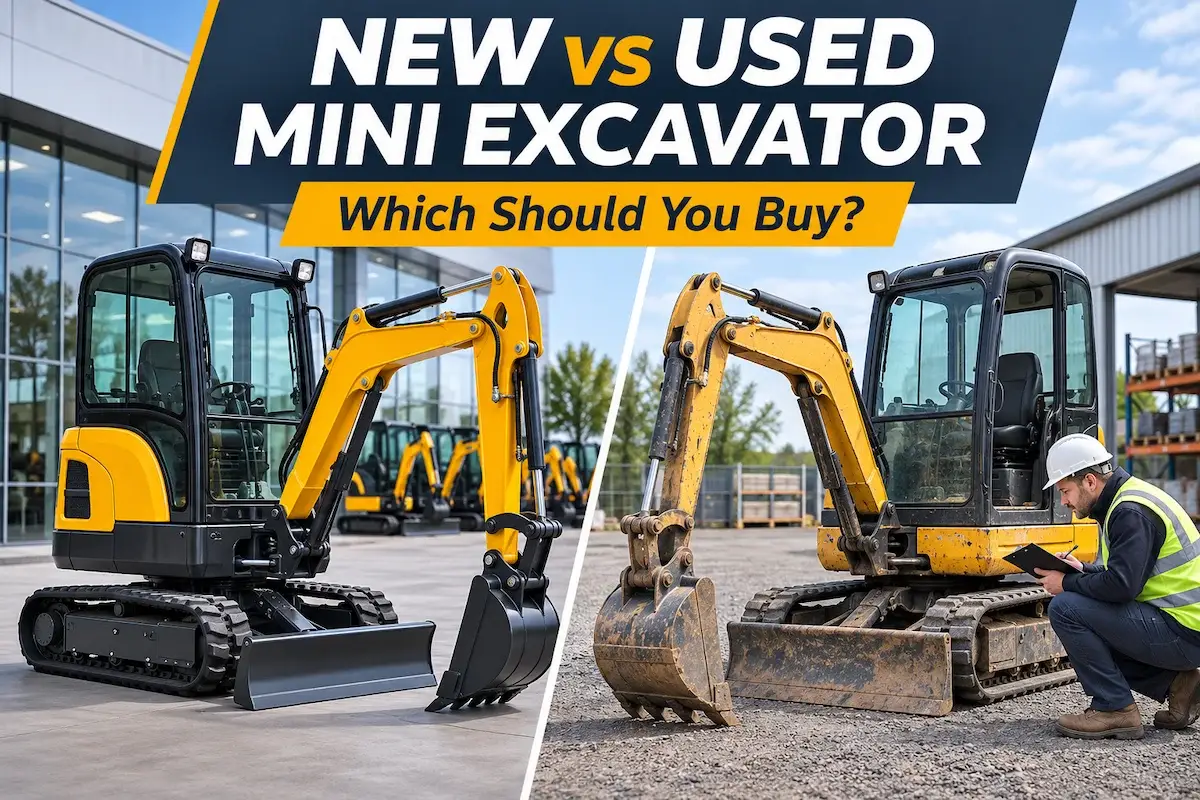
The new vs used mini excavator decision is not simply a comparison between two purchase prices. A lower-priced used machine can be excellent value if its condition, history and remaining service potential are strong, while a poorly maintained machine can create repair and downtime costs that erase the initial saving.
This guide is written for small contractors, landscapers, farm and property owners, utility contractors and first-time equipment buyers who have already concluded that ownership is the right choice and now need to decide whether to buy a new machine or a used one.
Quick Answer: New or Used Mini Excavator?
| Фактор принятия решения | New Mini Excavator | Used Mini Excavator |
|---|---|---|
| Purchase price | Generally higher | Often lower, but depends on the machine |
| Machine history | Known starting condition | Depends on records and inspection |
| Condition certainty | Predictable | Requires verification |
| Warranty | May be included depending on the agreement | Limited, remaining or none, depending on the seller |
| Configuration choice | Selected at order | Determined by what is available |
| Immediate repair risk | Generally lower | Depends on condition and history |
| Inspection requirement | Pre-delivery check where applicable | Detailed inspection is essential |
| Parts and support | Usually easier to verify through the current supplier or dealer; terms should still be confirmed | Depends on model, age, seller and local availability |
| Downtime exposure | Often lower from a known new starting condition, though not zero | Depends strongly on condition, history and maintenance |
| Buyer mechanical experience | Less critical | Often more helpful |
| Short-term budget pressure | Higher capital requirement | Lower entry cost may be possible |
| Long-term predictable use | Stronger starting point | Depends on remaining service potential |
The table describes general decision directions. It is not a financial recommendation. The correct decision depends on the specific machines being compared, the local market, the buyer’s workload and the buyer’s ability to inspect and maintain the machine.
New vs Used Mini Excavator — What Is the Real Difference?
The real difference is not simply age. Two machines built in the same year can have very different remaining service potential if one was maintained carefully and the other was not.
Relevant differences include:
- Machine history
- Operating condition
- Maintenance history
- Known versus unknown wear
- Warranty coverage
- Configuration fit
- Remaining service potential
- Parts and support availability
- Downtime risk
A used machine can be an excellent purchase. A new machine provides a more predictable starting condition. Neither statement is universally true for every buyer, and neither decision is automatically the cheaper one over the ownership period.
Advantages of Buying a New Mini Excavator
Buying new offers several practical advantages:
- Known machine history
- New components
- Warranty where included in the agreement
- Configuration selected at order
- Attachment compatibility confirmed before delivery
- Predictable maintenance starting point
- Current manuals and documentation
- Parts and support arrangements can often be confirmed before purchase
- Less uncertainty about hidden damage
These advantages reduce uncertainty. They do not remove risk entirely. A new machine is not a guarantee of zero downtime, and it is not automatically the economically better choice in every situation.
Advantages of Buying a Used Mini Excavator
Buying used offers practical advantages for some buyers:
- Lower entry price may be possible
- Immediate local availability may be possible
- Established models may have known repair knowledge
- Good value if the machine has been maintained well
- Suitable for mechanically experienced buyers
- May fit lower-utilization applications where a new machine is harder to justify
Used equipment is not inherently inferior. A well-maintained used machine can provide excellent service, and a buyer with strong inspection capability and maintenance resources may be able to obtain better value from a suitable used machine than from a new one.
The Biggest Used-Machine Risk: You Are Buying Its History
When a buyer purchases a used mini excavator, they are also purchasing the previous owner’s decisions and working conditions. That history includes:
- Previous operating conditions
- Maintenance decisions
- Repairs and repair quality
- Operator behaviour
- Storage conditions
- Wear accumulated on major components
- Possible abuse or overload
Useful records that reduce uncertainty:
- Service records
- Repair invoices
- Hour records
- Ownership history where available
- Parts replacement history
- Attachment usage
- Maintenance intervals
If records are missing, that does not automatically prove a machine is bad. It does increase uncertainty, and it should raise the standard of physical inspection before purchase.
Machine Hours Matter — But Hours Alone Are Not Enough
Operating hours are an important reference, but they should not be interpreted in isolation. Two machines with the same hour figure can have very different remaining service potential.
Relevant differences include:
- A low-hour machine used harshly
- A higher-hour machine maintained correctly
- Frequent breaker use on a machine rated for it
- Heavy trenching versus light landscaping
- Poor lubrication practices
- Delayed maintenance
A higher-hour machine with documented maintenance may be a better purchase than a lower-hour machine with poor service history or signs of abuse. There is no universal maximum hour figure that applies to every machine, application or market.
What Should You Inspect on a Used Mini Excavator?
This section covers the main inspection areas. A full verification article is available separately, but the points below outline what a used-machine buyer should check before purchase.
Cold Start
Check starting behaviour, smoke, unusual noise and warning indicators. Do not make diagnostic conclusions from smoke colour alone without qualified assessment.
Двигатель
Check for oil leaks, coolant leaks, unusual noise and service condition. Confirm the engine model and identification against the documented records where available.
Гидравлическая система
Check for hydraulic leaks, hose condition, cylinder condition, slow or inconsistent movement and unusual noise. Hydraulic condition is one of the most important factors in used excavator value.
Boom, Arm and Structure
Check for cracks, repairs, welds, bending, excessive play and worn pins and bushings. A repaired weld does not automatically mean machine failure, but it should be reviewed and understood.
Ходовая часть
Check tracks, rollers, sprockets, idlers, track tension and uneven wear. Undercarriage is a wear area and should be inspected closely.
Swing and Travel
Check for excessive play, unusual noise and consistent movement.
Вложения
Check bucket wear, pins, coupler condition and whether powered attachments are hydraulically compatible with the machine.
Этот Контрольный список для проверки мини-экскаватора на заводе explains the checks used when verifying a machine before shipment. A factory inspection and a used-machine inspection are not identical, but many of the same basic verification principles apply.
Why Undercarriage Condition Matters
Tracks, rollers, sprockets, idlers and related wear components can represent a meaningful part of a machine’s running cost. A low purchase price can lose its advantage if major wear components require replacement soon after purchase.
The buyer should assess the undercarriage as part of the total used-machine value, not only as a cosmetic detail. Specific replacement costs depend on the machine, the components and the local market.
Hydraulic Condition Can Matter More Than Cosmetic Appearance
Fresh paint, clean body panels and new decals do not prove hydraulic condition. A used machine should be evaluated on function and mechanical evidence, not on appearance.
Useful evaluation points:
- Smooth function of each hydraulic circuit
- Visible leaks
- Cylinder condition
- Hose condition
- Control response
- Service history and previous repairs
Cosmetic refurbishment is not automatically a problem. It is simply not evidence of mechanical condition. The buyer should look at the machine as a working system, not as a surface finish.
Warranty and After-Sales Support: New vs Used
New machines may include manufacturer or supplier warranty depending on the agreement. Used machines may have limited warranty, dealer warranty, remaining original warranty or no warranty at all. The buyer must confirm the terms in writing before purchase.
Parts and after-sales support also matter. Buyers should consider:
- Наличие запчастей
- Manuals and documentation
- Engine parts
- Hydraulic parts
- Filters and wear parts
- Техническая поддержка
Этот Руководство по запасным частям для мини-экскаваторов explains parts categories and the information needed for accurate parts identification. Warranty and support terms vary by supplier, machine and market, so nothing should be assumed without confirmation.
Downtime Risk Can Change the Economics
For a contractor, downtime may mean a delayed job, idle labor, rescheduling, lost customer confidence and emergency rental. For a farm or private property owner, downtime may be less financially damaging if the work is not time-sensitive.
The same used-machine risk may be acceptable to one buyer and unacceptable to another. A contractor whose jobs are tightly scheduled is naturally more sensitive to downtime than a property owner who uses the machine occasionally and can wait for a repair.
Downtime exposure is a genuine decision factor even though it cannot be assigned a fixed number in advance. It should be weighed against the buyer’s actual work and time constraints.
New vs Used for First-Time Buyers
A first-time buyer may place greater value on known configuration, documentation, warranty, parts support and lower condition uncertainty. A mechanically experienced buyer may be more comfortable evaluating used equipment and managing repair work themselves.
This is not a rule that first-time buyers must buy new. It is a recognition that inspection experience and repair capability change the practical risk of a used purchase. A first-time buyer without inspection experience can still buy used, but should plan for a higher level of verification before purchase.
New vs Used for Contractors
Contractors should weigh utilization, downtime sensitivity, predictability, job schedules, backup equipment and repair capability. A contractor with workshop capability may evaluate used equipment differently from a small operator with no service resources.
A contractor whose machine is critical to daily production may place a higher value on predictable condition. A contractor whose machine is used occasionally and alongside other equipment may find a used machine a practical starting point.
New vs Used for Farms and Property Owners
Farms and properties often have lower annual usage than contractors, but the usage pattern is often unpredictable. A farm with recurring urgent irrigation or drainage needs may still value reliability and availability even if the annual hour count is modest.
A property owner with a single project may be able to tolerate more condition uncertainty. A farm with recurring maintenance tasks across the year may not.
The right choice depends on the buyer’s tolerance for repair uncertainty, mechanical capability, storage, long-term ownership horizon and the consequences of a machine being unavailable when it is needed.
What About Low-Cost New Mini Excavators?
Buyers sometimes assume that a used machine must always be cheaper than a new one. That assumption may not hold in every equipment class or market, especially in the small and micro excavator segment.
For small and micro excavators, buyers should compare:
- Actual delivered new-machine price
- Used-machine price
- Configuration
- Condition
- Доставка
- Taxes and duties where applicable
- Warranty and support
- Наличие запчастей
- Вложения
- Required repairs on the used machine
In some markets, a new micro excavator may compare more closely than expected with a used machine of similar capability. In other markets, the used market may offer a clear price advantage. The correct comparison depends on the actual figures available to the buyer, not on a general rule about new versus used.
When a New Micro Excavator Like the ZL-05 May Be Worth Comparing
The ZL-05 is one real new-machine reference for buyers whose repeated work fits the micro excavator category. It should be compared only against used machines that match the same working scope, not against larger machines that would be needed for a different job.
The comparison should cover actual delivered cost, required capability, condition risk, warranty and support, parts availability and expected workload. A used machine is not automatically cheaper once the full picture is considered, and a new machine is not automatically the more expensive option once downtime and repair risk are included.
| Технические характеристики | ZL-05 Reference |
|---|---|
| Эксплуатационная масса | 420 ± 20 кг |
| Транспортная ширина | 640 мм |
| Transport Height | 1101 mm with handles removed |
| Максимальная глубина копания | 912 мм |
| Maximum Vertical Digging Depth | 594 мм |
| Максимальный радиус копания | 1962 мм |
| Максимальная высота копания | 1837 мм |
| Максимальная высота сброса | 1320 мм |
| Boom Swing | 50° left / 50° right |
| Смещение ковша | 245 mm left / 245 mm right |
| Engine Reference | Rato gasoline engine |
| Мощность двигателя | 6,5 л.с. |
| Maximum System Flow | 12 л/мин |
The ZL-05 is not automatically a better choice than a used machine, is not automatically cheaper than a used machine, and does not replace larger excavators. The correct positioning is this: a buyer comparing an older used machine with a new micro excavator should compare actual delivered cost, required capability, condition risk, warranty and support, parts availability and expected workload. The full configuration is listed on the ZL-05 МИКРОЭКСКАВАТОР 0,5 Т product page.
A Simple New-vs-Used Cost Framework
The following is a decision framework, not formal accounting advice. Exact accounting methods vary, and local data should be supplied by the buyer for their own market.
Used Machine Comparative Cost
Used Machine Comparative Cost = Purchase Price + Financing Cost Where Applicable + Immediate Repairs / Deferred Maintenance + Scheduled Maintenance Over the Planned Period + Transport + Required Attachments − Expected Resale Proceeds
Downtime exposure and condition uncertainty are decision risks, not guaranteed accounting costs. They should be considered alongside the numerical framework, but they should not be forced into a numerical formula unless the buyer has their own data.
New Machine Comparative Cost
New Machine Comparative Cost = Purchase Price + Financing Cost Where Applicable + Scheduled Maintenance Over the Planned Period + Transport + Required Attachments − Expected Resale Proceeds
Expected resale value is uncertain. Insurance, storage, fuel and operator labor should be treated consistently on both sides when they apply similarly. If one option creates materially different costs, include that difference explicitly rather than assuming both machines carry the same cost.
Purchase price and near-term repair risk are only part of the comparison. Buyers who want to convert fuel, maintenance, wear, repairs and ownership costs into a consistent hourly figure can use our mini excavator operating cost per hour руководство.
When Buying Used Is the Better Decision
- A lower entry budget is important
- The buyer can inspect machinery confidently
- The machine has documented maintenance
- Condition has been verified
- Parts are available
- The machine specification fits the work
- The buyer can tolerate some repair uncertainty
- The machine will be used less frequently
- A suitable local used machine is immediately available
Not every used machine fits these conditions. The point is that used becomes a strong option when the conditions above are genuinely met, not when they are assumed.
When Buying New Is the Better Decision
- Condition certainty is important
- Downtime is highly disruptive
- The buyer needs a specific configuration
- Warranty and support matter
- The buyer lacks used-equipment inspection experience
- The machine will be used regularly
- Parts and documentation need to be clearly established
- Long-term predictable ownership is planned
New is not automatically the financially better choice. It becomes a stronger option when condition certainty and predictable support carry real operational value for the buyer.
New vs Used Mini Excavator Checklist
| Вопрос | Почему это важно | New Machine | Used Machine |
|---|---|---|---|
| Бюджет на закупки | Determines what is affordable | Higher capital requirement | Lower entry cost may be possible |
| Condition | Affects risk and downtime | Predictable starting condition | Requires inspection |
| Hours | Reference for wear | Minimal or zero | Depends on history and application |
| Service history | Helps establish machine care and maintenance | Known from delivery and subsequent service | Depends on available records |
| Immediate repairs | Affects true entry cost | Generally minimal, though not guaranteed | Depends on condition |
| Гидравлика | Critical to machine function | Known new starting condition | Requires verification |
| Ходовая часть | Major wear area | Known new starting condition | Requires verification |
| Warranty | Can reduce some ownership risk | May be included depending on the agreement | Varies by seller and machine |
| Наличие запчастей | Affects uptime | Can usually be confirmed with the current supplier before purchase | Depends on model, age and market |
| Размеры машины | Must fit the work | Selected at order | Limited to available machines |
| Вложения | Affects capability | Can be configured at order | Depends on machine compatibility |
| Транспорт | Affects logistics and cost | Can be planned before order | Depends on machine size and location |
| Downtime tolerance | Affects economic impact | Often lower uncertainty from a new starting condition | Depends strongly on condition and history |
| Expected ownership period | Affects overall value | Can be planned from a new starting point | Depends on condition and remaining service potential |
| Resale expectations | Affects overall cost | Uncertain and market-dependent | Uncertain and condition-dependent |
Final Decision: Should You Buy New or Used?
A practical framework:
- Choose used when: condition is verified, the price advantage is meaningful, the machine fits the job, maintenance history is credible, and the buyer can manage repair risk.
- Choose new when: predictable condition, configuration, support and warranty are more important than minimising the initial purchase price.
There is no universal winner. The cheapest purchase price is not automatically the lowest total-cost machine. The right decision depends on the machine, the buyer’s work, the buyer’s inspection capability and the buyer’s tolerance for uncertainty.
Этот Справочник по ценам на мини-экскаваторы explains how configuration and commercial terms affect the purchase price, and the Руководство по размерам мини-экскаваторов explains machine class selection before the specific machine decision is made. The Rent vs Buy a Mini Excavator guide explains the decision that comes before this one, and the Mini Excavator Order Checklist explains how to confirm a new machine configuration before paying a deposit.
Looking for a New Mini Excavator?
If you have concluded that new equipment deserves consideration, send ZHAOLU the main application, required digging depth, minimum access width, attachments, quantity and destination country. ZHAOLU can help identify which current mini excavator class matches the confirmed requirements.
ZHAOLU cannot evaluate a specific used machine unless the actual inspection data is provided, but we can confirm which new machine class fits the confirmed work.
Review the Продажа мини-экскаваторов page or the ZL-05 МИКРОЭКСКАВАТОР 0,5 Т product page.
Frequently Asked Questions: New vs Used Mini Excavator
Is it better to buy a new or used mini excavator?
Neither is universally better. A used machine can be the better choice when condition is verified, price advantage is meaningful and the buyer can manage repair risk. A new machine can be the better choice when predictable condition, configuration, support and warranty matter more than minimising the initial purchase price.
Is buying a used mini excavator worth it?
A used mini excavator can be worth it when the machine has been well maintained, its condition can be verified, parts are available and the machine fits the intended work. Poorly maintained used machines can become expensive despite a low purchase price.
How many hours are too many on a used mini excavator?
There is no universal hour figure. Machine life depends on maintenance, application, operator behaviour, working conditions, engine condition, hydraulic condition and undercarriage wear. A higher-hour machine with documented maintenance may be a better purchase than a lower-hour machine with poor service history.
What should I inspect before buying a used mini excavator?
Inspect the cold start, engine, hydraulic system, boom and arm structure, undercarriage, swing and travel, and attachments. Verify service records where available. A full inspection is essential before purchase.
Is a low-hour used excavator always better?
Not necessarily. A low-hour machine used harshly may be in worse condition than a higher-hour machine maintained correctly. Hours are one input, not a final answer.
What are the main advantages of buying new?
New machines provide a predictable starting condition, known history, warranty where included, configuration selected at order, current documentation and support arrangements that can often be confirmed before purchase. These reduce uncertainty but do not eliminate all risk.
What are the biggest risks of buying used?
The main risks are unknown machine history, uncertain hydraulic and undercarriage condition, hidden repair needs, limited or no warranty, parts availability challenges and downtime exposure. Careful inspection and record review reduce these risks.
Should a first-time buyer purchase new or used?
It depends on the buyer’s inspection experience and repair capability. A first-time buyer may value the predictable condition, documentation, warranty and support of a new machine, but used can still be viable if verification is strong.
Does warranty matter when buying a mini excavator?
Warranty matters when it is included in the agreement and matches the buyer’s risk tolerance. Used machines may have limited warranty, remaining original warranty or no warranty. The exact terms should be confirmed in writing before purchase.
Can a new micro excavator be worth comparing with an older used machine?
Yes. In some markets and equipment classes, a new micro excavator may compare more closely with a used machine than buyers expect once delivered cost, configuration, warranty, parts support and condition risk are considered. The correct comparison depends on the actual figures available to the buyer.