
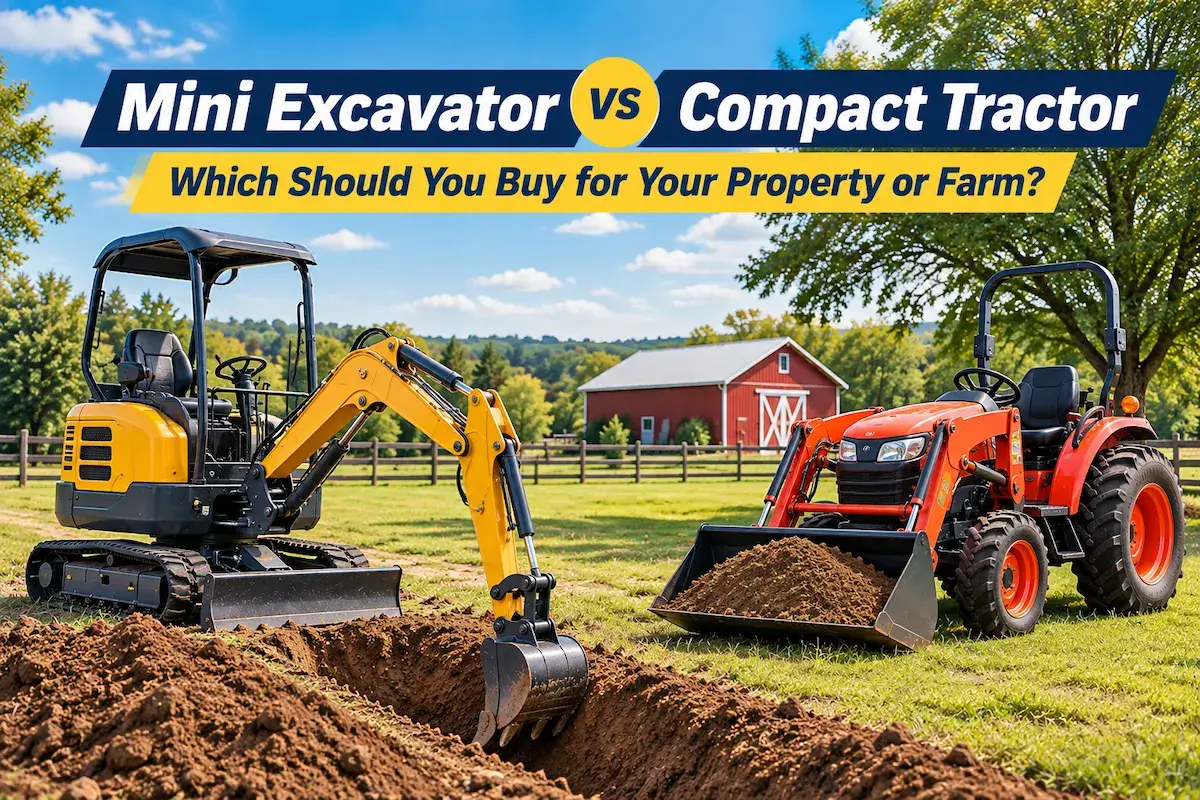
Mini excavator vs compact tractor is a common equipment decision for farm owners, property owners and contractors. The better choice is not simply the machine that is more powerful or more versatile, but the one that matches the work you need to perform most often.
A mini excavator is designed around digging, trenching, reaching and controlled excavation. A compact tractor is generally designed around broader property work such as mowing, towing, material handling and operating rear-mounted or PTO-driven implements where the tractor is equipped for them.
For a farm or property owner who can only buy one machine, the most important question is therefore not “Which machine can do more things?” but “Which machine is better suited to the jobs that matter most on my property?”
Do not base the decision only on total operating hours. Give more weight to jobs that are frequent, expensive to outsource, difficult to schedule, or impossible with the equipment you already own.
If you have already decided that excavation is the main requirement but are unsure about machine size, start with the Руководство по размерам мини-экскаваторов.
Quick Answer — Mini Excavator or Compact Tractor?
Choose a mini excavator when the main jobs involve digging, trenching, drainage, planting pits, removing soil or working in relatively confined areas.
Choose a compact tractor when the main jobs involve mowing, towing, carrying material across a property, maintaining open land or using tractor implements.
| Primary Job | Usually Better Fit | Why |
|---|---|---|
| Digging trenches | Мини-экскаватор | Purpose-built boom, arm and bucket system for excavation |
| Drainage and irrigation work | Мини-экскаватор | Better suited to controlled digging along trenches and localized excavation |
| Planting pits | Мини-экскаватор | Useful where soil must be excavated rather than simply drilled |
| Narrow-access excavation | Мини-экскаватор | Compact excavators can work where wider property equipment may have difficulty accessing |
| Mowing large open areas | Compact Tractor | Tractor-mounted mowing equipment is designed for repeated area coverage |
| Moving material around a property | Compact Tractor | A front loader and travel-oriented layout can be more practical for repeated carrying work |
| PTO-driven implements | Compact Tractor | Many compact tractors support PTO-driven agricultural and property-maintenance implements |
| General farm/property versatility | Compact Tractor | A tractor can support a broad range of mounted and towed implements |
| Dedicated excavation | Мини-экскаватор | Excavation is its primary machine function rather than an added capability |
What Is the Main Difference Between a Mini Excavator and a Compact Tractor?
The two machines are designed around different kinds of work.
A mini excavator centers its design around an excavating boom, arm and bucket. The machine normally works from a relatively concentrated position while the digging equipment reaches into the work area.
A compact tractor is primarily a mobile property or agricultural machine. Depending on configuration, it may use a front loader, three-point hitch, PTO, mower, tiller, blade or other implements.
A mini excavator is primarily an excavation machine. A compact tractor is primarily a mobile implement carrier and general property-work machine.
Attachments can expand both machines, but attachments do not completely remove their underlying design differences.
Mini Excavator vs Compact Tractor for Digging, Trenching and Drainage
If digging is the main reason for buying equipment, a dedicated mini excavator is normally the more logical machine to evaluate first.
Typical excavation jobs include:
- utility trenches;
- drainage trenches;
- irrigation work;
- planting pits;
- small foundations;
- soil removal;
- ditch maintenance;
- localized excavation around a property.
A mini excavator can dig while remaining largely in one working position and reposition excavated material around the work area.
Trenching and drainage are particularly well suited to this layout because the machine can repeatedly excavate along a defined line while controlling bucket position and digging depth.
A compact tractor can also perform digging work when equipped with a compatible backhoe attachment, but that does not automatically make a tractor-backhoe combination equivalent to a dedicated excavator for repeated excavation.
If excavation is only an occasional secondary task, the tractor may still make more sense. If excavation, drainage or trenching is a regular high-value job, the mini excavator becomes much more relevant.
Soil conditions, trench dimensions, underground utilities, access and project scale still determine the appropriate equipment.
Этот Mini Excavator for Utility Work Guide explains trenching and installation applications in more detail.
For buyers specifically comparing dedicated excavation with a backhoe-style machine, see Mini Excavator vs Backhoe.
Compact Tractor vs Mini Excavator for Mowing
If mowing is a major part of the workload, the compact tractor has a clear advantage.
Compact tractors can be configured with mowing equipment and are designed to travel repeatedly across larger areas. This makes them more appropriate for jobs such as maintaining fields, grassed acreage and open property.
A mini excavator is not designed to replace a tractor or dedicated mowing machine for routine area mowing.
If your regular property work is dominated by mowing and your digging requirements are only occasional, a mini excavator is unlikely to be the best first machine.
Which Is Better for Moving Dirt, Gravel or Other Material?
This depends on whether the work is mainly excavating and placing material nearby или transporting material repeatedly across the property.
A mini excavator is well suited to digging soil and placing it around the excavation area.
A compact tractor equipped with a front loader can be more practical when material needs to be collected, carried across the property and dumped somewhere else repeatedly.
Например:
- Digging a drainage trench and placing spoil beside it favors the excavator.
- Moving repeated loader buckets of gravel from one side of a property to another favors the tractor.
Digging productivity and material-transport productivity are different requirements, so buyers should avoid treating them as the same job.
Mini Excavator vs Compact Tractor for Narrow Access
Access can completely change the equipment decision.
Before buying either machine, measure:
- the narrowest gate or entrance;
- the route from the unloading area to the jobsite;
- turning space;
- working clearance;
- overhead obstacles;
- ground conditions;
- the space needed to use the selected attachment.
A machine fitting through a gate does not automatically mean it has enough space to work effectively after entering.
Micro excavators can be especially relevant when excavation is needed in gardens, orchards, residential properties or other confined areas.
Этот Mini Excavator Width Guide explains how to evaluate machine width against real access restrictions.
Which Machine Has the More Useful Attachment System?
Both machine types can support multiple attachments, but they serve different attachment ecosystems.
| Мини-экскаватор | Compact Tractor |
|---|---|
| Digging buckets | Front loader bucket |
| Trenching buckets | Газонокосилка |
| Grading buckets | Rotary tiller |
| Hydraulic breaker | Rear blade |
| Шнек | Box blade |
| Риппер | Post-hole auger |
| Grapple or thumb where compatible | Three-point or PTO implements where compatible |
The important question is not which machine has more attachments. It is which attachment system matches the work you actually perform.
Mini excavator attachment selection is covered separately in the Руководство по навесному оборудованию для мини-экскаваторов.
PTO and Three-Point Implements Are an Important Tractor Advantage
One of the biggest differences between the two machine categories is the tractor’s ability, where equipped, to operate agricultural and property-maintenance implements through a rear three-point hitch and PTO.
This can make a compact tractor much more useful for work such as:
- mowing;
- tilling;
- soil preparation;
- seeding;
- rear grading;
- other PTO-driven or mounted property work.
A mini excavator does not replace this tractor function.
If PTO-driven or rear-mounted implement work represents an important part of the jobs you need to complete, that should carry significant weight in the buying decision.
Which Is Better for Landscaping?
Landscaping can involve both excavation and surface work, so neither machine automatically wins.
A mini excavator becomes attractive when landscaping work includes:
- digging planting pits;
- installing drainage;
- excavating small trenches;
- removing localized soil;
- working close to existing structures;
- working through narrow property access.
A compact tractor may be the better machine where landscaping work mainly involves:
- moving mulch, gravel or soil over distance;
- mowing;
- surface grading;
- maintaining larger open areas;
- towing;
- using rear implements.
For excavation-focused landscaping, see Mini Excavator for Landscaping.
Which Is Better for Farm and Property Work?
This is where the decision becomes more balanced.
A farm or acreage property may require many unrelated jobs during the year. Those jobs can include mowing, maintaining tracks, transporting materials, digging drainage, planting trees, repairing irrigation and preparing soil.
If most important jobs require moving around the property and operating implements, a compact tractor can provide broader everyday versatility.
If excavation represents a recurring equipment gap — especially when drainage, trenching, irrigation repair or planting work is expensive or difficult to outsource — a mini excavator may provide more value.
If the property already has a tractor or another machine for mowing and material transport, adding a mini excavator can fill the excavation gap without trying to duplicate the tractor’s role.
For many property owners, the real decision is not tractor versus excavator forever. It is which machine should be purchased first and which important jobs will remain uncovered afterward.
Read the Mini Excavator for Farm Use Guide for excavation-focused farm applications.
Mini Excavator vs Compact Tractor for Tree Planting
Tree planting illustrates the difference between these machines particularly well.
A tractor-mounted auger can be effective when the job mainly requires drilling repeated holes of a suitable diameter in appropriate soil.
A mini excavator becomes useful when planting requires actual excavation, larger pits, irregular hole shapes, removing difficult soil or working in locations where the machine must dig and place material precisely.
The correct method depends on tree size, root-ball dimensions, soil, spacing and site access.
It would therefore be misleading to say that either an auger or a mini excavator is always the better tree-planting tool.
Which Machine Is Easier to Move Around a Large Property?
A compact tractor is generally more travel-oriented than a tracked mini excavator and is often better suited to repeatedly moving between widely separated jobs around open acreage.
A mini excavator is designed to travel around a jobsite, but its main productivity comes from excavation rather than covering long distances.
If your work involves spending much of the day moving equipment, material or implements across a large property, this difference matters.
If the machine is normally transported to one work area and then spends most of its time digging, the excavator’s slower property travel may matter much less.
What About Ground Disturbance?
Ground impact depends on machine weight, tires or tracks, soil moisture, turning behavior and how the machine is operated.
Rubber tracks can distribute machine weight over a relatively large contact area, but a tracked machine can still disturb turf or soft ground, especially during turning.
Tractor tires can also rut soft ground when the machine is loaded or when the soil is wet.
Do not choose equipment based on a simple claim that tracks are always “ground friendly” or tires always cause less damage. Evaluate the actual ground conditions and machine operating method.
Ownership Considerations: Transport, Maintenance and Budget
The work a machine can perform is only one part of the buying decision. Transport, maintenance, parts availability and how the purchase budget is being used can also affect which machine makes more sense.
| Factor | Мини-экскаватор | Compact Tractor |
|---|---|---|
| Транспорт | Often requires suitable trailer or transport equipment; check actual machine weight, width and transport dimensions | Transport requirements depend on tractor size, weight and attached implements |
| Loading / Unloading | Trailer ramps, loading capacity and secure transport setup should be considered | Trailer requirements may increase when loaders or rear implements are installed |
| Daily Maintenance | Hydraulic hoses, grease points, tracks, fluids and engine checks | Engine, tires, lubrication, transmission, PTO and implement-related checks |
| Parts Planning | Hydraulic parts, seals, filters, track components and engine service parts may matter | Engine, drivetrain, PTO, tires and implement parts may matter |
| Budget Use | More specialized investment when excavation is the priority | Broader property-use investment when several implement-based jobs are required |
| Utilization | Best justified when excavation replaces recurring rental or outsourced work | Best justified when property maintenance and implement work occur regularly |
The better value is not automatically the machine with the lower purchase price. It is the machine that replaces more of the work you currently rent, outsource or cannot complete efficiently.
Mini Excavator vs Compact Tractor — Side-by-Side Comparison
| Factor | Мини-экскаватор | Compact Tractor |
|---|---|---|
| Primary design purpose | Excavation | General property / agricultural work |
| Trenching | Strong fit | Possible with suitable backhoe or other equipment |
| Drainage excavation | Strong fit | Secondary capability depending on configuration |
| Mowing | Not a primary function | Strong fit with suitable mower |
| PTO implements | No tractor-style PTO system | Major advantage where PTO equipped |
| Material carrying across property | Limited compared with loader-oriented equipment | Good fit with front loader |
| Localized digging | Strong fit | Depends on backhoe configuration |
| Narrow excavation areas | Potentially strong fit depending on machine dimensions | Depends heavily on tractor width and maneuvering room |
| Open-property travel | Secondary function | Strong fit |
| General implement versatility | Excavator-focused attachments | Broad tractor implement ecosystem |
When Should You Choose a Mini Excavator?
A mini excavator deserves priority when your most important recurring work involves:
- trenching;
- drainage;
- irrigation excavation;
- planting pits;
- localized digging;
- confined-access work;
- small utility excavation;
- repeated bucket excavation.
If these are the jobs that repeatedly require outside contractors or rental equipment, owning a mini excavator may solve a meaningful equipment gap.
Buyers who decide excavation is the priority can compare available machines on the Продажа мини-экскаваторов страница.
When Should You Choose a Compact Tractor Instead?
A compact tractor is usually the more sensible first machine when the majority of the important workload involves:
- mowing fields or acreage;
- tilling or soil preparation;
- towing trailers or implements;
- carrying material across the property;
- surface grading;
- using rear-mounted implements;
- PTO-driven work;
- general open-property maintenance.
If digging is only an occasional task, renting an excavator when required may be more logical than buying an excavator that remains unused for most of the year.
A mini excavator should not be presented as a replacement for a compact tractor when the primary work is mowing, towing or PTO-based property maintenance.
What If You Already Own a Compact Tractor?
This changes the decision significantly.
A property owner who already has a tractor may already have mowing, towing, loader work and general property travel covered.
In that situation, a mini excavator does not need to replace the tractor. Instead, it can add a dedicated capability that the existing machine does not perform as efficiently: excavation.
This combination can make sense where the property regularly requires drainage work, trenching, irrigation repairs, planting, ditch maintenance or other concentrated digging tasks.
Where Does a Micro Excavator Such as the ZL-05 Fit?
Этот ZL-05 МИКРОЭКСКАВАТОР 0,5 Т represents the very compact end of the excavator category.
Current reference specifications include:
- operating weight: 420 ± 20 kg;
- overall width: 640 mm;
- maximum digging depth: 912 mm;
- Rato gasoline engine reference rated at 6.5 HP;
- boom side swing;
- maximum hydraulic-system flow: 12 L/min.
Its intended role is compact, light excavation where machine access is important. Typical supported applications include landscaping, planting pits, light trenching, irrigation maintenance, orchard work and property maintenance.
The ZL-05 is not a compact-tractor replacement. It should not be selected when the buyer’s main jobs are mowing acreage, towing, long-distance material transport or PTO-driven work. Its value comes from compact excavation capability.
What If You Can Only Buy One Machine?
List the important jobs you expect to perform over a full year and evaluate them by frequency, cost, difficulty and whether you already have another way to complete them.
Choose the Mini Excavator First If:
- digging is one of your highest-value recurring tasks;
- you frequently rent excavation equipment;
- drainage and trenching are regular jobs;
- access is limited for larger equipment;
- you already have another way to mow and move material.
Choose the Compact Tractor First If:
- mowing is a regular requirement;
- you need to move material across a larger property;
- you regularly use rear implements;
- you need towing capability;
- excavation is occasional rather than regular.
If machine utilization is still uncertain, renting before buying can provide useful real-world information. The Rent vs Buy a Mini Excavator Guide explains how to evaluate that decision.
Mini Excavator vs Compact Tractor vs Skid Steer — Do You Need Another Option?
Sometimes the real choice is not limited to a tractor and an excavator.
If the work is heavily focused on loading, grading, handling pallets or operating hydraulic attachments while moving frequently around a jobsite, a skid steer or compact loader may deserve consideration.
Этот Mini Excavator vs Skid Steer Guide compares those categories separately.
Do not force a tractor-versus-excavator decision if a third equipment category better matches the work.
Final Answer — Mini Excavator or Compact Tractor?
A mini excavator is generally the stronger choice when digging, trenching and drainage are the main jobs. A compact tractor is generally the stronger choice when broad property maintenance, mowing, material transport and implement use dominate the workload.
Neither machine is universally better.
For many farms and larger properties, the machines are complementary rather than direct substitutes: the tractor handles recurring mobile property work, while the mini excavator handles concentrated excavation.
Before buying, identify the jobs that are most frequent, expensive to outsource or difficult to complete with your current equipment. Then compare access limitations, transport requirements, attachment needs and the work each machine would actually replace.
Not Sure Whether a Mini Excavator Fits Your Property?
Tell us your main job, site access width and destination. If you already know your required digging depth, attachments, quantity or budget range, you can include those details too.
We can help you narrow down whether a compact excavator is suitable for the work and which size range is worth comparing.
Explore Продажа мини-экскаваторов or review the ZL-05 МИКРОЭКСКАВАТОР 0,5 Т.
Frequently Asked Questions About Mini Excavators vs Compact Tractors
Is a mini excavator better than a compact tractor?
Not universally. A mini excavator is primarily designed for excavation, while a compact tractor is designed for broader property and implement-based work. The better machine depends on the jobs that are most important on the property.
Which is better for digging, a mini excavator or a compact tractor?
For regular dedicated excavation, a mini excavator is generally the more purpose-built choice. A compact tractor can perform some digging work when equipped with a compatible backhoe, but whether that is sufficient depends on how frequently and intensively the buyer needs to excavate.
Which is better for a small farm?
If the main jobs include mowing, towing, carrying material and operating farm implements, a compact tractor may provide broader daily versatility. If drainage, trenching, planting pits and excavation are important recurring jobs, a mini excavator may provide more value.
Can a mini excavator replace a compact tractor?
Not for many common tractor jobs. A mini excavator does not replace tractor functions such as routine mowing, PTO-driven implements, towing and repeated material transport across larger open properties.
Should I buy a mini excavator if I already own a compact tractor?
It may make sense if the tractor already covers mowing, towing and material handling but you regularly need dedicated excavation for drainage, trenches, irrigation, planting or similar work.
Is a micro excavator like the ZL-05 suitable for property work?
It can be suitable where the work involves compact-access excavation such as landscaping, planting pits, light trenching, irrigation maintenance, orchard work or similar property tasks. It is not intended to replace a tractor for mowing, towing, long-distance material transport or PTO-driven work.