
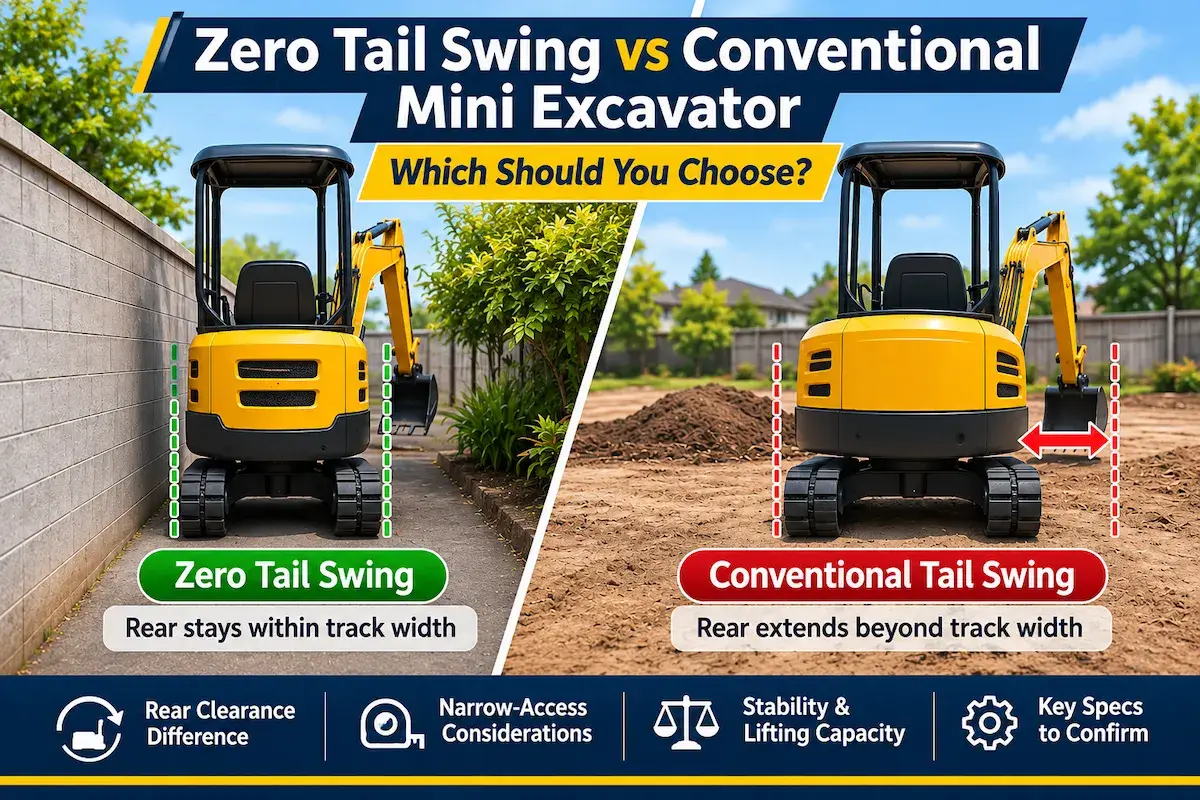
A zero tail swing mini excavator can be a practical choice for working beside walls, fences and other obstacles where rear rotation clearance is limited. However, zero tail swing does not automatically mean a narrower machine, greater stability or better performance in every working environment.
Two mini excavators with similar operating weights may have different machine widths, rear swing radii, boom configurations and lifting capabilities. Buyers need to evaluate these specifications together rather than select a machine based on its tail swing label alone.
This guide compares zero, reduced and conventional tail swing mini excavators, explains their advantages and limitations, and helps buyers determine which configuration is suitable for their intended applications.
Quick Answer: Zero Tail Swing vs Conventional Mini Excavator
A zero tail swing mini excavator is generally a suitable option when rear clearance during upper-structure rotation is restricted. Its rear structure is designed to remain within the specified track-width envelope under the manufacturer’s stated configuration.
A conventional tail swing mini excavator requires additional rear clearance but remains a practical choice for open construction sites, landscaping, farm work and other applications where sufficient operating space is available.
Neither design is universally better. Buyers should compare machine width, rear swing radius, stability, rated lifting capacity, boom swing and the complete working envelope before making a purchasing decision.
What Is a Zero Tail Swing Mini Excavator?
A zero tail swing mini excavator is designed so that the rear portion of its rotating upper structure remains within the specified track-width envelope during rotation under the manufacturer’s stated configuration.
Unlike a conventional excavator with a projecting rear counterweight, a zero tail swing machine uses a compact rear structure to reduce the space required behind and beside the machine during rotation.
This design can be particularly useful for:
- Working alongside walls and fences
- Residential construction
- Urban utility installation
- Landscaping in confined areas
- Working within narrow property boundaries
- Job sites with restricted rear rotation clearance
Важно: Zero tail swing does not mean the entire excavator remains within the width of its tracks. The boom, arm, bucket and other attachments still require sufficient operating clearance.
Manufacturers may use different measurement conventions. Buyers should confirm the actual rear swing dimensions and the undercarriage configuration to which the zero tail swing specification applies.
What Is a Conventional Tail Swing Mini Excavator?
A conventional tail swing mini excavator has a rear structure that extends beyond the track width during upper-structure rotation.
This design provides additional packaging flexibility for components such as the counterweight and engine compartment. However, the projecting rear structure requires more clearance during rotation compared with a zero tail swing design of otherwise comparable dimensions.
Conventional tail swing machines remain suitable for many applications, including:
- Open construction sites
- General excavation
- Farm and agricultural work
- Landscaping with sufficient operating space
- Foundation excavation
- Material loading and handling
Although conventional designs may offer greater flexibility in counterweight placement, their actual stability, lifting capacity and digging performance depend on the complete machine configuration rather than the tail swing type alone.
Zero vs Reduced vs Conventional Tail Swing
Mini excavators are commonly described as having zero, reduced or conventional tail swing configurations. Each design has different rear clearance characteristics.
| Configuration | Rear Overhang | Typical Application |
|---|---|---|
| Zero Tail Swing | Designed to remain within the specified track-width envelope during rotation. | Confined sites and work near boundaries. |
| Reduced Tail Swing | Limited rear projection beyond the tracks, depending on the design. | Sites with restricted but available rear clearance. |
| Conventional Tail Swing | Rear structure extends beyond the track width during rotation. | Open sites with sufficient operating space. |

Reduced tail swing is sometimes described as short tail swing or minimal tail swing. There is no universal overhang threshold that applies to every manufacturer.
Rather than comparing marketing terminology alone, buyers should request the actual dimensional drawing and rear swing measurements for each machine.
What Is Mini Excavator Tail Swing Radius?
Rear swing radius describes the distance from the center of upper-structure rotation to the outermost rear point covered by the manufacturer’s stated measurement.
It helps buyers understand the space occupied by the rear of the excavator as the upper structure rotates.
Three related specifications should be checked separately:
| Технические характеристики | What It Describes |
|---|---|
| Overall Machine Width | The external width of the machine in the stated configuration, relevant to access and transport. |
| Rear Swing Radius | The radial distance from the rotation center to the specified outer rear point. |
| Rear Overhang | The extent to which the rear structure projects beyond the track-width envelope during rotation. |
These figures are not interchangeable. A machine with a narrow transport width may still require considerable rear rotation clearance.
For machines with adjustable undercarriages, buyers should also confirm whether rear swing and overhang specifications apply to the retracted or extended track configuration. A machine may satisfy a zero tail swing definition only in a specified operating configuration.
Zero Tail Swing vs Conventional Mini Excavator: Comparison Table
| Comparison Factor | Zero Tail Swing | Conventional Tail Swing |
|---|---|---|
| Rear rotation clearance | Reduced rear projection under the stated configuration. | Additional clearance required for rear overhang. |
| Working beside obstacles | Often suitable where rear clearance is restricted. | Requires sufficient clearance around the rear structure. |
| Machine width | Not necessarily narrower. | May be narrower or wider depending on the model. |
| Counterweight packaging | Limited by the compact rear design. | Generally greater packaging flexibility. |
| Стабильность | Depends on complete machine configuration. | Depends on complete machine configuration. |
| Lifting capacity | Check manufacturer-rated lifting data. | Check manufacturer-rated lifting data. |
| Производительность при копании | Depends on hydraulic and working equipment design. | Depends on hydraulic and working equipment design. |
| Service accessibility | Model-dependent. | Model-dependent. |
| Purchase price | Depends on model and configuration. | Depends on model and configuration. |
The primary difference is rear clearance during rotation. Other purchasing factors should be evaluated using the specifications of the individual machines being compared.
Advantages and Disadvantages of Zero Tail Swing Mini Excavators
Возможные преимущества
- Reduced rear clearance requirements — Useful when working near walls, fences and other boundaries.
- Greater positioning flexibility in confined spaces — Reduced rear overhang may allow more practical machine positioning where space is limited.
- Potentially fewer repositioning movements — Depending on the site layout and working equipment, the operator may be able to complete certain tasks without moving the undercarriage as frequently.
- Suitability for restricted job sites — Particularly relevant to residential construction, urban utilities and landscaping.
Potential Limitations
- Compact component packaging — Counterweight placement, component layout and service access may be affected by the machine design.
- Machine width may still be substantial — Zero tail swing does not guarantee that the excavator can pass through narrow gates or doorways.
- Front working clearance is still required — The boom, arm, bucket and attachments may extend beyond the undercarriage.
- Performance must be verified — Stability, lifting capacity and digging force cannot be determined from tail swing configuration alone.
These limitations vary by model. Buyers should compare the actual specifications and working conditions rather than assume that every zero tail swing excavator has the same advantages or disadvantages.
How Tail Swing Affects Stability, Lifting Capacity and Digging Performance
Stability and Lifting Capacity
A conventional tail swing design may provide greater flexibility for counterweight placement, while a zero tail swing design must accommodate the counterweight within a more compact rear structure.
Actual stability and lifting capability depend on several factors:
- Эксплуатационная масса
- Counterweight design and mass
- Center of gravity
- Undercarriage width and track configuration
- Boom and arm geometry
- Attachment weight
- Lifting radius, height and direction
- Ground conditions and machine positioning
It is therefore incorrect to assume that every conventional tail swing excavator has higher lifting capacity than a zero tail swing machine.
For lifting applications, buyers should request the manufacturer’s rated lifting data or applicable lift chart for the exact machine configuration. Our Mini Excavator Lifting Capacity Guide explains how to interpret these ratings.
Производительность при копании
Rated bucket breakout force and arm digging force depend primarily on hydraulic pressure, cylinder dimensions, linkage geometry and the manufacturer’s rating configuration.
Tail swing type does not independently determine these force ratings. Actual excavation performance also depends on machine stability, bucket selection, ground conditions and the working method.
Buyers comparing excavation capability should refer to the Mini Excavator Digging Force Guide rather than infer digging force from the rear structure of the machine.
Zero Tail Swing vs Swing Boom: What Is the Difference?
Zero tail swing and swing boom are two separate excavator features that solve different working-space problems.
| Feature | Main Function | Typical Benefit |
|---|---|---|
| Zero Tail Swing | Reduces rear projection during upper-structure rotation. | Working where rear rotation clearance is limited. |
| Swing Boom | Allows the boom to pivot sideways relative to the upper structure. | Offset digging alongside walls, fences and other obstacles. |

A mini excavator can have a swing boom without zero tail swing, zero tail swing without a swing boom, both features or neither.
For example, a buyer digging a trench beside a wall may need boom swing to position the bucket along the required digging line. If the same machine must rotate within a confined space, rear tail swing clearance becomes an additional consideration.
Наш Mini Excavator Swing Boom Guide explains boom swing angles, offset digging and the specifications buyers should verify.
Is Zero Tail Swing Better for Narrow Spaces?
Not necessarily. Buyers working in restricted areas should evaluate three separate requirements: entering the site, rotating within the site and performing the intended excavation.
1. Entering the Job Site
The machine must first pass through the available access point. Overall machine width, transport height and any projecting components should be checked against the actual opening.
A narrow conventional tail swing excavator may be able to enter a site that a wider zero tail swing machine cannot access.
For detailed access measurements, see our Mini Excavator Width Guide.
2. Rotating Within the Job Site
After entering the site, the excavator needs sufficient clearance to rotate its upper structure. Rear swing radius, rear overhang and the position of surrounding obstacles determine whether the planned machine movement can be accommodated.
3. Completing the Intended Work
Successful access and rotation do not guarantee that the machine can complete the job. Buyers must also account for boom geometry, attachment movement, spoil placement, loading space and machine repositioning.

Buyer Tip: Measure both the access route and the intended operating area before choosing an excavator. Zero tail swing reduces one clearance requirement, but the complete working envelope must still be considered. Always follow the manufacturer’s operating instructions and applicable job-site safety procedures.
Which Tail Swing Configuration Should You Choose for Your Job?
| Заявка | Main Consideration | Configuration to Consider |
|---|---|---|
| Residential construction | Restricted access and property boundaries. | Zero or reduced tail swing where rear clearance is limited. |
| Ландшафтный дизайн | Access width, planting areas and existing structures. | Any suitable design based on the available space. |
| Urban utility work | Confined working corridors and nearby obstacles. | Zero or reduced tail swing where appropriate. |
| Working beside walls | Rear rotation clearance and offset digging requirements. | Check both tail swing and swing boom. |
| Open construction sites | Digging capability, stability and productivity. | Conventional or compact rear designs. |
| Farm and orchard work | Tree spacing, ground conditions and access routes. | Model selection based on actual working dimensions. |
| Property maintenance | Access through gates and space around buildings. | Compact machines matched to the site layout. |
These are initial selection considerations rather than universal recommendations. Buyers working on small residential job sites can also review our Mini Excavator for Residential Construction Guide for application-specific machine selection advice.
ZL-05 0.5 Ton Micro Excavator: Narrow-Access Considerations
For buyers carrying out light excavation, landscaping, planting and property maintenance, the ZL-05 МИКРОЭКСКАВАТОР 0,5 Т provides an example of a compact machine designed for narrow-access applications.
| Технические характеристики | ZL-05 |
|---|---|
| Класс машины | Микроэкскаватор грузоподъемностью 0,5 тонны |
| Эксплуатационная масса | 420 ± 20 кг |
| Транспортная ширина | 640 mm (25.2 in) |
| Boom Swing | 50° влево / 50° вправо |
| Смещение ковша | 245 мм слева / 245 мм справа |
| Типичные области применения | Light excavation, landscaping, planting and property maintenance. |
The narrow transport width is relevant to restricted access, while the swing boom supports offset digging. These are separate characteristics from rear tail swing clearance.
If your application requires a specific rear swing radius or zero tail swing configuration, contact ZHAOLU to confirm the actual rear clearance dimensions of the offered machine before ordering.
What Buyers Should Check Before Ordering
When comparing mini excavator quotations, request the dimensional and performance specifications for the exact configuration being offered.
- Machine model and operating weight
- Overall transport width and height
- Rear swing radius and maximum rear overhang
- Tail swing classification
- Undercarriage width used for rear swing measurements
- Retracted and extended track dimensions, where applicable
- Boom swing availability and swing angle
- Complete working envelope
- Maximum digging depth and working reach
- Planned attachment dimensions and weight
- Manufacturer-rated lifting data, where required
- Available job-site access and operating clearance
- Ground conditions and service requirements
Этот Руководство по техническим характеристикам мини-экскаваторов explains the wider range of technical parameters buyers should review when comparing different machines.
Buyers who are still selecting an appropriate machine class can start with our Руководство по размерам мини-экскаваторов.
Final Answer: Is Zero Tail Swing Better Than Conventional Tail Swing?
Zero tail swing mini excavators are worth considering when rear rotation clearance is a major job-site constraint. They can be particularly useful for working alongside buildings, fences and other obstacles.
Conventional tail swing mini excavators remain practical where sufficient operating space is available and the machine’s specifications match the intended work.
The right choice depends on the complete machine configuration, including access width, rear swing clearance, boom swing, digging capability and rated lifting performance.
Explore our продажа мини-экскаваторов to compare available machine classes and discuss the configuration required for your application.
Need Help Choosing a Mini Excavator for Your Job Site?
Send ZHAOLU your intended application, available access width, working space, required digging depth, planned attachments, destination country and postal code.
We can help you compare machine configurations and confirm the specifications required for your job before preparing a quotation.
Frequently Asked Questions About Zero Tail Swing Mini Excavators
What does zero tail swing mean on a mini excavator?
It means the rear portion of the rotating upper structure is designed to remain within the specified track-width envelope during rotation under the manufacturer’s stated configuration.
What is the difference between zero tail swing and conventional tail swing?
Zero tail swing minimizes rear projection relative to the track width, while conventional tail swing allows the rear structure to extend beyond the tracks during rotation.
Is reduced tail swing the same as zero tail swing?
No. Reduced tail swing limits rear overhang but may still extend beyond the tracks. Buyers should confirm the actual measurements because terminology varies between manufacturers.
Are zero tail swing excavators better for tight spaces?
They can be useful where rear rotation clearance is restricted. However, overall machine width, boom movement, attachment dimensions and the complete working envelope must also be considered.
Are conventional tail swing excavators more stable?
Not automatically. Stability depends on operating weight, counterweight design, center of gravity, undercarriage width, attachment configuration and working conditions.
Does zero tail swing reduce digging force?
Not necessarily. Rated digging force depends primarily on hydraulic and linkage design. Tail swing type alone does not determine the machine’s rated bucket or arm digging force.
Is zero tail swing the same as boom swing?
No. Zero tail swing describes rear clearance during upper-structure rotation. Boom swing allows the boom to pivot sideways for offset digging. They are independent features.
How do I check mini excavator tail swing clearance?
Request the manufacturer’s rear swing radius, maximum rear overhang and applicable undercarriage dimensions. Compare the complete machine working envelope against the actual site conditions.
Can a zero tail swing excavator hit nearby obstacles?
Yes. Zero tail swing reduces rear projection, but the machine can still contact obstacles with its upper structure, boom, arm or attachments. Appropriate operating clearance and safety procedures are always required.
Are zero tail swing mini excavators more expensive?
Not necessarily. Purchase price depends on the manufacturer, machine class, components, equipment configuration and destination market. Buyers should compare quotations for complete machine configurations.