
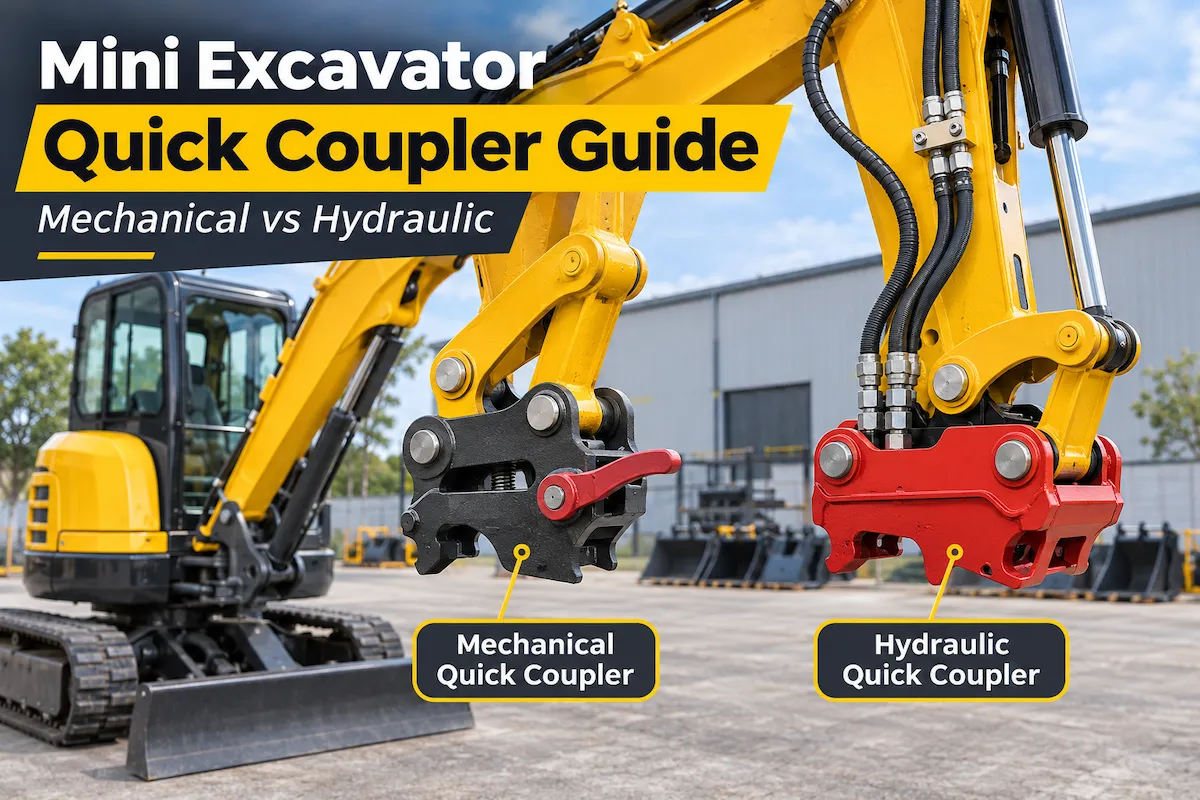
A mini excavator quick coupler is an interface between the dipper arm and the attachment. It allows buckets and other work tools to be connected and released as a system, rather than repinning the attachment directly to the arm for every change. Buyers comparing options quickly meet a second question: mechanical or hydraulic.
This guide explains how mechanical and hydraulic quick couplers differ, why a hydraulic coupler does not automatically connect hydraulic hoses, and what must be confirmed on both the machine side and the attachment side before ordering.
Quick Answer: Mechanical or Hydraulic Quick Coupler?
A mechanical quick coupler is generally simpler and involves no dedicated hydraulic circuit for the locking function. It may suit buyers who change attachments less frequently or who want fewer system components.
A hydraulic quick coupler uses hydraulic actuation for the locking mechanism, which is often more convenient where attachments are changed frequently. It requires a compatible hydraulic control arrangement on the machine. Importantly, hydraulic actuation of the coupler lock does not automatically mean that hydraulic hoses for powered attachments are also connected.
The right choice depends on attachment-change frequency, machine configuration, hydraulic control availability and the buyer’s maintenance priorities.
What Is a Mini Excavator Quick Coupler?
A quick coupler, also called a quick hitch, is a mechanical interface mounted between the dipper arm and the attachment. Its purpose is to allow compatible attachments to be connected and released without removing and reinstalling the dipper pins for every change.
The coupler itself is not the attachment. It adds an interface layer between the machine and the bucket, breaker, auger or other tool. That interface layer has its own dimensions, weight, locking method and compatibility requirements.
A quick coupler system therefore involves three parties: the machine, the coupler and the attachment. All three must be technically compatible for the system to work as intended.
Pin-On vs Quick Coupler: What Changes?
With a pin-on configuration, the attachment connects directly to the dipper arm and linkage using mounting pins. The interface is simple and involves fewer components between the arm and the tool.
A quick coupler inserts an additional interface between the arm and the attachment. This changes the attachment-change workflow: instead of removing and reinstalling pins, the coupler locks and releases the attachment through its own mechanism.
The added interface also changes what must be confirmed. With a pin-on attachment, the key question is whether the attachment matches the arm and linkage. With a quick coupler, the questions expand to whether the coupler fits the machine and whether the attachment fits the coupler.
Buyers comparing attachment options across different mounting systems should review the Руководство по навесному оборудованию для мини-экскаваторов for attachment-type selection, while this page focuses on the coupler interface itself.
Mechanical Quick Coupler: How It Works
A mechanical quick coupler uses a mechanical locking system to secure the attachment. The locking and unlocking action is performed through a manual procedure rather than a hydraulic actuator.
Depending on the specific design, the operator may need to leave the operating position to complete or verify the attachment change. Some mechanical systems use a lever, a wrench-operated mechanism or a semi-automatic arrangement. The exact procedure varies by coupler design and manufacturer.
Mechanical couplers generally involve fewer hydraulic components than hydraulic couplers. They are often considered where attachment changes are less frequent, where the machine does not have a suitable hydraulic control arrangement for a coupler, or where the buyer prefers a simpler system.
Hydraulic Quick Coupler: How It Works
A hydraulic quick coupler uses hydraulic actuation to control the locking and unlocking mechanism. The machine’s hydraulic system operates a cylinder or equivalent actuator that moves the locking element.
This arrangement is generally intended to make attachment changes more convenient, particularly where attachments are changed frequently. The operator may be able to lock and release the attachment from the operating position, depending on the coupler design and machine configuration.
A hydraulic quick coupler requires a compatible hydraulic control arrangement on the machine. The coupler locking function is different from the hydraulic function used to power attachments such as breakers, augers or grapples, although the exact hydraulic supply and control arrangement depends on the machine and coupler design.
For general hydraulic system terminology and flow/pressure interpretation, the Руководство по гидравлической системе мини-экскаватора provides background. This page stays focused on the coupler locking function.
Mechanical vs Hydraulic Quick Coupler
| Factor | Mechanical Quick Coupler | Hydraulic Quick Coupler |
|---|---|---|
| Locking actuation | Manual locking / unlocking procedure | Hydraulic actuation of the locking mechanism |
| Operator involvement | Usually involves leaving the operating position to complete or verify the change; exact procedure depends on design | May allow locking / unlocking from the operating position; depends on coupler and machine configuration |
| Attachment-change frequency | Generally better suited to less frequent changes | Generally more convenient where attachments are changed frequently |
| System complexity | Generally fewer hydraulic components | Requires a compatible hydraulic control arrangement |
| Hydraulic requirement | No dedicated hydraulic locking circuit | Requires a hydraulic locking circuit or control function |
| Cost tendency | Generally lower system complexity; actual pricing depends on supplier and specification | Generally higher system complexity; actual pricing depends on supplier and specification |
| Maintenance considerations | Inspect mechanical locking components and engagement | Inspect hydraulic locking components, hoses and engagement |
| Suitable use pattern | Less frequent changes; simpler system preference | Frequent changes; operator convenience priority |
Both types serve the same interface function. Neither type is universally better; the appropriate choice depends on the work pattern, machine configuration and buyer priorities.
Does a Hydraulic Quick Coupler Automatically Connect Hydraulic Hoses?
No, not necessarily. A hydraulic quick coupler usually refers to hydraulic actuation of the attachment-locking mechanism. The “hydraulic” part of the name describes how the coupler lock is operated, not whether the hydraulic hoses for a powered attachment are connected automatically.
Hydraulic hose connection for a breaker, grapple, auger or other powered attachment is a separate function. It may require manual connection of the attachment’s hydraulic hoses, unless the coupler system is specifically designed and specified to provide automatic hydraulic connection.
Some specialized automatic coupling systems combine attachment locking with automatic connection of hydraulic services, but terminology varies by manufacturer. Buyers should confirm whether a system only operates the coupler lock hydraulically or also connects the attachment’s hydraulic lines automatically.
When powered attachments are part of the plan, the auxiliary hydraulic requirements should be reviewed separately from the coupler locking circuit. The Hydraulic System Guide covers auxiliary hydraulic circuit basics.
How Often Do You Change Attachments?
Attachment-change frequency is one of the most practical inputs into the mechanical-versus-hydraulic decision.
If attachments are changed infrequently, a mechanical coupler may be sufficient. The simpler system and the absence of a dedicated hydraulic locking circuit can reduce the number of components involved in the interface.
If attachments are changed frequently during a working day, the convenience of hydraulic locking may become more important. A hydraulic coupler can reduce the repeated manual steps associated with mechanical locking, provided the machine has the required hydraulic control arrangement.
This is a workflow question rather than a universal rule. A buyer who changes one bucket to one breaker once a week has a different requirement from an operator who switches between several attachments multiple times per day.
Machine-Side vs Attachment-Side Compatibility
Quick coupler compatibility has two directions, and both must be confirmed.
Machine-Side Compatibility
The coupler must correctly fit the dipper arm, linkage and machine mounting geometry. This includes the machine-side pin arrangement, pin dimensions, mounting width and the way the coupler attaches to the arm.
Attachment-Side Compatibility
The bucket or attachment must correctly match the coupler’s pickup geometry. This includes the attachment-side pin interface, locking surface and required dimensions.
A coupler that fits the machine does not automatically make every bucket compatible. Likewise, a bucket that fits another coupler of a similar size may still not fit this coupler. The machine-side fit and the attachment-side fit are separate checks.
Pin Diameter, Pin Centers and Mounting Width
Pin diameter, pin-to-pin center distance and ear or dipper mounting width remain relevant when a coupler is introduced. They describe the physical interface between the machine and the coupler, and between the coupler and the attachment.
Pin diameter is the diameter of the mounting pins. Pin centers describe the distance between pin centerlines. Mounting width describes the width of the mounting brackets or the dipper arm interface. Linkage geometry and coupler pickup dimensions also affect whether the system engages correctly.
These dimensions must be measured and confirmed rather than inferred from the machine’s operating weight or tonnage class. Even relatively small differences can prevent direct fitment or interfere with the required engagement.
Этот Mini Excavator Bucket Size Guide explains bucket-side measurement in more detail. This page uses the same dimensions in the context of coupler compatibility.
How a Quick Coupler Affects Bucket Compatibility
Adding a coupler introduces an interface layer between the machine and the bucket. That layer changes what the bucket must match. Instead of matching the dipper arm directly, the bucket must match the coupler’s pickup geometry and locking arrangement.
Compatibility therefore requires confirming that the coupler fits the machine, that the bucket fits the coupler, that the attachment geometry is suitable for the locking system, and that the locking mechanism can engage correctly with the attachment.
A matching pin diameter alone is not sufficient. Two buckets with the same pin diameter can have different pin-center distances, different ear widths or different locking surfaces. The full interface must be confirmed.
Does a Quick Coupler Change Digging Geometry?
A coupler may add distance between the dipper linkage and the attachment. It may also add weight and alter the attachment’s position relative to the arm. These changes can affect working geometry, bucket tip position, breakout behavior and machine balance.
The magnitude of the effect depends on the coupler’s design and the machine configuration. A low-profile coupler designed to keep the attachment close to the original geometry may have a different effect from a taller coupler that adds more offset.
The actual effect depends on the coupler geometry and machine configuration. Buyers should not assume a fixed percentage loss or gain in digging performance without model-specific data. The Mini Excavator Digging Force Guide explains breakout force concepts separately.
Quick Coupler Weight and Machine Stability
A quick coupler adds weight to the front attachment system. That added weight, combined with the attachment and the material being handled, can affect machine balance, available lifting performance and working stability.
The effect is configuration-dependent. A light coupler on a stable machine with a suitable attachment may have a modest effect; a heavier coupler on a smaller machine near its working limits may have a more noticeable effect.
Model-specific lifting data should govern lifting decisions. This article does not provide lifting-capacity reduction figures because the actual rated limit depends on the machine model, coupler, attachment and working position. The Mini Excavator Lifting Capacity Guide explains lifting capacity interpretation.
Hydraulic Requirements for a Hydraulic Quick Coupler
A hydraulic quick coupler requires a hydraulic control arrangement for the locking function. This typically involves a dedicated circuit, control valve or control function that allows the operator to actuate the locking mechanism.
The machine-side hydraulic configuration must be compatible with the coupler’s requirements. Hose routing, connection points and control arrangement should be confirmed with the coupler supplier and the machine specification.
The coupler-locking function is distinct from the auxiliary hydraulic function used to power attachments. Depending on the machine design, the hydraulic supply and control arrangement may be configured differently. A hydraulic quick coupler does not, by itself, provide the flow, connections or operating circuit required for a breaker, auger or grapple. Those requirements should be checked separately against the machine’s auxiliary hydraulic specifications.
What Buyers Should Confirm About the Locking System
The locking system is a safety-critical part of the coupler interface. Buyers should confirm the coupler’s locking method, whether a secondary locking or retention feature is provided, and whether a visual or mechanical lock indication is present.
The manufacturer’s operating procedure for attachment engagement and lock verification should be followed. Operators should verify engagement according to the coupler manufacturer’s instructions and the machine’s operating manual.
This article does not provide step-by-step lock verification procedures, because the correct procedure varies by coupler design. Buyers should obtain the coupler manufacturer’s documentation and follow it, together with the machine’s operating manual.
What Should ZL-05 Buyers Confirm Before Ordering a Quick Coupler?
The ZL-05 is a 0.5 Ton Micro Excavator. Some machine specifications are confirmed, but the coupler-related configuration and interface dimensions are not currently verified. The table below shows both sets of information.
| Технические характеристики | Current ZL-05 Reference |
|---|---|
| Эксплуатационная масса | 420 ± 20 кг |
| Ширина станка | 640 mm / 25.2 in |
| Максимальная глубина копания | 912 мм |
| Максимальный радиус копания | 1962 мм |
| Engine Reference | Rato gasoline engine |
| Reference Engine Power | 6,5 л.с. |
| Maximum System Flow | 12 л/мин |
| Quick Coupler Type | Not currently verified |
| Coupler Weight | Not currently verified |
| Machine-Side Pin Dimensions | Not currently verified |
| Attachment-Side Interface | Not currently verified |
| Hydraulic Locking Circuit | Not currently verified |
| Locking Method | Not currently verified |
| Secondary Retention System | Not currently verified |
Важно: These coupler-related dimensions and configuration details must be confirmed from the current production specification before ordering. They cannot be inferred from machine weight, system flow, engine power, product photos or generic 0.5-ton excavator assumptions. The ZL-05 МИКРОЭКСКАВАТОР 0,5 Т product page lists the confirmed machine data.
Buyers planning to add a quick coupler to a ZL-05 should confirm the coupler type, machine-side interface, attachment-side interface and hydraulic control arrangement with the supplier before ordering.
What Buyers Should Send the Supplier
A clear quick coupler request reduces the risk of receiving an incompatible system. Buyers should provide the following information where available:
- Excavator brand and model
- Machine operating weight / class
- Current attachment mounting type (pin-on or existing coupler)
- Photos of the existing bucket or attachment mounting area
- Диаметр штифта
- Pin-to-pin center distance
- Ear / dipper mounting width
- Required attachment types
- Expected attachment-change frequency
- Mechanical or hydraulic preference, if known
- Machine hydraulic-control information if a hydraulic coupler is required
- Страна назначения
- Количество
If dimensions are uncertain, clear photographs and measurement data should be provided. Photos alone are not a substitute for measurements, because pin dimensions and mounting geometry cannot be reliably inferred from images.
Common Quick Coupler Buying Mistakes
- Choosing a coupler by machine tonnage only
- Assuming all buckets fit the same coupler
- Checking machine-side fit but ignoring attachment-side fit
- Assuming the same pin diameter means compatibility
- Confusing a hydraulic quick coupler with automatic hydraulic hose connection
- Ignoring added coupler weight
- Ignoring the change in attachment geometry
- Ordering before confirming the locking system
- Assuming hydraulic is always better than mechanical
- Ordering from photos only without dimensions
Each mistake can be avoided by confirming the full interface and the intended use before ordering.
Final Answer
A mini excavator quick coupler is an interface system, not a universal adapter. Mechanical and hydraulic couplers differ in how the locking mechanism is actuated, but both require the same discipline: confirm machine-side fit, confirm attachment-side fit, and confirm that the locking system is suitable for the intended use.
A hydraulic quick coupler automates the locking function, not necessarily the hydraulic hose connection. Attachment-change frequency, machine hydraulic configuration and buyer priorities should guide the mechanical-versus-hydraulic decision. The Руководство по техническим характеристикам мини-экскаваторов explains how to interpret machine data for configuration decisions.
Need Help Matching a Quick Coupler to Your Mini Excavator?
Send ZHAOLU the machine model, required attachment types, current mounting dimensions, pin dimensions, coupler preference, hydraulic configuration, destination country and quantity. ZHAOLU can help confirm the correct coupler configuration for the machine and the job.
Review the Продажа мини-экскаваторов page or the ZL-05 МИКРОЭКСКАВАТОР 0,5 Т product page.
Frequently Asked Questions About Mini Excavator Quick Couplers
What is a mini excavator quick coupler?
A quick coupler, or quick hitch, is an interface between the dipper arm and the attachment that allows compatible attachments to be connected and released without repinning the attachment directly to the arm for every change.
What is the difference between a mechanical and hydraulic quick coupler?
A mechanical coupler uses a manual locking and unlocking procedure. A hydraulic coupler uses hydraulic actuation for the locking mechanism, which may allow the operator to lock or release the attachment from the operating position. The exact procedure varies by coupler design.
Is a hydraulic quick coupler better than a mechanical coupler?
Not universally. A hydraulic coupler may be more convenient where attachments are changed frequently, but it requires a compatible hydraulic control arrangement and adds hydraulic locking components. A mechanical coupler may be sufficient where changes are less frequent and a simpler system is preferred.
Does a hydraulic quick coupler automatically connect hydraulic hoses?
No, not necessarily. A hydraulic quick coupler usually refers to hydraulic actuation of the attachment-locking mechanism. Hydraulic hose connection for powered attachments is a separate function unless the coupler system is specifically designed and specified to provide automatic hydraulic connection.
Can any bucket fit a mini excavator quick coupler?
No. The bucket must match the coupler’s attachment-side pickup geometry, pin interface and locking arrangement. A bucket that fits another coupler of a similar size may still not fit this coupler. Machine-side and attachment-side compatibility must both be confirmed.
Does a quick coupler reduce digging force?
A coupler can change attachment geometry and the distance between the linkage and the bucket tip, which may influence effective digging behavior. The actual effect depends on the coupler and machine geometry. A percentage reduction should not be assumed without manufacturer data.
Does a quick coupler affect digging depth?
It may alter the effective attachment position and working geometry depending on coupler design. The actual effect depends on the specific coupler and machine configuration. If digging depth is critical to the job, buyers should confirm whether the published machine data applies to the exact coupler and attachment configuration being supplied.
Does a quick coupler affect lifting capacity?
A quick coupler adds attachment-side weight and may affect the working geometry. The actual rated lifting limit must come from the model-specific lifting data and the machine configuration. A general percentage reduction should not be applied without model-specific information.
What measurements are needed for a quick coupler?
Buyers should confirm pin diameter, pin-to-pin center distance and ear or dipper mounting width for the machine side, and the attachment-side pickup geometry required by the coupler. Photos and measurement data should both be provided where possible.
How do I know if a quick coupler fits my mini excavator?
The coupler must match the machine-side pin arrangement, mounting geometry and, for a hydraulic coupler, the machine’s hydraulic control arrangement. The attachment side must also match the coupler. Both sides should be confirmed against measured dimensions rather than assumed from tonnage or photos.