
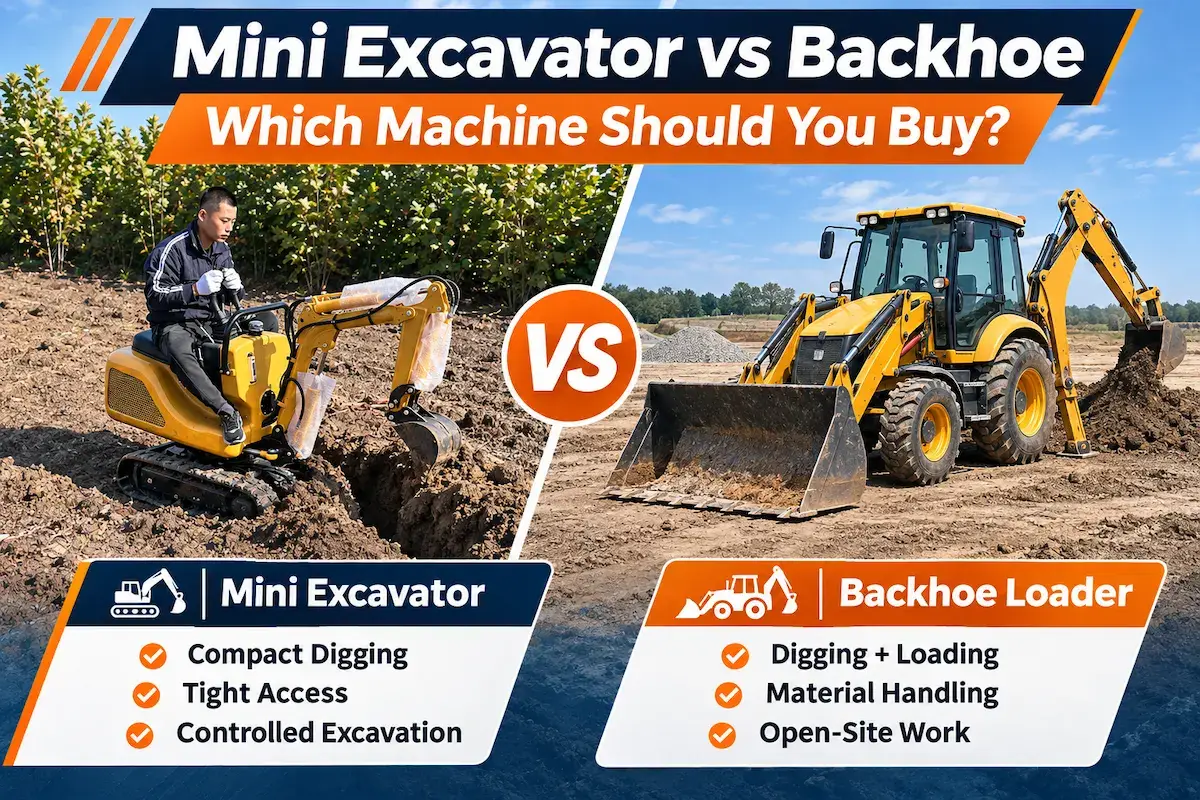
The mini excavator vs backhoe decision usually comes down to specialization versus multitasking. If most of your work is compact excavation, trenching or digging in restricted areas, start by evaluating a mini excavator. If the job regularly combines rear excavation with front loading, carrying and backfilling on open sites, a backhoe loader may be the more practical machine.
This article compares a dedicated mini excavator with a complete backhoe loader. It is written for small contractors, landscapers, property maintenance businesses, farm and orchard operators, utility contractors and first-time compact equipment buyers who are choosing a machine category before requesting a quotation.
Quick Answer: Mini Excavator vs Backhoe
| Фактор принятия решения | Мини-экскаватор | Backhoe Loader |
|---|---|---|
| Primary strength | Dedicated compact excavation | Digging combined with loading and material handling |
| Excavation | Designed for it, including below track level | Rear digging arm designed for it |
| Loading | Limited fit compared with a loader | Front loader bucket built into the machine |
| Trenching | Strong fit, especially in confined areas | Capable, with a larger working footprint on many conventional models |
| Material carrying | Limited fit | Strong fit |
| Backfilling | Possible, less efficient than a loader | Strong fit with the front loader |
| Working footprint | Compact, depending on tail swing and boom offset | Often larger, especially when stabilisers are deployed |
| Tight access | Often a strong fit in micro and small classes | Often more constrained than micro excavators; compact backhoe models vary |
| Upper-structure rotation | Typical mini excavators provide 360-degree swing | Rear digging operates through a limited arc |
| Stabilisation when digging | Separate outriggers are usually not used; the dozer blade may assist stability | Outriggers or stabilisers are common on conventional models; configuration-dependent |
| Site mobility | Usually slower between work areas | Often greater self-propelled mobility; configuration-dependent |
| Working near structures | Often a strong fit, depending on model | Depends on stabiliser footprint and dig arc |
| Typical buying reason | Controlled digging in compact spaces | One machine that digs, loads and moves material |
The table describes general design intent. It is not a performance comparison of specific machines.
What Is the Main Difference Between a Mini Excavator and Backhoe?
The two machines are built around different workflows.
A mini excavator is a tracked excavation platform with a rotating upper structure, a boom, an arm and a bucket. Its workflow is: dig into the ground, lift the material, swing the upper structure and place the spoil. The machine can stay in one position through the digging and placement cycle.
A conventional backhoe loader typically combines a rear digging boom with a front loader bucket on a wheeled chassis. Compact tracked backhoe loaders also exist, so buyers should compare the exact machine configuration rather than assuming every backhoe loader uses wheels. Its workflow mixes digging and material handling: excavate at the rear, then use the front loader to move, load or backfill material across the site.
In one sentence: a mini excavator is a specialized excavation machine, while a backhoe loader is a multifunction machine that combines excavation with loading and material movement.
360-Degree Excavation vs Rear Digging Position
A typical mini excavator’s upper structure rotates around the undercarriage and provides 360-degree swing. This allows the operator to dig, lift the bucket, swing to the side and place the spoil without repositioning the whole machine for each cycle.
A backhoe loader excavates from its rear digging position. The rear boom works through a limited arc rather than a full rotating upper structure. The operator can reposition the machine or adjust the rear boom to place material, but the workflow is different from a rotating excavator.
This difference matters most for:
- Long trenches where repeated spoil placement cycles are required
- Working beside structures where the machine cannot reposition freely
- Confined sites where repositioning space is limited
- Repetitive excavation where the machine stays near one position
The rear digging arc of a backhoe loader is not a weakness. It matches its multitask design. The point for buyers is that the two workflows suit different kinds of jobs.
Which Is Better for Digging and Trenching?
For excavation-dominated work, a mini excavator is generally the more natural starting point. The boom and arm geometry is designed to reach below the track level, the upper structure rotates for spoil placement, and the machine can work in tighter positions without repositioning for every cycle.
This makes a mini excavator especially relevant for drainage trenches, utility trenches, irrigation work, planting pits and digging beside structures.
This does not mean a backhoe loader cannot dig. A larger backhoe loader may offer substantial digging capability, and it may make more sense when excavation is only one part of a mixed job that also includes loading and backfilling.
The required depth and reach depend on the specific model. Buyers should compare the actual machine specifications against the project requirements. The Mini Excavator Digging Depth Guide explains how to match excavation depth to machine capability.
Which Is Better for Loading, Carrying and Backfilling?
If the dominant work is loading, carrying, spreading or backfilling, a backhoe loader is generally the stronger starting point. Its front loader bucket is designed for moving material, and the machine can travel with the load.
Relevant tasks where the backhoe loader has a clear advantage:
- Loading trucks
- Moving soil or gravel across a site
- Carrying material
- Backfilling trenches
- Site cleanup and material relocation
A mini excavator can reposition spoil with its bucket and, on models that have one, with the dozer blade. But it is not designed to replace a dedicated loader for repeated site-wide material movement.
Buyers whose paid work is dominated by loading and material handling should evaluate a backhoe loader first rather than forcing a mini excavator into that role.
How Stabilisers Change the Working Footprint
This is one of the most practical differences between the two categories.
Conventional wheeled backhoe loaders typically deploy stabilisers or outriggers when operating the rear digging equipment. However, stabiliser use varies by machine design; some compact tracked backhoe loaders may rely more on track stability and use stabilisers only under certain digging conditions. Once deployed, the effective working footprint can be wider than the machine body itself. Buyers should consider:
- Machine width in transport
- Stabiliser spread when digging
- Rear digging area
- Front loader length
- Turning and positioning space
- Clearance around walls, fences, buildings and traffic lanes
A backhoe loader may physically fit through an area but still need more space to operate effectively. This is an important distinction on tight residential or roadside sites.
A mini excavator has a different footprint. Depending on the model, its working footprint is affected by:
- Machine width
- Размах хвоста
- Boom swing or offset
- Upper-structure rotation
- Рабочий радиус
The mini excavator does not always need less space. The correct comparison depends on the specific models being considered and the actual site conditions. In general, however, where access is restricted, small mini excavators often have a practical advantage because they typically do not require separate outrigger deployment to establish the digging footprint.
Which Machine Is Better for Tight Spaces?
This is where compact mini excavators can have a strong advantage. A small mini excavator can reach work areas that many conventional backhoe loaders cannot practically enter, and it can dig without deploying separate outriggers.
As one real micro-excavator reference, the ZL-05 lists a transport width of 640 mm. That figure is specific to the ZL-05 and is not an industry-wide mini excavator dimension. Buyers should measure their actual access conditions before assuming any machine will fit.
The measurement that matters includes:
- The narrowest gate or passage on the access route
- The working area once the machine has entered
- The machine width in transport
- Operating clearance around the machine
Этот Mini Excavator Width Guide explains gate and access measurement, and the Smallest Mini Excavator guide covers the micro-excavator category in more detail.
Which Machine Is Better for Open Sites and Mixed Work?
This is where the backhoe loader’s design pays off. Where one operator needs to dig, load, carry, backfill and move around an open site, the backhoe loader can perform several roles without switching machines.
Typical situations where the backhoe loader is a natural fit:
- Roadside and open construction sites
- Farms with dispersed tasks across a property
- Large properties with mixed excavation and material work
- Municipal-style maintenance work spread over an area
A conventional wheeled backhoe loader may offer greater self-propelled mobility between work areas, subject to the machine configuration and local road requirements. Public-road use depends on machine configuration, registration, licensing, insurance and local regulations, so the buyer should confirm those points locally rather than assuming the machine can travel on public roads.
Mini Excavator vs Backhoe for Landscaping and Property Work
Landscaping and property work often include both excavation and material handling. That makes the comparison task-based.
| Job | Better Starting Point | Why |
|---|---|---|
| Drainage trench | Мини-экскаватор | Controlled digging below grade in tight positions |
| Tree planting | Мини-экскаватор | Bucket reach and positioning suit pit digging |
| Irrigation trench | Мини-экскаватор | Repetitive trenching workflow |
| Excavating beside a house | Мини-экскаватор | Compact footprint and boom offset on suitable models |
| Moving bulk soil | Backhoe Loader | Front loader designed for material movement |
| Loading a truck | Backhoe Loader | Front loader and load-and-travel workflow |
| Spreading gravel | Backhoe Loader | Surface material-handling task |
| Backfilling | Backhoe Loader | Front loader designed for backfilling |
| Large open-property maintenance | Backhoe Loader | Mixed tasks across an open site |
| Narrow garden access | Мини-экскаватор | Compact width and access |
These are general starting points, not absolute recommendations. The specific machine and site conditions still matter. The Mini Excavator for Landscaping guide covers excavator selection for that application, and the Mini Excavator for Farm Use guide covers farm and property selection.
Which Machine Is Easier to Move Between Jobs?
This depends on the specific machine and the transport setup. A micro or small mini excavator may have relatively low transport requirements. A larger mini excavator may require substantial trailer capacity. A conventional backhoe loader is generally larger and heavier, but may offer greater self-propelled site mobility.
Some backhoe loaders may be configured for road travel, subject to local regulations, registration, licensing, insurance and machine configuration. This should be confirmed locally rather than assumed.
As one real micro-excavator reference, the ZL-05 lists an operating weight of 420 ± 20 kg and a transport width of 640 mm. That combination provides a lower transport starting point than larger mini excavator classes and typical backhoe loaders, but it does not confirm that a specific trailer or tow vehicle is suitable.
Этот Mini Excavator Trailer Guide explains trailer payload, deck dimensions and tow vehicle limits in more detail.
Which Machine Causes Less Ground Disturbance?
Ground disturbance depends on the specific machine, not on the category label. Relevant factors include machine weight, tracks versus tyres, ground pressure, soil moisture, turning technique, stabiliser use and how often the machine travels across the surface.
A tracked mini excavator can spread load differently from a wheeled backhoe loader, but a tracked machine turning on turf can still cause disturbance. Where stabilisers are used, their pads can also concentrate load locally during rear excavation.
Neither category should be assumed to protect finished surfaces automatically. The correct decision depends on the actual ground conditions, the machine configuration and how the work will be carried out.
When a Micro Excavator Like the ZL-05 Makes Sense
The ZL-05 is a real micro-excavator reference for buyers whose dominant work is light excavation in narrow-access locations. It should be evaluated when the job mix includes light excavation, very narrow access, small gardens, orchards, irrigation, small trenches, property maintenance or work beside boundaries.
| Технические характеристики | ZL-05 Reference | Почему это важно |
|---|---|---|
| Эксплуатационная масса | 420 ± 20 кг | Low starting point for transport planning |
| Транспортная ширина | 640 мм | Relevant for narrow gates and side access |
| Transport Height | 1101 mm with handles removed | Relevant for overhead clearance and storage |
| Максимальная глубина копания | 912 мм | Relevant for shallow trenching and planting |
| Максимальный радиус копания | 1962 мм | Working reach from a fixed machine position |
| Boom Swing | 50° left / 50° right | Offset digging beside walls and fences |
| Смещение ковша | 245 mm left / 245 mm right | Lateral positioning for offset work |
The full configuration is listed on the ZL-05 МИКРОЭКСКАВАТОР 0,5 Т product page.
The ZL-05 is not a replacement for a backhoe loader where the job requires substantial front loading, bulk material movement, large-scale earthwork or frequent open-site multitasking. Buyers whose work is dominated by those tasks should evaluate the backhoe loader category instead.
When a Backhoe Loader Is the Better Purchase
Buyers should lean toward a backhoe loader when most of their paid work combines rear excavation with front loading and material movement. Typical situations include:
- Regular loading of trucks or trailers
- Bulk material handling across a site
- Backfilling trenches as a routine task
- Open sites where the larger working footprint is not a problem
- Mixed digging and loader tasks in the same working day
- Work distributed over a large property
- A single machine needs to perform several roles
In those cases, the backhoe loader’s design matches the work directly, and a mini excavator would be a secondary machine at best. This is not a sales position. It is the practical answer to the comparison.
Can a Mini Excavator Replace a Backhoe?
Not completely. A mini excavator may replace the digging portion of a backhoe workflow where excavation dominates. It does not provide an equivalent front loader function for repeated site-wide material handling, loading and backfilling.
Buyers whose work includes both substantial digging and substantial loading should not assume a mini excavator alone will cover the full backhoe workflow.
Can a Backhoe Replace a Mini Excavator?
Sometimes for general excavation, but not in every site condition. A conventional backhoe loader’s working footprint, stabiliser deployment and rear digging arc can make it less practical on confined sites, in tight residential areas, or where repetitive 360-degree spoil placement is central to the workflow.
A backhoe loader can perform precision excavation, but the site conditions and the working footprint determine whether it is the practical choice for a specific job. Buyers should compare the actual machine and site before assuming one category replaces the other.
Which Machine Should a Small Contractor Buy First?
A practical decision framework:
- What earns most of your revenue?
- Is excavation the dominant task?
- Do you regularly load or carry material?
- How tight are typical job sites?
- Do you need to work beside houses or fences?
- Do jobs occur on one site or across a large open property?
- Do you already own a loader?
- Do you already own an excavator?
- How frequently must the machine move between jobs?
The decision logic:
- Excavation-dominated work on confined sites: evaluate a mini excavator first.
- Mixed digging and loading on open sites: evaluate a backhoe loader first.
- Very narrow access with light excavation: evaluate a micro excavator such as the ZL-05.
- Large mixed workload: one machine may not fully replace two specialized machines.
Этот Руководство по размерам мини-экскаваторов explains how to choose the right excavator class once the category decision is made.
What Should Buyers Confirm Before Requesting a Mini Excavator Quote?
If the work fits the mini excavator category, buyers should provide:
- Основное применение
- Требуемая глубина выемки грунта
- Minimum access width
- Вложения
- Количество
- Страна назначения
- Transport restrictions
This allows the supplier to confirm which machine class should be evaluated. The Mini Excavator Order Checklist explains how to confirm the final configuration before paying a deposit.
Final Decision: Mini Excavator or Backhoe?
A concise decision framework:
- Choose a mini excavator when: excavation dominates, access is restricted, repetitive digging is important and a compact working footprint matters.
- Choose a backhoe loader when: digging and loading are both frequent, material movement is important, the site is open and one machine must perform several roles.
- Choose a micro excavator such as the ZL-05 when: excavation is light, access width is highly restricted and compact transport is important.
- If both substantial excavation and substantial loading are core daily tasks: do not assume one machine will perfectly replace the other.
Choosing the correct machine category first saves both money and re-planning later.
Does Your Work Fit a Mini Excavator?
If most of your work involves compact excavation, trenching or digging in restricted areas, send ZHAOLU the main application, required digging depth, minimum access width, attachments, quantity and destination country. ZHAOLU can recommend which current mini excavator class should be evaluated.
If most of your work combines regular loading, bulk material movement and open-site multitasking, a backhoe loader is likely the better starting point, and a mini excavator may not be the right first purchase.
Review the ZL-05 МИКРОЭКСКАВАТОР 0,5 Т or browse the Продажа мини-экскаваторов страница.
Frequently Asked Questions: Mini Excavator vs Backhoe
Which is better, a mini excavator or backhoe?
Neither is universally better. A mini excavator is a dedicated compact excavation machine, while a backhoe loader combines rear excavation with front loading and material movement. The correct choice depends on the dominant task in the buyer’s work.
What is the main difference between a mini excavator and backhoe loader?
A mini excavator typically uses a tracked undercarriage, a rotating upper structure and a boom and arm for dedicated excavation. A conventional backhoe loader combines a rear digging boom with a front loader bucket, typically on a wheeled chassis, and commonly uses stabilisers when digging at the rear. Compact tracked backhoe loaders also exist.
Which is better for trenching?
For regular trenching in confined areas, a mini excavator is generally the more natural starting point. Its rotating upper structure supports repetitive spoil placement without repositioning the whole machine. A backhoe loader can trench as well, but many conventional models have a larger working footprint and a rear digging arc better suited to more open sites.
Which is better for loading material?
A backhoe loader is the stronger starting point for loading and material movement. Its front loader bucket is designed for loading trucks, carrying soil or gravel, and backfilling, which a mini excavator is not designed to do at the same scale.
Can a mini excavator replace a backhoe?
Not completely. A mini excavator may replace the digging portion of a backhoe workflow where excavation dominates, but it does not provide an equivalent front loader function for repeated site-wide material handling and backfilling.
Can a backhoe replace a mini excavator?
Sometimes for general excavation, but not in every site condition. A conventional backhoe loader’s working footprint, stabiliser deployment and rear digging arc can make it less practical on confined sites or where repetitive rotating spoil placement is central to the workflow.
Which is better for tight spaces?
Compact mini excavators often have a practical advantage in tight spaces because they typically do not require separate outrigger deployment for digging and can be very narrow in the smallest classes. Buyers should compare the actual overall width, tail swing, boom offset and working footprint of the specific machines being considered.
Which is better for landscaping?
It depends on the task. Drainage trenches, planting pits and excavation beside structures fit a mini excavator. Moving bulk soil, loading a truck, spreading gravel and backfilling fit a backhoe loader. Landscaping businesses whose work spans both areas may eventually need both machines.
Which is better for farm or property work?
It depends on the property and the tasks. Orchards, gardens, irrigation work and narrow-access digging fit a mini excavator. Mixed digging and material movement across a large open property may fit a backhoe loader better. Buyers should compare their actual dominant tasks before choosing.
When should I choose a micro excavator like the ZL-05?
A micro excavator should be evaluated when the work is primarily light excavation in narrow-access locations, such as planting, shallow trenching, irrigation maintenance and property work. It is not designed for substantial front loading, bulk material movement or open-site multitasking.