
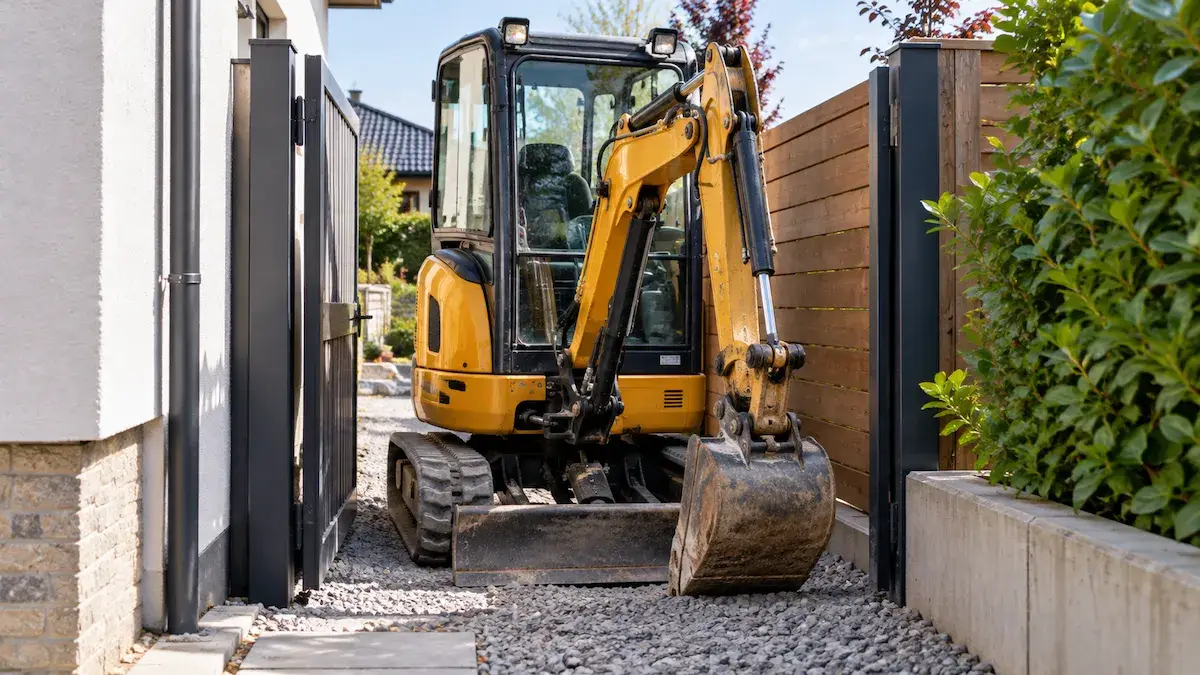
Mini excavator width is often one of the first specifications that determines whether a machine can access the intended work area. For narrow-access work, digging capability is irrelevant if the excavator cannot reach the work area. Buyers sometimes start by comparing tonnage or digging depth, but access dimensions can eliminate a machine before those figures matter. The real question is: what is the narrowest point on the full access route, and what is the confirmed transport width of the machine?
This guide focuses on that practical access question — how to measure the route, which width value actually matters, and what to confirm with the supplier before requesting a quotation.
Quick Answer: How Wide Is a Mini Excavator?
There is no single width for all mini excavators. Width varies by machine class, model, undercarriage, blade and transport configuration. A micro excavator may offer substantially narrower access dimensions than larger mini excavator classes, depending on the model and configuration.
As one real reference, the ZL-05 0.5 ton micro excavator has a listed transport width of 640 mm. This is a model-specific value and should not be assumed to apply to every 0.5 ton excavator. Buyers should confirm the exact transport width of the model they are considering.
Mini Excavator Width: Which Measurement Actually Matters?
Several different width figures appear on specification sheets, and they are not interchangeable. Buyers who rely on the wrong one can discover the problem only when the machine arrives at the site.
- Track or track-shoe width — Depending on the manufacturer’s specification format, this may refer to the width of an individual track rather than the machine’s total width. Buyers should not use this value alone to judge whether the excavator will fit through an opening.
- Overall machine width — The widest fixed part of the machine in its standard configuration.
- Transport width — The width stated by the manufacturer or supplier for the machine in its specified transport configuration. Buyers should confirm which components and machine settings are included in that measurement.
For narrow-access purchasing decisions, use the supplier-confirmed maximum overall width for the exact configuration that will pass through the site. Track width alone is often not enough. If a blade, attachment or other component extends beyond the tracks, that must be included in the confirmed width.
The Przewodnik po parametrach technicznych minikoparek explains how to read these values correctly on a specification sheet.
Measure the Entire Access Route, Not Just the Gate
A common mistake is to measure only the gate and assume the rest of the route is fine. In practice, access is a route problem, not a single-point problem.
Buyers should check:
- The narrowest gate or opening on the route
- Any side passage between the entry and the work area
- Turns, corners and changes of direction
- Walls, fences and fixed obstacles
- Surface slope and uneven ground
- Overhead obstacles such as branches, beams or door frames
- Turning and positioning space at the work area
- Available working space once the machine reaches the site
A gate may be wide enough while a narrow passage farther inside is not. If the machine cannot reach the work area, its specifications are not the deciding factor.
A Real Narrow-Access Reference: ZL-05
The ZL-05 0.5 ton micro excavator provides a real reference for how a compact machine can support restricted-access work.
- Szerokość transportowa: 640 mm
- Transport height with handle removed: 1101 mm
- Maksymalna głębokość kopania: 912 mm
- Maksymalny promień kopania: 1962 mm
The 640 mm transport width helps buyers evaluate restricted entry conditions. The 1101 mm transport height with the handle removed helps evaluate low-clearance movement or storage situations. The digging depth and radius figures show that even when a machine is compact, its working capability still needs to be compared against the actual job.
Full configuration details are available on the ZL-05 – MIKROKOPARKA KLASY 0,5 T product page.
Narrower Is Not Always Better
Choosing the narrowest machine available is not automatically the correct decision. The machine still has to meet the working requirements of the job.
Buyers should compare access against:
- Required digging depth
- Required working radius
- Job intensity and how often the machine will be used
- Attachment requirements
- Site conditions and material type
As real ZHAOLU references, the ZL-05 has a maximum digging depth of 912 mm and a maximum digging radius of 1962 mm, while the ZL-17 1.2 ton machine lists 1940 mm and 3380 mm respectively. These are model-specific values, not universal rules. A buyer should not choose the ZL-05 purely because it is narrow if the required work regularly exceeds its capability.
The 0.5 Ton vs 1.2 Ton Mini Excavator comparison explains how access and capability trade off between the two classes.
When Does a 0.5 Ton Micro Excavator Make Sense for Narrow Access?
The 0.5 ton class is commonly considered when entry width is the dominant constraint. Typical situations include:
- Residential side access with narrow gates
- Garden renovation and landscaping work
- Small landscaping projects with restricted entry
- Restricted utility access on established properties
- Sites with limited storage or transport space
These are conditional use cases. Suitability still depends on whether the machine can complete the required work once it reaches the site. The 0.5 Ton Mini Excavator Buying Guide covers the compact class decision in more detail.
When Should You Consider a Larger Mini Excavator?
A larger machine may be the better choice when the site access allows it and the work requires more than the smallest class can provide. Common reasons include:
- Required digging depth exceeds the smaller machine’s capability
- Greater working radius is consistently needed
- Job demand requires more working capability
- Attachment requirements exceed the smaller machine’s confirmed limits
Moving to a larger class is not automatically more productive. It trades compact access for additional working capability, and the buyer should confirm the trade-off against the typical job. The Przewodnik po rozmiarach minikoparek compares the full 0.5–2.5 ton range.
Mini Excavator Access Checklist Before Requesting a Quote
| Access Check | What the Buyer Should Measure or Confirm | Dlaczego ma to znaczenie |
|---|---|---|
| Narrowest opening | Measure the tightest gate or opening on the full access route | Sets the maximum machine width the access route can accommodate, subject to practical clearance |
| Access route width | Check the full path from entry to work area | Narrow sections may exist beyond the gate |
| Corner / turning area | Confirm space to turn and reposition | A machine can enter but still be unable to maneuver |
| Machine transport width | Confirm the maximum transport width from the supplier | Track width alone may not represent the full machine |
| Machine transport height | Confirm height in the relevant access configuration | Overhead clearance can limit access or storage |
| Ground condition | Check surface type, firmness and stability | Ground affects machine stability and access safety |
| Slope | Note any incline along the access route or work area | Slope affects safe movement and operation |
| Working area | Confirm available space once the machine has entered | Working radius and dumping require free space |
| Required digging depth | Confirm the typical trench or excavation depth | Access alone does not guarantee the job can be completed |
| Required working radius | Confirm how far the machine must reach from position | Determines whether the machine can work from available space |
| Załączniki | Confirm whether required attachments affect access width or height | Some attachments change machine footprint |
| Transport method | Confirm how the machine will be moved to site | Transport method affects practical machine selection |
What Information Should You Send the Supplier?
To receive a useful recommendation, buyers should provide practical site information rather than engineering drawings. Useful details include:
- Country and destination
- Intended application
- Narrowest access width
- Available access height if relevant
- Photos or simple access-route measurements if useful
- Required digging depth if known
- Quantity
- Required attachments
- Preferred commercial term if known
- Contact information
The Mini Excavator Quote Guide explains how to prepare an RFQ that a supplier can answer accurately.
How to Choose a Mini Excavator for Narrow Access
A practical sequence for narrow-access decisions:
- Measure the narrowest part of the entire access route
- Confirm the machine’s maximum transport width and height
- Check turning and working space at the work area
- Confirm the required digging depth and working radius
- Confirm attachment requirements and any effect on machine footprint
- Request the exact quoted machine configuration from the supplier
This sequence treats access as a full route problem rather than a single dimension. It also ensures that once the machine reaches the site, it can actually complete the work.
Request a Mini Excavator Quote for Your Access Conditions
If access is the main constraint, send your narrowest site opening width, typical work requirement, required digging depth and destination. ZHAOLU can review the requirements and recommend a machine class based on the confirmed configuration.
Frequently Asked Questions About Mini Excavator Width
How wide is a mini excavator?
Width varies by model and class. As one real reference, the ZL-05 0.5 ton micro excavator has a listed transport width of 640 mm. This is a model-specific value and should not be assumed to apply to every 0.5 ton excavator. Buyers should confirm the exact transport width of the specific model being considered.
Can a mini excavator fit through a garden gate?
It depends on the confirmed maximum machine width and the narrowest point along the entire access route, not only the gate itself. Buyers should measure the full route, including any narrow passages, corners or overhead restrictions, before assuming the machine will fit.
Is track width the same as mini excavator width?
No. Track or track-shoe width may refer to an individual track rather than the machine’s total width, depending on the manufacturer’s specification format. For narrow-access decisions, the supplier-confirmed maximum transport width in the relevant configuration is usually the value that matters most.
What is the width of the ZL-05 mini excavator?
The verified ZL-05 transport width is 640 mm. This value applies to the ZL-05 and should not be generalised to all 0.5 ton excavators. Buyers should confirm the exact transport width for each model they consider.
Should I choose the narrowest mini excavator available?
Not automatically. Access has to be balanced against digging depth, working radius, job demand and attachment requirements. A machine that fits through the gate still needs to complete the required work once it reaches the site.