In the global mini excavator industry, overseas buyers often face a common dilemma: choosing to cooperate directly with a professional mini excavator manufacturing factory or a traditional mini excavator foreign trade company. Both cooperation modes have unique advantages and inherent shortcomings, and there is no absolute “best choice” in the industry. As a professional China mini excavator manufacturer with years of mini excavator OEMODM customization experience, we will objectively analyze the pros and cons of mini excavator factory vs trading company for OEM procurement from the perspective of overseas procurement, and share the core logic of long-term construction machinery foreign trade cooperation.
1. Advantages & Disadvantages of Cooperating with Foreign Trade Factories
As a direct mini excavator production factory with an independent foreign trade department, we have deep experience in direct overseas cooperation. Factory direct sales have always been the mainstream choice for medium and long-term bulk procurement, mini excavator wholesale, and customized orders in the construction machinery industry.
Core Advantages of Factories
- Controllable Cost & Competitive Pricing: Factory direct sales eliminate all intermediate markup links. We independently control the entire industrial chain from raw material procurement, production processing to finished product debugging. For standardized mini excavator orders and bulk batch orders, we can provide more transparent and cost-effective prices, helping buyers reduce procurement costs steadily.
- Powerful Customization & OEM/ODM Capabilities: This is the core advantage of professional machinery factories. We have a complete R&D team, production workshop and mold development system. We can fully meet personalized needs such as machine color customization, logo printing, parameter adjustment, configuration upgrade and mini excavator private label OEM processing according to customers’ local market demands and brand positioning, which is difficult for most trading companies to support.
- Full Quality & Delivery Control: The factory directly supervises every production link, from parts assembly, performance testing to factory inspection. We can strictly follow international industry standards and customer requirements to control product quality. Meanwhile, we arrange production schedules independently, with more flexible delivery cycles and more guaranteed after-sales traceability, effectively avoiding quality problems caused by intermediate information deviation.
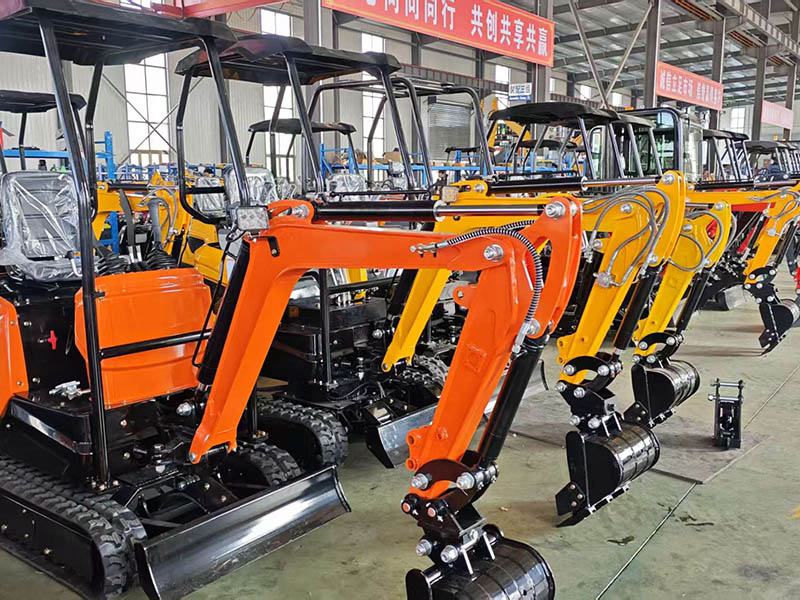
- Strong On-site Trust Support: Physical factories have fixed production workshops, production equipment and professional teams. Overseas customers can conduct on-site inspections at any time to verify production strength, production capacity and product quality, which is the most intuitive endorsement of cooperation credibility.
Shortcomings of Factories
- Limited product categories: Factories mainly focus on self-produced core products (mini excavators and supporting accessories), and cannot provide one-stop procurement of multiple types of mechanical equipment like trading companies.
- Partial service threshold for small orders: For scattered small-batch trial orders, the factory’s production scheduling and arrangement flexibility is slightly lower than that of professional trading companies.
2. Advantages & Disadvantages of Cooperating with Foreign Trade Companies
Foreign trade companies act as intermediate service providers, connecting factories and overseas buyers, and have long occupied an important position in international trade. They are more suitable for customers with diversified procurement and small-batch trial purchase demands.
Core Advantages of Foreign Trade Companies
- Diversified One-stop Procurement: Trading companies cooperate with multiple manufacturers and cover rich product categories. Customers can purchase different types of construction machinery and supporting parts at one time, saving the time cost of docking multiple suppliers.
- Flexible Small-order Service: They are more flexible in small-batch, scattered orders and trial orders, with lower order threshold and faster order arrangement speed, meeting the needs of small distributors and retail customers.
- Mature Trade Process: Professional trading teams are proficient in international logistics, customs declaration, foreign exchange settlement and document processing, which can save customers the trouble of complex trade procedures to a certain extent.
Shortcomings of Foreign Trade Companies
- High Comprehensive Procurement Cost: As intermediaries, trading companies need to earn profit margins, resulting in higher overall procurement prices than direct factory cooperation for the same mini excavator products.
- Weak Customization Ability: Without independent production and R&D capacity, they can only deliver fixed factory products, and cannot support in-depth mini excavator OEM/ODM private label customization, personalized configuration adjustment and other high-demand services.
- Unstable Quality & After-sales: They cannot control the production process directly. The product quality is uneven due to different supplier sources. Once quality problems occur, the responsibility division is vague, and the after-sales response efficiency is far lower than that of direct factory cooperation.
- Lack of Physical Credibility Endorsement: Most trading companies have no fixed production bases. Customers cannot verify the product production process on site, and there are hidden risks of order delay and inconsistent product quality.
3. Core Conclusion: Trust Is the Foundation of All Foreign Trade Cooperation
After analyzing the two cooperation modes, we can clearly find that there is no absolute superiority or inferiority between factories and foreign trade companies. Different customers choose different cooperation channels according to their order scale, procurement demands and business layout.
But the core of all cross-border foreign trade cooperation is never price or channel, but trust.
International trade spans countries, regions and time zones. Remote docking inevitably brings information asymmetry. Stable product quality, honest quotation, punctual delivery and responsible after-sales service are the key to building long-term trust between suppliers and buyers. A channel with low trust, no matter how low the price is, will bring endless hidden risks such as quality disputes, order delays and after-sales losses to customers; while a trustworthy supplier can bring stable, safe and sustainable cooperation value to customers.
4. Sincere Invitation: Welcome to Visit Our Mini Excavator Factory
As a professional mini excavator manufacturing factory focusing on foreign trade for years, we have always taken integrity-based cooperation and quality-first service as our core tenet. We have complete production lines, mature R&D technology, strict quality inspection system and professional foreign trade service team, supporting global customers’ private label customization, OEM/ODM exclusive processing, and mini excavator bulk wholesale customization services.
We firmly believe thaton-site inspection is the best way to build trust. Words are no substitute for on-site witnessing. We sincerely welcome customers and partners from all over the world to visit our factory at any time! You can check our production workshops, product testing process, factory strength and product quality on site, communicate customization solutions face to face, and establish a sincere and long-term cooperative relationship based on true strength and full transparency.
We look forward to creating greater commercial value with global partners through trustworthy products and services!