
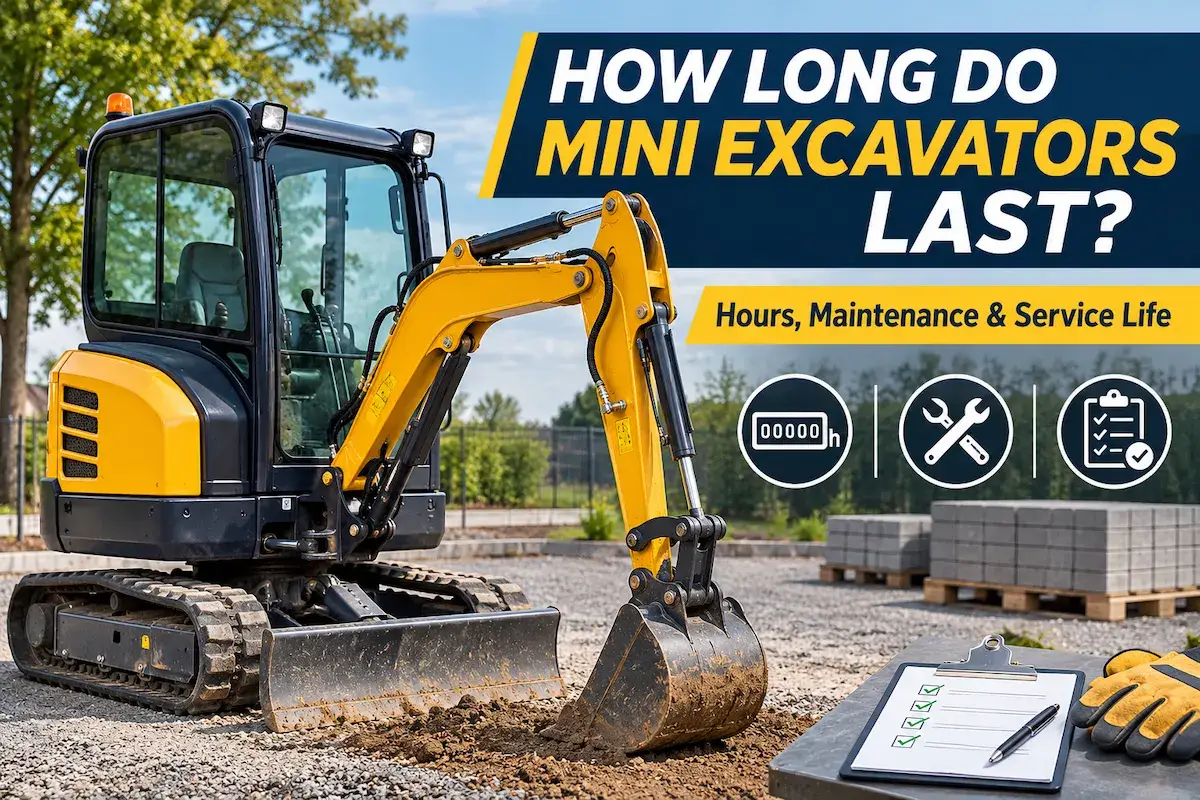
If you are asking how long do mini excavators last, the most important point is that there is no universal hour-meter number that marks the end of a machine’s useful life. Maintenance history, workload, hydraulic condition, undercarriage wear and operating environment often matter more than the hour reading alone.
This guide explains how to interpret machine hours, which factors shorten service life, how to distinguish mechanical life from economic life, and how buyers should evaluate a used machine’s remaining potential. It is written for small contractors, landscapers, utility contractors, farm and property owners, and first-time equipment buyers.
Quick Answer: How Long Do Mini Excavators Last?
There is no universal hour limit that defines a mini excavator’s lifespan. Service life depends on the machine, the application, the operator, the maintenance history and the condition of major components. The hour meter is useful context, but it does not describe condition on its own.
In many cases, a machine’s economic life — the point at which ongoing repairs and downtime no longer make commercial sense — ends before its mechanical life. A machine does not have to be completely broken to reach the end of its practical service life.
| Factor | Effect on Service Life |
|---|---|
| Maintenance | Regular maintenance supports longer, more predictable service life; delayed maintenance can accelerate wear |
| Application | Light landscaping and heavy breaker work impose very different loads on the same machine |
| Operator Behaviour | Smooth operation and correct use can reduce unnecessary structural and component stress |
| Hydraulic Cleanliness | Clean hydraulic fluid and correct filtration help protect hydraulic components |
| Cooling | Maintaining correct operating temperature helps reduce accelerated deterioration |
| Undercarriage Care | Correct track tension and regular inspection help control track, roller and sprocket wear |
| Storage | Long-term exposure and idle time can contribute to corrosion, hose and seal aging and electrical issues |
| Parts Availability | If parts become difficult to source, economic service life may end before mechanical life does |
| Downtime Tolerance | A contractor on a tight schedule may be affected by downtime more severely than a private owner with flexible use |
Why There Is No Universal Mini Excavator Lifespan
Mini excavators perform very different jobs. Two machines with identical hour readings can experience completely different wear if one spent its life on light landscaping and the other spent its life on breaker work in rocky ground.
Typical application differences include:
- Light landscaping and garden work
- Orchard and property maintenance
- Utility trenching
- Rocky excavation
- Breaker and light demolition work
- Rental fleet use with many different operators
- Private property maintenance with one operator
Because of this range, a single lifespan figure cannot describe every machine in the mini excavator class. Machine hours are one input, not a measurement of remaining life.
How Should You Interpret Mini Excavator Hours?
The hour meter is useful for several practical purposes:
- Maintenance planning
- Usage history reference
- Comparing similar machines
- Checking whether service records are plausible
It cannot reveal everything. The hour meter does not tell the buyer about hydraulic condition, engine condition, undercarriage wear, previous breaker use, overheating history, contamination history or operator abuse.
A 1,000-hour machine with poor maintenance may create more concern than a 3,000-hour machine with well-documented service records. That comparison is illustrative, not a universal rule about specific hour figures.
How Many Hours Is a Lot on a Mini Excavator?
There is no universal number that separates acceptable hours from excessive hours. The more useful question is what the hour reading means when it is combined with maintenance records, physical condition and application history.
As hours increase, buyers should place more weight on:
- Service records
- Component condition
- Repair history
- Oil leaks
- Hydraulic performance
- Undercarriage wear
- Pins and bushings
- Engine behaviour
- Cooling-system condition
- Parts availability
Some industry sources refer to several-thousand-hour service lives for well-maintained compact equipment, but these figures are not universal retirement limits. They should not be converted into a fixed maximum-hours rule for every machine, application or operating environment.
Maintenance History Can Matter More Than Hour Count
Maintenance history is one of the most useful indicators of remaining service potential, especially when it can be compared with the machine’s current physical and operating condition.
Regular maintenance areas to look for in records include:
- Engine oil
- Filters
- Hydraulic oil where specified
- Hydraulic filters
- Greasing
- Coolant
- Air filters
- Fuel system
- Track tension
- Hose inspection
- Pins and bushings inspection
Exact service intervals must follow the specific machine’s operation and maintenance manual. There is no universal maintenance interval that applies to every mini excavator, application or operating environment.
What Shortens Mini Excavator Service Life?
Several recurring conditions can accelerate wear and reduce practical service life.
Poor Lubrication
Insufficient or delayed greasing can accelerate pin and bushing wear and affect the boom, arm and attachment joints.
Contaminated Hydraulic System
Dirt, debris or degraded hydraulic fluid can contribute to component wear, reduced performance and higher repair requirements.
Overheating
Repeated overheating can accelerate deterioration and may indicate a cooling-system, airflow, fluid, operating-load or maintenance issue that requires diagnosis.
Incorrect Track Tension
Tracks that are too tight or too loose can accelerate undercarriage wear and place additional stress on track components.
Heavy Breaker or Demolition Work
Breaker and demolition work can place more severe structural and hydraulic loading on the machine than light landscaping. This does not automatically mean the machine will fail early, but it changes the wear profile.
Harsh Ground Conditions
Rock, mud, abrasive soil and debris can accelerate wear on buckets, tracks, undercarriage components and exposed structures.
Poor Storage
Long-term exposure to weather, dampness and debris can contribute to corrosion, hose deterioration and electrical problems.
Delayed Repairs
Small issues that are not addressed early can develop into larger and more expensive problems. Early diagnosis can help prevent secondary damage.
Does Heavy Work Reduce Mini Excavator Lifespan?
Workload severity affects wear, but not in a way that can be reduced to a simple ratio. One hour of light landscaping is not necessarily equivalent to one hour of breaker work in rocky ground, but the difference depends on the machine, operator, maintenance and actual application.
Light-duty applications commonly include:
- Landscaping and garden excavation
- Property maintenance
- Orchard work
More demanding applications may include:
- Rocky excavation
- Light demolition
- Continuous breaker use
- High-utilization contracting
The point is not that heavy work automatically ends the machine’s life. The point is that the wear profile is different, so maintenance history and component condition should be interpreted in the context of the work the machine actually performed.
Which Components May Wear Before the Whole Machine Is Finished?
Mini excavators usually do not reach the end of their service life all at once. Wear and maintenance occur progressively across different systems.
Components and areas that may require attention during the machine’s life include:
- Undercarriage components
- Rubber tracks
- Rollers
- Sprockets
- Pins and bushings
- Hoses
- Seals
- Cylinders
- Engine-related service components
- Hydraulic components
- Electrical components
- Buckets and attachments
Many of these are normal wear items. Replacing one component does not automatically mean the machine has reached the end of its useful life. The more important question is whether the remaining systems can support continued operation and whether the overall repair requirement remains reasonable for the machine’s value and intended workload.
Undercarriage Condition and Machine Life
The undercarriage is a high-wear area and should be considered separately from engine hours. Relevant components include:
- Tracks
- Rollers
- Sprockets
- Idlers
- Track tension
Undercarriage wear can represent a meaningful part of ongoing repair cost, and a machine’s service life should not be judged only by engine hours. A recently renewed undercarriage can reduce one major area of near-term wear, but it does not establish the remaining life of the engine, hydraulic system, structure or other components.
Hydraulic Condition and Long-Term Service Life
Hydraulic-system condition depends on several factors:
- Clean hydraulic fluid
- Correct filtration
- Hose condition
- Seal condition
- Cylinder condition
- Operating temperature
- Contamination control
The hydraulic system represents an important part of overall machine condition. A machine with well-maintained hydraulics may provide more predictable service than one with neglected hydraulic maintenance, but hydraulic condition should still be considered together with the rest of the machine.
The Mini Excavator Hydraulic System Guide explains flow, pressure and auxiliary hydraulics in more detail.
Engine Hours Do Not Tell the Whole Story
Engine hours matter, but they should be interpreted together with other evidence:
- Cold-start behaviour
- Oil leaks
- Cooling condition
- Service history
- Air filtration
- Load history
A single symptom should not be used to diagnose engine condition. The correct interpretation combines the hour reading with service records, observed operating behaviour and the condition of related systems such as cooling and lubrication.
The Mini Excavator Engine Guide explains engine configuration and engine verification in more detail.
Does Low Annual Usage Mean a Mini Excavator Will Last Longer?
Not automatically. Low annual usage can reduce some kinds of wear, but long idle periods can introduce other concerns, including:
- Battery deterioration
- Corrosion
- Fluid aging
- Moisture accumulation
- Hose and seal aging
- Storage-related deterioration
This matters for farms, orchards and property owners who may use a machine seasonally or occasionally. A low-hour machine may still be in excellent condition, but buyers should confirm how it was stored and maintained between uses rather than assume that low use alone guarantees long service life.
How Should Used-Machine Buyers Evaluate Hours?
The hour meter should be considered together with records and physical condition. Useful questions include:
- Are service records available?
- Does the observed wear match the displayed hours?
- Has the hour meter been replaced?
- What applications was the machine used for?
- Was breaker work common?
- Are repairs documented?
- What is the undercarriage condition?
- What is the hydraulic condition?
Hour-meter readings should be considered together with records and physical condition. A low reading that does not appear consistent with physical wear should be investigated, but this is a reason for verification rather than an automatic conclusion.
The New vs Used Mini Excavator guide explains the broader purchase decision, while the Mini Excavator Factory Inspection Checklist covers equipment verification in more detail.
Mechanical Life vs Economic Life
Mechanical life and economic life are different concepts, and buyers should consider both.
Mechanical Life
The machine can still operate and can potentially be maintained or repaired. Its mechanical systems remain capable of performing useful work.
Economic Life
Continued operation may no longer make commercial sense because of factors such as:
- Frequent repairs
- Downtime
- Parts cost
- Parts availability
- Lost productivity
- Low resale value
- Changing business requirements
A machine does not need to be completely broken to reach the end of its economic service life. For a contractor, equipment that remains technically repairable but repeatedly disrupts job schedules may no longer be the most economical machine to keep operating.
When Is a Mini Excavator Near the End of Its Economic Life?
There is no universal hour number for this decision. Warning patterns may include:
- Repeated downtime
- Multiple major systems requiring repair within a short period
- Parts becoming increasingly difficult to obtain
- Repair costs becoming disproportionate to machine value
- The machine no longer meeting current job requirements
- Unpredictable availability affecting project schedules
One repair alone does not mean the machine should be replaced. The relevant question is whether the accumulated repair pattern, downtime and cost remain consistent with the owner’s workload, machine value and tolerance for disruption.
New vs Used: Which Gives You More Predictable Remaining Life?
A new machine provides a known starting condition, a maintenance record that begins with the owner, current documentation and support arrangements that can be confirmed before purchase.
A used machine’s remaining life depends more heavily on previous history and current condition. A well-maintained used machine may still provide strong value, but its history and condition need to be verified rather than assumed.
The New vs Used Mini Excavator guide explains that purchase decision in more detail. This article focuses specifically on how hours, condition and maintenance relate to remaining service potential.
What About a New Micro Excavator Like the ZL-05?
A new machine provides a known starting condition and allows the owner to establish maintenance records from the beginning. That can be useful for buyers who value a documented and predictable ownership history.
The ZL-05 is a micro-excavator reference for buyers whose work fits the compact class. Current verified specifications include:
| Specification | ZL-05 Reference |
|---|---|
| Operating Weight | 420 ± 20 kg |
| Transport Width | 640 mm |
| Transport Height | 1101 mm with handles removed |
| Maximum Digging Depth | 912 mm |
| Maximum Vertical Digging Depth | 594 mm |
| Maximum Digging Radius | 1962 mm |
| Maximum Digging Height | 1837 mm |
| Maximum Dumping Height | 1320 mm |
| Boom Swing | 50° left / 50° right |
| Bucket Offset | 245 mm left / 245 mm right |
| Engine Reference | Rato gasoline engine |
| Engine Power | 6.5 HP |
| Maximum System Flow | 12 L/min |
Typical applications for the ZL-05 include small-scale landscaping, tree planting, light trenching, small utility work, irrigation, orchard maintenance, garden soil removal and property maintenance.
ZHAOLU does not claim a universal hour-based lifespan for the ZL-05. Actual service life depends on use, maintenance, operating conditions and component condition.
The full configuration is listed on the ZL-05 0.5 Ton Micro Excavator product page.
How to Extend the Service Life of a Mini Excavator
Long-term service life is strongly influenced by routine care and operating practices. Useful principles include:
- Follow the manufacturer maintenance schedule
- Keep the machine clean
- Maintain lubrication on pins and bushings
- Monitor fluid leaks early
- Maintain the cooling system
- Check track tension
- Inspect hoses and cylinders
- Use appropriate attachments for the work
- Avoid unnecessary overload
- Repair problems early
- Store the machine appropriately
- Keep maintenance records
Exact service intervals depend on the machine manual and actual operating conditions. There is no universal maintenance schedule that applies to every mini excavator, application or environment.
Mini Excavator Lifespan Checklist for Buyers
| Question | Why It Matters |
|---|---|
| Displayed hours | Provides usage context, but does not directly measure condition |
| Service history | Shows how consistently the machine appears to have been maintained |
| Application history | Breaker work and rocky excavation create a different wear profile from light landscaping |
| Hydraulic condition | Helps indicate the condition of one of the machine’s major operating systems |
| Engine condition | Affects reliability and future repair requirements |
| Cooling system | Cooling problems or overheating history may indicate additional wear or unresolved issues |
| Undercarriage | A high-wear area that can materially affect ongoing ownership cost |
| Pins and bushings | Wear can affect joint play, precision and repair requirements |
| Leaks | May indicate issues involving seals, hoses, fittings or cylinders |
| Repair history | Shows what has already been repaired and helps identify recurring issues |
| Parts availability | Can affect economic life even while the machine remains mechanically usable |
| Downtime history | Helps indicate whether the machine supports reliable work |
| Storage condition | Can affect corrosion, hose aging and electrical condition |
| Future workload | Determines whether the machine’s remaining service potential fits the intended work |
Final Answer: How Long Do Mini Excavators Last?
There is no universal hour limit that defines how long a mini excavator will last. Service life depends on maintenance, workload, operating conditions and component condition. Hour-meter readings are useful context, but condition and maintenance history are more important than relying on a single maximum-hours number.
Buyers should evaluate total machine condition rather than search for one magic hour threshold. A higher-hour machine with solid maintenance records and good component condition may have more remaining service potential than a lower-hour machine with weaker maintenance and poorer condition.
The Mini Excavator Spare Parts Guide explains parts and after-sales considerations, while the Mini Excavator Size Guide helps buyers choose the correct machine class for the work.
Looking for a Mini Excavator with a Known Starting Condition?
If you prefer a new machine with a known starting condition, confirmed configuration and maintenance history that begins from delivery, send ZHAOLU the main application, required digging depth, minimum access width, attachments, expected usage pattern, quantity and destination country.
ZHAOLU can use those requirements to help identify which current mini excavator class should be evaluated. New equipment is not automatically the better choice for every buyer, but it does provide a known starting point for ownership and maintenance planning.
Review the Mini Excavators for Sale page or the ZL-05 0.5 Ton Micro Excavator product page.
Frequently Asked Questions: How Long Do Mini Excavators Last?
How long do mini excavators last?
There is no universal hour limit. Service life depends on maintenance, application, operator behaviour, hydraulic condition, undercarriage wear, storage and overall component condition. Hours are useful context, not a direct measurement of remaining life.
How many hours does a mini excavator last?
There is no universal hour figure. Some industry sources refer to several-thousand-hour service lives for well-maintained compact equipment, but these figures are not universal retirement limits. Machine condition and maintenance history matter more than relying on one hour number.
How many hours is a lot on a mini excavator?
There is no universal threshold. As operating hours increase, buyers should place greater emphasis on service records, component condition, repair history, hydraulic performance, undercarriage wear and engine behaviour.
Is 3,000 hours high for a mini excavator?
3,000 hours alone is not enough to judge machine condition. Maintenance history, workload, component wear and actual operating behaviour should also be evaluated. A 3,000-hour machine with strong records may be in better condition than a lower-hour machine with poor maintenance.
Is a low-hour mini excavator always better?
Not necessarily. A low-hour machine that was abused, poorly maintained or stored badly can be in worse condition than a higher-hour machine with a strong service history. Hours are one input, not the final answer.
What affects mini excavator lifespan?
Maintenance quality, application severity, operator behaviour, hydraulic cleanliness, cooling condition, undercarriage care, storage conditions, parts availability and downtime all affect practical service life.
Does heavy breaker work shorten excavator life?
Breaker and demolition work creates a different wear profile from light landscaping. This does not automatically mean the machine will fail early, but maintenance requirements and component condition should be evaluated in the context of that workload.
Can maintenance extend mini excavator service life?
Consistent maintenance can support longer and more predictable service life. Greasing, correct fluids, filtration, cooling-system care, track adjustment and early repair of developing problems all matter. Exact maintenance intervals should follow the specific machine manual.
What wears out first on a mini excavator?
There is no universal first component to fail. Wear develops progressively across areas such as the undercarriage, tracks, pins and bushings, hoses, seals and attachments. Which component requires attention first depends on the machine, application, environment and maintenance history.
How should I evaluate hours on a used mini excavator?
Evaluate the hour reading together with service records, application history, hydraulic condition, undercarriage wear, engine behaviour and repair history. Hour-meter readings should not be used as a standalone judgment of machine condition.