
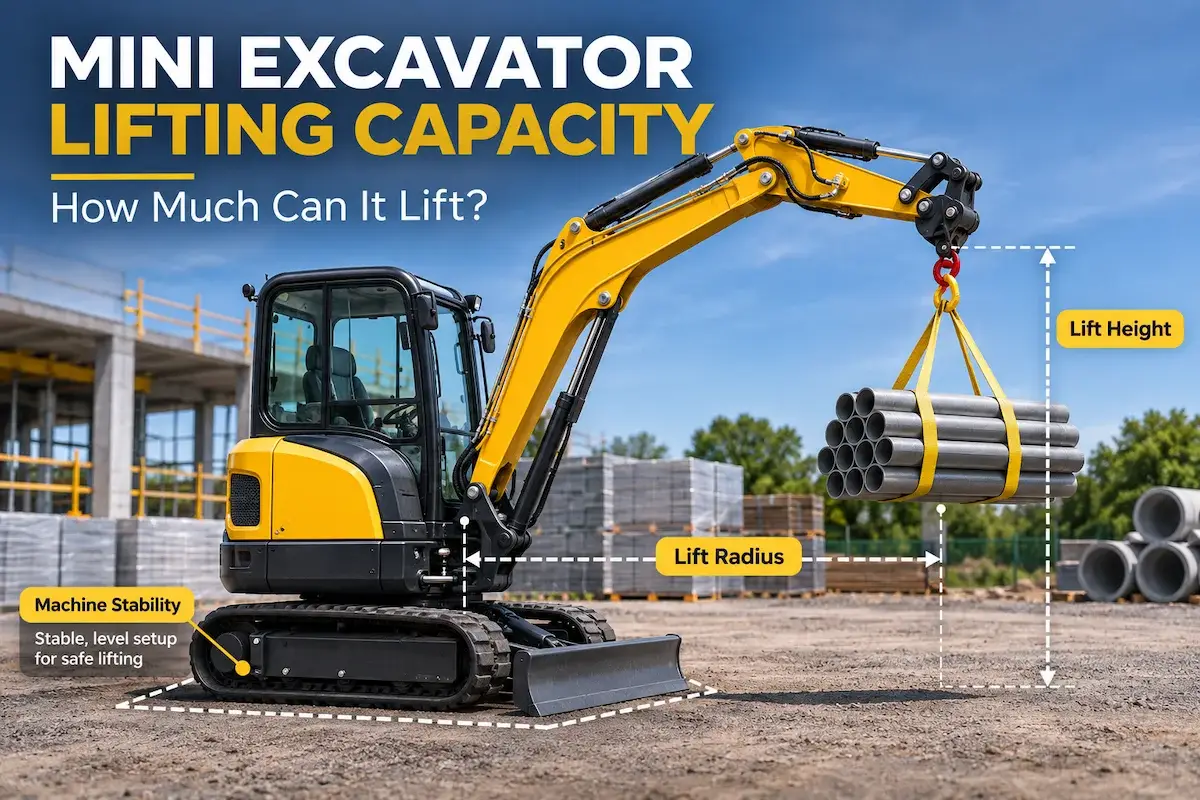
Mini excavator lifting capacity cannot be reduced to one number. The amount a machine can safely lift changes with lifting radius, lifting height, machine configuration, lifting direction and stability, so the correct value must come from the specific machine’s rated lifting data, not from its tonnage class or operating weight.
This guide explains why lifting capacity changes, what a lift chart actually represents, and what buyers should confirm before assuming a mini excavator can handle a particular load. It is written for small contractors, landscapers, utility contractors, farm and property owners, and first-time equipment buyers who need to understand lifting as part of machine selection.
Quick Answer: How Much Can a Mini Excavator Lift?
There is no universal lifting-capacity figure based on machine tonnage, operating weight or hydraulic flow. The rated lifting limit depends on the specific machine, configuration, lifting radius, lifting height, lifting direction, blade position and other conditions defined by the manufacturer. Actual lifting safety also depends on site conditions such as ground stability.
The reliable reference for a specific machine is the manufacturer’s lift chart or verified model-specific lifting data for the applicable operating condition, together with the machine’s operating instructions.
| Factor | Pourquoi est-ce important ? |
|---|---|
| Dimensions de la machine | Larger machines generally provide more stability and load-handling capability, but the rated figure still depends on geometry and configuration |
| Lift radius | As the load moves farther from the machine, the overturning effect increases and the permitted load usually decreases |
| Lift point height | Different lifting heights can have different rated capacities on a lift chart |
| Front vs side | Machine stability changes with lifting direction, so rated capacities can differ by orientation |
| Blade position | Blade up or blade down can change stability and may be treated differently on the lift chart |
| Poids de l'accessoire | Buckets, couplers and other mounted equipment add mass that may affect the available lifting capability |
| Machine configuration | Boom, arm, counterweight and machine setup affect the rated lifting condition |
| Ground condition | Soft, uneven or sloped ground can reduce stability compared with the conditions required for safe operation |
Why Mini Excavator Lifting Capacity Is Not One Fixed Number
Lifting capacity is not a single property of the machine. It is a limit that changes as the machine’s geometry and stability condition change.
A load that can be lifted close to the machine may not be permissible when the boom and arm are extended farther outward. A load that can be handled over the front may not have the same rated capacity over the side. A machine that is stable on firm, level ground may not have the same stability margin on soft or uneven ground.
This is why a single number printed on a specification sheet cannot answer the question “how much can it lift.” The correct answer is tied to the actual machine configuration and operating condition, and the manufacturer’s model-specific lifting data must be consulted.
Hydraulic Limit vs Stability Limit
Lifting capacity can be limited by two different factors, and they matter for different reasons.
Hydraulic Limit
The hydraulic system reaches its rated ability to raise or hold the load. Beyond this point, the machine may not have enough hydraulic force to lift or hold the load in that position.
Stability Limit
The machine approaches its allowable stability limitation before hydraulic force becomes the limiting factor. Beyond this point, tipping or loss of stability becomes the governing concern.
Manufacturer lift charts may identify whether a rated value is hydraulically limited or stability limited. The presentation differs between manufacturers, so buyers should read the chart for the specific machine rather than assume a universal format.
Why Lifting Radius Changes Capacity
Lifting radius is the horizontal distance from the machine’s swing or rotation centre to the lifting point, according to the manufacturer’s chart definition.
The basic mechanical principle is simple: as the load moves farther away from the machine, the overturning effect increases. That is why lifting capacity usually decreases as lifting radius increases.
A load that is acceptable close to the machine may exceed the permitted capacity when the boom and arm are extended farther outward. The machine has not become weaker. The load has become harder to support safely from that position.
This is one of the most important points for buyers comparing machines for lifting work. A machine’s rated capacity at a short radius does not automatically describe its capacity at a longer radius.
Why Lifting Height Matters
Lift charts may show capacity at different lifting-point heights. The required lifting height is not simply how high the object appears from the ground.
Relevant factors include the height of the lifting point, the dimensions of the object, the length of the lifting arrangement and the final placement height required on site.
Because capacity can change with lifting height, buyers should confirm the rated figure for the lifting-point height that applies to the actual job. A rating at one height does not automatically apply at another.
Front vs Side Lifting
Excavator stability changes depending on lifting direction. Many excavator lift charts show different capacities for front lifting and side lifting because the machine’s stability margin changes with orientation.
Some machines may show a higher rated capacity over the front. Others may show different figures depending on configuration and counterweight. Buyers should not assume a universal direction preference, and they should not assume that a value quoted for one direction applies to another.
The applicable manufacturer chart must be checked for the lifting direction that matches the actual job.
Does the Dozer Blade Affect Lifting Capacity?
Blade position can affect machine stability. Some manufacturer lift charts distinguish conditions such as blade down and blade up because the blade changes the machine’s support condition.
Lowering the blade does not automatically make every lift safe, and the manufacturer’s rated chart remains the primary reference for the rated lifting condition. The chart condition must match the actual blade condition used on site.
Buyers should treat blade position as part of the machine configuration, not as an adjustment that allows the rated limit to be bypassed.
Does Mini Excavator Weight Determine Lifting Capacity?
No. Operating weight and lifting capacity are related through machine stability, but they are not the same specification.
Operating weight tells the buyer about machine mass and is relevant for transport, ground loading and stability context. Lifting capacity depends on machine geometry, hydraulic performance, stability, lifting radius, lifting height and configuration.
There is no reliable formula that converts machine operating weight into lifting capacity. A heavier machine is not automatically a stronger lifter at a given radius, and a lighter machine is not automatically weaker at every radius. The relationship depends on how the machine is designed and where the load is positioned.
Le Mini Excavator Weight Guide explains operating weight, transport weight and shipping weight. It does not provide lifting capacity because operating weight is a different specification.
Do Attachments Reduce Available Lifting Capacity?
Attachments and couplers have their own mass. A bucket, quick coupler, grapple, lifting device or other mounted equipment adds weight to the machine configuration and can affect the available lifting capability.
Depending on how the manufacturer defines the lift chart, attachment or coupler weight may need to be included in the lifting calculation, or it may already be reflected in the published configuration. Buyers must understand exactly what machine configuration the chart assumes before applying it to a real lift.
There is no universal deduction formula for attachments. The correct approach is to use manufacturer data that matches the configuration actually fitted to the machine.
Le Guide des accessoires pour mini-pelles explains attachment selection and compatibility in more detail.
Mini Excavator Lifting Capacity by Size
Machine size affects lifting capability in general terms, but it does not produce a predictable lifting number by class. The descriptions below show general trends, not rated capacity figures.
Micro Excavators
Micro excavators are designed around tight-access work, light excavation and compact transport. Lifting is usually secondary to compactness. If lifting is an important part of the intended work, the exact manufacturer lifting data must be checked for the specific model.
1–2 Ton Mini Excavators
Machines in this range generally offer more stability and lifting capability than micro machines, but exact capacities vary substantially by model and working radius. Two machines in the same tonnage class can have very different rated capacities at the same radius.
2–3 Ton Mini Excavators
Larger compact machines may provide more useful material-handling capability for contractors, landscaping and utility work while still remaining compact. Again, this is a general trend, and the rated figure must be confirmed from the specific machine’s data.
Le Guide des tailles des mini-pelles explains machine class selection across the compact range.
What Is a Mini Excavator Lift Chart?
A lift chart provides manufacturer-rated lifting data for defined conditions and is the primary model-specific reference for rated lifting capacity. It should be used together with the machine’s operation manual, the specified machine configuration and applicable operating requirements.
Common information that may appear on a lift chart includes:
- Lifting-point height
- Lifting radius
- Over-front or over-side condition
- Blade position
- Machine configuration
- Boom and arm configuration
- Coupler or bucket assumption
- Rated load for the defined condition
Different manufacturers format their charts differently. Buyers should read the chart as it is written for the specific machine and should not assume a universal layout.
How to Read a Mini Excavator Lift Chart
The following sequence is a conceptual guide to understanding a lift chart. It is not a substitute for the machine manual or qualified operating procedures.
- Confirm the exact machine configuration
- Confirm the required lifting-point height
- Confirm the lifting radius
- Confirm the lifting direction
- Confirm the blade condition if the chart distinguishes it
- Check the applicable rated value for that condition
- Confirm the attachment and coupler assumptions used in the chart
If the relevant condition is not covered or the chart is unclear, the correct manufacturer data should be obtained rather than estimated. The lift chart should not be loosely interpolated beyond the conditions for which it is provided.
Digging Force Is NOT Lifting Capacity
Three different force or capability specifications are often confused. They measure different things.
Force d'excavation du godet
Bucket digging force describes the force associated with the bucket digging action and indicates how strongly the bucket can act on material during excavation.
Force de creusage du bras
Arm digging force describes the force associated with the arm or dipper digging action. It represents a different part of the excavation cycle.
Capacité de levage nominale
Rated lifting capacity describes permissible lifting capability under defined machine geometry and stability conditions. It is a lifting limit, not an excavation-force specification.
A machine can have high digging force without that number representing how much suspended load it may safely lift. Digging force cannot be converted directly into lifting capacity, and the two specifications should not be used interchangeably.
For a deeper explanation of bucket breakout force, arm digging force and how the two values should be compared, see the Mini Excavator Digging Force Guide.
Le Guide des caractéristiques techniques des mini-pelles explains how digging force and lifting capacity fit into the wider machine specification sheet.
Hydraulic Flow Is NOT Lifting Capacity
This distinction matters because buyers often see hydraulic flow figures on a specification sheet and assume they describe lifting performance.
Hydraulic flow mainly relates to actuator speed and hydraulic-system operation. Hydraulic pressure and cylinder geometry contribute to available force, but rated lifting capacity is also constrained by machine stability, geometry, working radius, working height and configuration.
Hydraulic flow alone cannot be used to calculate lifting capacity, and a higher flow figure does not automatically mean a higher rated lift. The applicable manufacturer lift chart remains the primary reference for rated lifting capacity.
Le Guide du système hydraulique des mini-pelles explains flow, pressure and auxiliary hydraulics in more detail.
Can a Mini Excavator Lift Logs, Pipes, Rocks or Construction Materials?
Buyers often ask whether a mini excavator can lift logs, pipes, landscaping rocks, drainage materials or small construction components. There is no blanket yes or no.
The answer depends on several factors:
- The actual weight of the object, verified as far as possible
- The rated lifting capacity of the specific machine at the required lifting radius and lifting height
- The machine configuration and lifting direction
- The lifting arrangement
- The ground and site conditions
Buyers should not assume that a machine can lift a load simply because similar machines are sometimes shown handling similar objects. The applicable manufacturer data must match the actual lifting condition.
This article does not provide rigging instructions. Lifting arrangements should be appropriate for the load and handled according to applicable operating requirements and qualified procedures.
Can a Mini Excavator Lift a Pallet?
A pallet’s weight can vary greatly depending on its material and contents. A mini excavator is not automatically equivalent to a forklift, and suitability cannot be determined from machine class alone.
Handling a pallet requires consideration of:
- Rated lifting capacity appropriate for the actual pallet weight and lifting radius
- An appropriate lifting arrangement or approved attachment for the intended work
- Machine configuration
- Suitable ground and working conditions
Improvised lifting methods, such as lifting a pallet with bucket teeth or attaching chains to random structural parts, are not substitutes for a proper lifting arrangement. Machine-specific rated data and appropriate operating procedures should be followed.
Ground Conditions Matter
Published lift ratings are based on specified conditions. Real jobsites may include soft soil, slopes, uneven ground, trenches, edges and unstable surfaces.
These conditions can affect machine stability in ways that are not represented simply by reading a maximum chart value. A published rated capacity should not be assumed to apply when the actual site conditions do not meet the conditions required by the manufacturer.
The applicable manufacturer lift chart remains the primary reference for rated lifting capacity, but lifting should not proceed if the actual ground or site conditions do not meet the conditions required for safe operation.
Lifting Capacity vs Machine Weight vs Digging Depth
The table below distinguishes several specifications that buyers often confuse.
| Caractéristiques techniques | What It Means | What It Does NOT Tell You |
|---|---|---|
| Poids en ordre de marche | Machine mass in operating condition, relevant for transport and stability context | Does not directly state rated lifting capacity |
| Digging Depth | Maximum excavation reach below ground under specified geometry | Does not state lifting capacity |
| Digging Force | Force associated with the excavation action | Does not equal suspended-load lifting capacity |
| Débit hydraulique | Hydraulic system flow rate | Does not equal rated lifting capacity |
| Lifting Capacity | Manufacturer-rated lifting capability for defined conditions | Cannot be interpreted without radius, height and machine configuration |
Le Mini Excavator Digging Depth Guide explains digging-depth specifications in more detail.
When a Micro Excavator Like the ZL-05 May Fit the Job
The ZL-05 is primarily relevant when the job prioritises narrow access, compact transport, light excavation, landscaping, tree planting, small trenches, irrigation, orchard maintenance and property work. Lifting is a secondary consideration for this class, and the machine should be evaluated primarily on its required working envelope.
| Caractéristiques techniques | ZL-05 Reference |
|---|---|
| Poids en ordre de marche | 420 ± 20 kg |
| Largeur de transport | 640 mm |
| Transport Height | 1101 mm with handles removed |
| Maximum Digging Depth | 912 mm |
| Maximum Digging Radius | 1 962 mm |
| Boom Swing | 50° left / 50° right |
| Décalage du godet | 245 mm left / 245 mm right |
| Référence moteur | Rato gasoline engine |
| Puissance du moteur | 6,5 HP |
| Maximum System Flow | 12 L/min |
Important : These specifications do not establish the machine’s rated lifting capacity. A verified lifting chart or manufacturer lifting data is required for lifting decisions.
If lifting is an important part of the intended work, the buyer should provide the actual object weight, required lifting radius, required lifting height, attachment or lifting configuration and working environment. ZHAOLU can then check the applicable machine data against the requirement. The full configuration is listed on the Micro-pelle ZL-05 de 0,5 tonne product page.
What Size Mini Excavator Do You Need for Lifting Work?
Machine size should not be chosen based on load mass alone. A larger machine does not automatically mean a higher rated lift at every radius, and a smaller machine is not automatically unsuitable for every lifting task.
Buyers should define:
- Load weight
- Maximum required lifting radius
- Required lifting height
- Minimum access width
- État du sol
- Digging requirement
- Pièces jointes
- Transport limits
The selection logic should follow this sequence: required work, lifting requirement, access requirement, digging requirement, suitable machine class and then specific model verification.
Le Guide des tailles des mini-pelles explains machine class selection in more detail.
Questions to Ask Before Ordering a Mini Excavator for Lifting Work
- What is the actual load?
- What is the maximum object weight?
- At what horizontal radius must the load be handled?
- How high must the load be lifted?
- Will the machine work mainly over the front or over the side?
- What attachment or lifting arrangement is required?
- What is the minimum access width?
- What digging depth is also required?
- What are the ground and site conditions?
- What is the destination country?
- How many machines are required?
Lifting work is not a case where the buyer only needs to state the load weight. Radius, height and machine configuration affect the rated limit, so these conditions should be confirmed before selecting a specific machine.
Final Answer: How Much Can a Mini Excavator Lift?
There is no single lifting-capacity number for all mini excavators. Rated lifting capacity depends on the exact machine, lifting radius, lifting height, lifting direction, blade position, attachments and configuration. Use the manufacturer’s lifting chart or verified model-specific data for the applicable operating condition.
The better question is not “how much can this tonnage class lift?” but “what is the rated lifting capacity of this exact machine, in this configuration, at the required lifting radius and height?” That is what model-specific lifting data is designed to answer.
Need a Mini Excavator for Digging and Material Handling?
Send ZHAOLU the main application, required load weight, required lifting radius, required lifting height, required digging depth, minimum access width, attachments, quantity and destination country. ZHAOLU can use the confirmed work requirements to help identify which mini excavator class should be evaluated.
Rated lifting capacity must be confirmed from the specific machine’s verified lifting data and applicable operating condition. A lifting requirement should not be approved from machine tonnage or operating weight alone.
Review the Mini-pelles à vendre page or the Micro-pelle ZL-05 de 0,5 tonne product page.
Frequently Asked Questions: Mini Excavator Lifting Capacity
How much weight can a mini excavator lift?
There is no single figure. Rated lifting capacity depends on the specific machine, lifting radius, lifting height, lifting direction, blade position, attachments and configuration. Use the manufacturer’s lift chart or verified model-specific lifting data for the required condition.
Does mini excavator lifting capacity depend on machine size?
Machine size affects lifting capability in general terms, but it does not produce a predictable lifting number by class. Two machines in the same tonnage class can have different rated capacities at the same radius.
Does a heavier mini excavator always lift more?
Not necessarily. A heavier machine is not automatically a stronger lifter at a given radius. Lifting capacity depends on geometry, hydraulic performance, stability, radius and configuration, not on operating weight alone.
Why does lifting capacity decrease with reach?
As the load moves farther from the machine, the overturning effect increases. That is why lifting capacity usually decreases as lifting radius increases, and why a rated capacity at a short radius does not automatically describe capacity at a longer one.
Can a mini excavator lift more over the front than the side?
Many lift charts show different capacities for front and side lifting because stability changes with orientation. The exact chart for the specific machine must be checked. A universal direction preference should not be assumed.
Does lowering the dozer blade increase lifting capacity?
Blade position can affect stability, and some lift charts distinguish blade-up and blade-down conditions. Lowering the blade does not automatically make every lift safe. The applicable chart condition must match the actual machine configuration.
Does a bucket or quick coupler reduce lifting capacity?
Buckets, couplers and other mounted equipment add mass and can affect available lifting capability. Buyers should confirm what machine configuration the lift chart assumes and match it to the actual setup.
Is digging force the same as lifting capacity?
No. Digging force describes excavation force. Rated lifting capacity describes a lifting limit under defined geometry and stability conditions. Digging force cannot be directly converted into lifting capacity.
Can a mini excavator lift logs or pipes?
It depends on the actual object weight, the rated lifting capacity of the specific machine at the required lifting radius and height, the machine configuration, the lifting arrangement and site conditions. The applicable model-specific data must match the actual condition.
How do I know the lifting capacity of a specific mini excavator?
Use the manufacturer’s lift chart or verified model-specific lifting data for the exact machine configuration, lifting radius, lifting height and lifting direction required by the job. A tonnage label, operating weight or hydraulic-flow figure cannot answer this question by itself.