
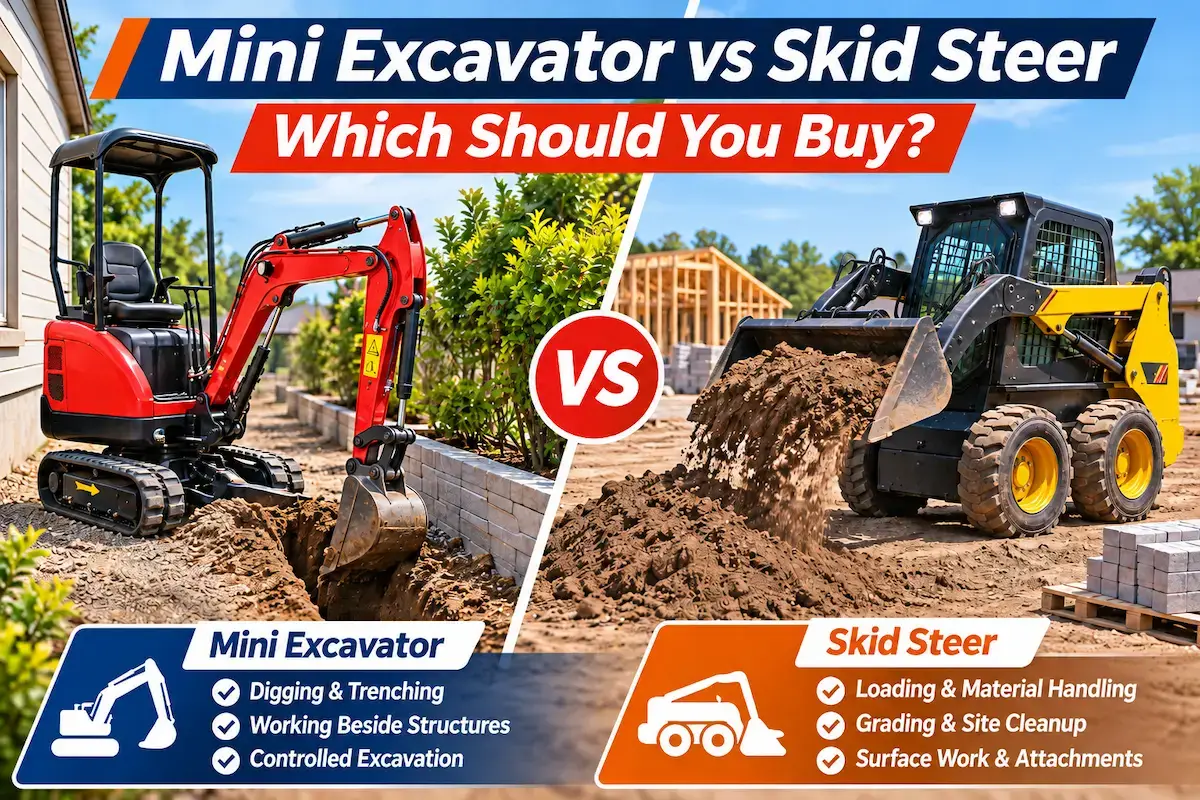
The mini excavator vs skid steer decision starts with one question: what does most of your work actually require? If most of your work involves digging below ground, trenching or working beside structures, start by evaluating a mini excavator. If most of your work involves loading, carrying, grading or moving material across a site, a skid steer is usually the more natural starting point. Many real jobs include both types of work, and one machine does not fully replace the other.
This article compares the two machine categories by dominant job, not by brand or model. It is written for small contractors, landscapers, property maintenance businesses and first-time compact equipment buyers who are choosing a machine category before requesting a quotation.
Quick Answer: Mini Excavator vs Skid Steer
| Decision Factor | Mini-pelle | Skid Steer |
|---|---|---|
| Primary job | Excavation below grade | Material handling and grading |
| Digging below ground | Designed for it | Possible with attachments, less natural |
| Trenching | Strong fit | Limited fit compared with an excavator |
| Loading and carrying material | Limited fit | Strong fit |
| Grading and surface work | Limited fit | Strong fit |
| Working close to walls or structures | Often a strong fit, depending on boom offset, tail swing and clearance | Depends on machine and attachment |
| Moving material across the site | Less efficient | Designed for it |
| Narrow access | Varies by model; micro classes can be very narrow | Varies by model and category |
| Ground disturbance | Depends on tracks, weight and turning | Depends on tyres or tracks and turning |
| Attachment use | Excavation-oriented attachments | Front-mounted attachments for many tasks |
| Travel speed across a site | Usually slower | Usually faster |
| Typical buying reason | Controlled digging and trenching | Material movement, loading and grading |
The table describes the general design intent of each category. It is not a performance comparison of specific machines.
A skid steer, mini skid steer and compact track loader are related loader categories, but they are not identical machines. Traditional skid steers normally use wheels, while compact track loaders use tracks; smaller mini loaders form another compact class. This guide uses “skid steer” as the main search comparison term, but buyers should compare the exact loader type and model when access, ground conditions or transport limits matter.
The Main Difference: Digging Down vs Moving Material
The clearest way to compare the two machine categories is the direction and nature of the work.
A mini excavator digs down into the ground, lifts the excavated material with the bucket, swings the upper structure, and places the material to the side. The machine can remain relatively stationary while the boom and arm perform the digging and the upper structure repositions the bucket.
A skid steer loads material into the bucket from the front, travels with the load, and unloads it elsewhere on the site. It is built around moving material across the surface of the site, and around front-mounted attachments for grading, cleanup and other surface tasks.
Neither workflow is superior in general. The relevant question is which workflow matches the dominant task on the buyer’s jobs.
Which Is Better for Digging and Trenching?
For regular excavation below grade, a dedicated mini excavator is generally the more natural starting point. The boom and arm geometry is designed to reach below the machine’s track level, position the bucket into the trench, and place the spoil with controlled swing rather than by travelling with the load.
This makes a mini excavator especially relevant for trenching for drainage, utilities, irrigation and similar work, and for digging beside structures where the machine can stay in one position and reach the work area.
The required digging depth and working radius depend on the specific model. Buyers should compare the actual machine specifications against the project requirements. The Mini Excavator Digging Depth Guide explains how to match excavation depth to machine capability.
Which Is Better for Loading, Moving Soil and Grading?
If the dominant work is loading, moving material, grading surfaces or cleaning up a site, a skid steer is generally the stronger starting point. It is designed to travel with the load, discharge it where needed, and repeat the cycle across the site.
This is an area where a mini excavator is often not the best machine. A mini excavator can move material with its bucket, but it is not designed to replace a loader for repeated site-wide material handling or surface grading.
Buyers whose paid work is dominated by loading, spreading gravel, grading driveways or moving soil across a site should evaluate a skid steer first rather than forcing a mini excavator into that role.
Mini Excavator vs Skid Steer for Landscaping
Landscaping work often includes both excavation and material handling. That makes the comparison task-based rather than category-based.
Typical landscaping tasks and the more natural starting point:
- Drainage trench: mini excavator
- Tree planting pit: mini excavator
- Excavating beside a wall or fence: mini excavator
- Small utility or irrigation trench: mini excavator
- Moving mulch or topsoil across a property: skid steer
- Spreading gravel: skid steer
- Site cleanup: skid steer
Landscaping companies whose work spans both areas may eventually need both machines. For a first purchase, the more useful question is which task limits productivity more often. The Mini Excavator for Landscaping guide covers excavator selection for that application in more detail.
Which Machine Is Better for Tight Spaces?
“Compact” does not mean both machines have the same access profile. The relevant figures depend on the specific model, and buyers should compare:
- Overall width
- How the machine turns or maneuvers
- Whether the upper structure rotates
- Whether the machine needs to travel repeatedly across the site
- Space needed to work beside a wall or boundary
As one real micro-excavator reference, the ZL-05 lists a transport width of 640 mm. That figure is specific to the ZL-05 and is not an industry standard for all mini excavators. Buyers should not assume every mini excavator is narrower than every skid steer, or the reverse.
Le Smallest Mini Excavator guide explains micro-excavator access in more detail, and the Mini Excavator Width Guide covers gate and access measurement.
How Ground Conditions Affect the Choice
Ground conditions affect both categories, and the effect depends on the specific machine. Machine weight, track or tyre type, soil moisture, turning technique and how often the machine travels across the surface all influence disturbance.
A tracked mini excavator does not automatically avoid turf damage, and a skid steer does not automatically cause it. On firm, hard-packed or paved surfaces, a wheeled skid steer can be efficient for repeated travel and material handling. On soft, muddy or sensitive ground, the decision becomes more dependent on undercarriage type, ground pressure, turning technique and travel frequency. Neither category should be assumed to protect finished surfaces automatically.
Where the work is dominated by digging from a relatively fixed position, the mini excavator is the more natural fit. Where the work is dominated by repeated surface travel across firm or hard-packed ground, the skid steer category is the more natural fit.
Which Machine Is Better for Attachments?
Both categories use attachments, but the attachment market and typical use differ.
Skid steers are often selected for frequent front-mounted attachment work, where attachments are used across the site for surface tasks, material handling and cleanup.
Mini excavators are commonly selected for excavation-related attachments such as breakers, augers, rippers, grapples and different bucket types. These support the digging and excavation workflow the machine is designed for.
Attachment compatibility depends on hydraulic flow, hydraulic pressure, mounting configuration, machine weight and attachment weight. The Guide du système hydraulique des mini-pelles explains flow, pressure and auxiliary hydraulics, and the Guide des accessoires pour mini-pelles explains mounting and compatibility checks.
Mini Excavator vs Skid Steer for Small Property Jobs
| Job | Better Starting Point | Why |
|---|---|---|
| Drainage trench | Mini excavator | Designed for controlled digging below grade |
| Tree planting | Mini excavator | Bucket reach and positioning suit pit digging |
| Small utility trench | Mini excavator | Trenching is a core excavator task |
| Moving gravel | Skid steer | Designed for loading and travelling with material |
| Loading soil | Skid steer | Loader-style workflow |
| Grading driveway | Skid steer | Surface grading workflow |
| Garden excavation | Mini excavator | Digging and placing spoil |
| Site cleanup | Skid steer | Repeated travel and front-mounted work |
| Working beside a wall | Depends / Both | Depends on machine width, boom swing and tail clearance |
| Moving pallets | Skid steer | Front-mounted handling workflow |
These are general starting points, not absolute recommendations. The specific machine, attachments and site conditions still matter.
Which Machine Is Easier to Transport?
Transport depends on the actual machine, not on the category label. Some mini excavators are light and narrow, while larger mini excavators can require substantially heavier transport setups. The same range exists in the skid steer category.
As one real micro-excavator reference, the ZL-05 lists an operating weight of 420 ± 20 kg and a transport width of 640 mm. That combination provides a lower transport starting point than larger mini excavator classes, but it does not confirm that a specific trailer or tow vehicle is suitable.
Le Mini Excavator Trailer Guide explains trailer payload, deck dimensions and tow vehicle limits in more detail.
When a Micro Excavator Like the ZL-05 Makes Sense
The ZL-05 is a real micro-excavator reference for buyers whose dominant work is light excavation in narrow-access locations. It should be evaluated when the job mix includes light excavation, narrow access, planting, shallow trenches, irrigation maintenance, orchard work or property maintenance.
| Caractéristiques techniques | ZL-05 Reference | Buyer Relevance |
|---|---|---|
| Poids en ordre de marche | 420 ± 20 kg | Low starting point for transport planning |
| Largeur de transport | 640 mm | Relevant for narrow access and gates |
| Transport Height | 1101 mm with handles removed | Relevant for overhead clearance and storage |
| Maximum Digging Depth | 912 mm | Relevant for shallow trenching and planting |
| Maximum Digging Radius | 1 962 mm | Working reach from a fixed machine position |
| Boom Swing | 50° left / 50° right | Offset digging beside walls and fences |
The ZL-05 is not designed for loading, site-wide material handling or surface grading. Buyers whose paid work is dominated by those tasks should evaluate the skid steer category instead. The full configuration is listed on the Micro-pelle ZL-05 de 0,5 tonne product page.
When a Skid Steer Is the Better Purchase
Buyers should lean toward a skid steer when most of their paid work involves loading, material transport, surface grading, cleanup, pallet work or front-mounted attachment tasks. In those cases, the skid steer’s design matches the work directly, and a mini excavator would be a secondary machine at best.
This is not a sales position. It is the practical answer to the comparison. Buyers whose dominant work is material handling should evaluate a skid steer first and only consider a mini excavator if the work later expands into excavation.
Can One Machine Replace the Other?
Sometimes for occasional secondary tasks, but not completely. A skid steer can use digging-oriented attachments, but that does not make it equivalent to a dedicated excavator for regular below-grade excavation. A mini excavator can move some material with its bucket, but it is not designed to replace a loader for repeated site-wide material handling.
Buyers whose work is genuinely mixed may find that one machine covers most of the work and the other is rented for specific projects. The decision should follow the dominant task, not the occasional one.
Which Machine Should a Small Contractor Buy First?
A practical decision framework:
- What earns most of your revenue?
- Do you dig below grade every week?
- Do you move material across the site every day?
- How narrow are your typical sites?
- What attachments do you actually use?
- How often will the machine move between jobs?
- Do you already own complementary equipment?
A digging-dominated business should start by evaluating a mini excavator. A material-handling-dominated business should start by evaluating a skid steer. A mixed workflow should identify which task limits productivity most, or consider owning or renting both.
Le Guide des tailles des mini-pelles explains how to choose the right excavator class once the category decision is made.
What Should You Confirm Before Requesting a Mini Excavator Quote?
If the work fits the mini excavator category, buyers should provide:
- Application principale
- Required digging depth
- Minimum access width
- Pièces jointes
- Quantité
- Pays de destination
- Transport restrictions
This allows the supplier to confirm which machine class should be evaluated. The Mini Excavator Order Checklist explains how to confirm the final configuration before paying a deposit.
Final Decision: Mini Excavator or Skid Steer?
A simple decision rule:
- If most of the work happens below ground: evaluate a mini excavator.
- If most of the work involves moving or grading material across the surface: evaluate a skid steer.
- If access is extremely restricted and the excavation work is light: evaluate a micro excavator such as the ZL-05.
- If the project mix includes substantial digging and substantial material handling: one machine may not replace the other.
Choosing the correct machine category first saves both money and re-planning later.
Does Your Work Fit a Mini Excavator?
If most of your work involves digging below grade, trenching or working beside structures, send ZHAOLU the main job, required digging depth, minimum access width, attachments, quantity and destination. ZHAOLU can recommend which current mini excavator class should be evaluated.
If most of your work involves loading, grading or moving material across a site, a skid steer is likely the better starting point, and a mini excavator may not be the right first purchase.
Review the Micro-pelle ZL-05 de 0,5 tonne or browse the Mini-pelles à vendre page.
Frequently Asked Questions: Mini Excavator vs Skid Steer
Which is better, a mini excavator or skid steer?
Neither is universally better. A mini excavator is primarily an excavation machine, while a skid steer is primarily a material-handling and grading machine. The correct choice depends on the dominant task in the buyer’s work.
Can a skid steer dig like a mini excavator?
A skid steer can use digging-oriented attachments, but it is not equivalent to a dedicated excavator for regular below-grade excavation. The boom and arm geometry of a mini excavator is designed specifically for digging below the machine’s track level.
Can a mini excavator do skid steer work?
A mini excavator can move some material with its bucket, but it is not designed to replace a loader for repeated site-wide material handling or surface grading. Buyers whose dominant work is material handling should evaluate a skid steer instead.
Which is better for trenching?
For regular trenching, a mini excavator is generally the more natural starting point. Its boom and arm geometry is designed for controlled digging below grade, and the upper structure can place spoil without travelling with the load.
Which is better for landscaping?
It depends on the task. Drainage trenches, planting pits and excavation beside structures fit a mini excavator. Moving mulch, spreading gravel and site cleanup fit a skid steer. Landscaping businesses whose work spans both areas may eventually need both machines.
Which is better for tight spaces?
It depends on the specific models being compared. Micro excavators can offer very narrow transport widths, but not every mini excavator is narrower than every skid steer. Buyers should compare the actual overall width, turning method and working space of the specific machines being considered.
Which machine causes less ground damage?
It depends on the specific machine, track or tyre type, soil moisture, turning technique and how often the machine travels across the surface. A tracked mini excavator does not automatically avoid turf damage, and a skid steer does not automatically cause it. The right choice depends on the actual ground conditions and travel pattern.
Should a small contractor buy a mini excavator or skid steer first?
The dominant revenue task should guide the first purchase. A digging-dominated business should evaluate a mini excavator first. A material-handling-dominated business should evaluate a skid steer first. Mixed workflows may require identifying which task limits productivity most, or owning or renting both.
When should I choose a micro excavator like the ZL-05?
A micro excavator should be evaluated when the work is primarily light excavation in narrow-access locations, such as planting, shallow trenching, irrigation maintenance and property work. It is not designed for loading, site-wide material handling or surface grading.