
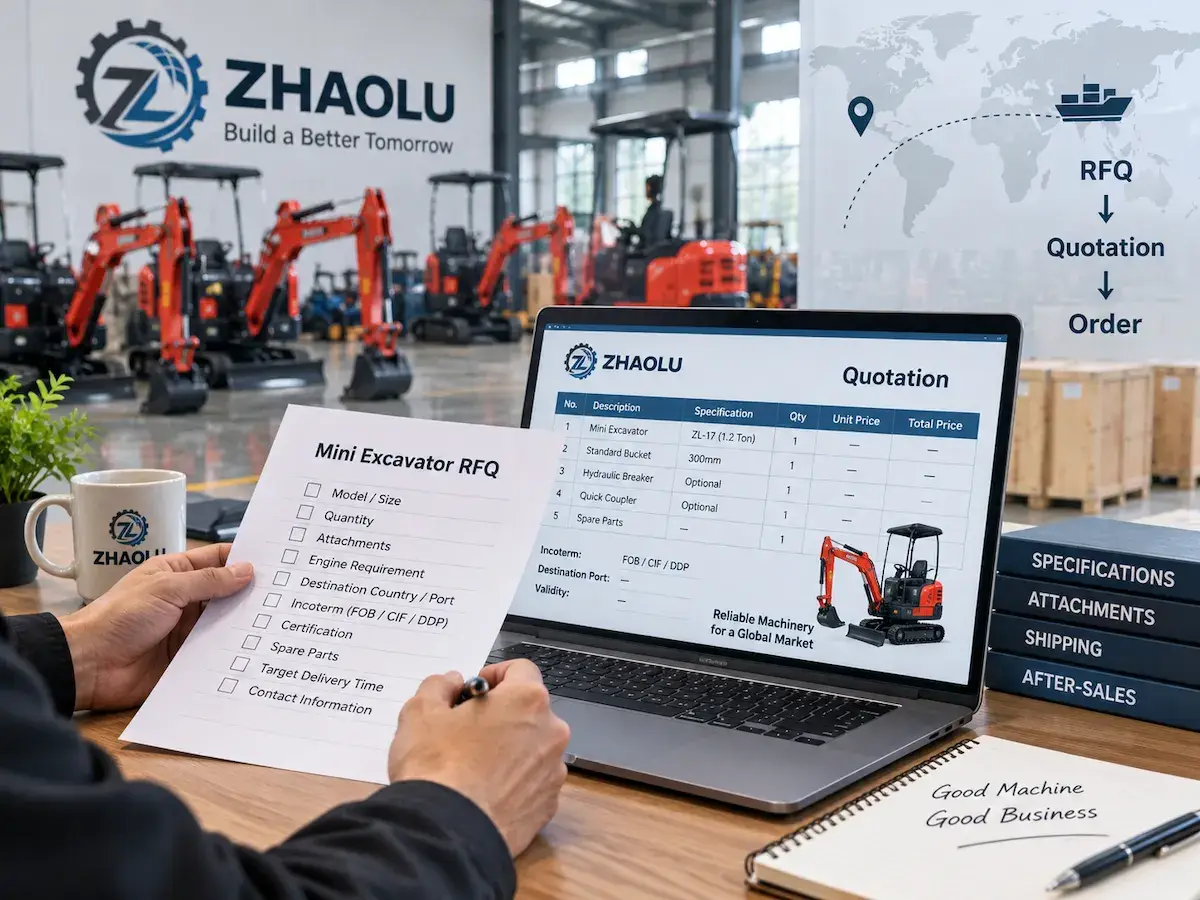
An accurate mini excavator quote depends on how much information the buyer provides. A short message such as “send me your best price for a 1 ton mini excavator” rarely produces a quotation that can be compared fairly with another supplier. The final price depends on the machine model, configuration, engine option, attachments, quantity, destination, Incoterm, packaging and documentation requirements. Each of these can change the quotation, sometimes significantly.
This guide explains what to include in a mini excavator RFQ, how to read a quotation, how to compare suppliers on the same basis, and what happens after an RFQ is sent. It is written as a practical B2B reference for overseas buyers, not a sales brochure. For a full overview of the purchasing process, refer to Cómo comprar una miniexcavadora en China.
Quick Answer: What Information Is Needed for an Accurate Mini Excavator Quote?
A useful RFQ should include the machine size or model, quantity, intended application, engine or emissions requirement if relevant, attachments, canopy or cab preference, required documentation, preferred Incoterm, destination country or port, spare parts requirements and target purchasing timeline. Buyers do not need to know every technical answer before contacting a supplier, but the more information provided, the more accurate and comparable the quotation will be.
Quotations should also be compared on the same basis. A FOB quotation and a CIF quotation are not directly comparable, and the same applies to different machine configurations. The checklist and comparison table in this guide help buyers make a fair evaluation.
Why “Send Me Your Best Price” Is Not Enough
A one-line price request usually results in one of two outcomes. Either the supplier replies with a rough indication that cannot be used for a real purchasing decision, or the supplier selects a configuration on the buyer’s behalf and quotes something that may not match the actual requirement.
The final mini excavator quote depends on multiple variables, including:
- Machine size and model
- Aplicación prevista
- Configuración del motor
- Attachments and optional equipment
- Cantidad
- Destination country and port
- Incoterm (EXW, FOB, CIF, DDP)
- Packaging method
- Certification or compliance requirements
- Necesidades de piezas de recambio
Without this information, the quotation is only an estimate. Buyers who want to compare suppliers seriously should invest a few minutes in preparing an RFQ. The result is a clearer quotation and less back-and-forth communication later. Buyers reviewing available models can also visit the Proveedor de miniexcavadoras page for an overview of available options.
What Information Should Be Included in a Mini Excavator RFQ?
The following items cover the main information suppliers need. Not every item applies to every buyer, and missing details can be clarified during the quotation process.
- Buyer name and company
- País de destino
- Destination port if known
- Machine size or preferred model
- Aplicación prevista
- Cantidad necesaria
- Preferred engine or emissions requirement if relevant
- Attachments required
- Canopy or cab preference if applicable
- Other configuration requirements
- Required documentation or certification
- Incoterm preferido
- Spare parts requirement
- Target purchasing timeline
- Contact information
Buyers should not feel that they must answer every point before sending an RFQ. Describing the application and destination is often enough for the supplier to suggest a starting configuration, which can then be refined.
Machine Size and Model
Describing the machine as a “small excavator” or “1 ton excavator” is usually not specific enough. Mini excavators in the same nominal size class can differ in operating weight, dimensions, digging depth, engine configuration and hydraulic setup. These differences affect both the machine price and the shipping arrangement.
Buyers should provide either a preferred model, an operating weight range, or a description of the work that the machine needs to perform. If the buyer is unsure which size class is appropriate, the Guía de tamaños de miniexcavadoras explains how operating weight and dimensions relate to common applications.
For buyers comparing specifications across suppliers, the Guía de especificaciones de miniexcavadoras explains operating weight, digging range, engine and other parameters that appear on a specification sheet.
Application and Working Conditions
The intended application has a direct effect on the recommended configuration. A machine used for landscaping work is not necessarily configured the same way as one used for utility trenching or rental fleet operation.
Common applications include:
- Landscaping and garden work
- Residential construction
- Trenching for utilities and drainage
- Farm and agricultural work
- Narrow-access or indoor work
- Rental fleet operation
- Light demolition and site preparation
Describing the working conditions helps the supplier recommend a suitable configuration. This includes access width, ground conditions, working hours per day, and whether the machine will be operated by the owner or rented out to different users. Rental fleet operators, for example, often prefer a configuration that is straightforward to operate and easy to maintain.
Engine and Compliance Requirements
Engine and emissions requirements vary by destination country and intended use. Some markets have specific regulations that affect which engines can be imported and operated legally. Other markets do not have strict requirements at the machine level but may impose them at the port or through local registration.
Buyers should confirm the applicable local requirements before ordering. Useful information to provide in the RFQ includes:
- Any preferred engine brand or model if applicable
- Any emissions regulation that applies in the destination country
- Whether documentation of engine configuration is required for import
- Whether the machine will be registered or operated in a regulated environment
Do not assume that every supplier quotes the same engine configuration for a given model. Engine options can affect the quotation and may also affect availability or production scheduling. Buyers should confirm the exact engine configuration in the quotation.
Attachments and Optional Equipment
Attachments can significantly change the machine quotation. Buckets, hydraulic breakers, augers, grapples, rippers and quick couplers all have different costs and may require additional hydraulic configuration on the machine.
Buyers should specify:
- Which attachments are required
- Whether they are standard or optional
- Whether hydraulic compatibility has been confirmed
- Whether attachment spare parts are also needed
Attachment compatibility is not limited to mounting dimensions. Hydraulic flow and pressure requirements also matter. The Guía de accesorios para miniexcavadoras explains how to check mounting, coupler and hydraulic compatibility before ordering.
Quantity and Dealer Orders
Quantity affects several parts of the quotation beyond the unit price. Suppliers use the quantity to plan production, allocate container space, prepare packaging and arrange freight. Spare parts planning may also depend on the number of machines ordered.
Buyers should state the required quantity clearly, including whether the order is a single unit, a small fleet, or a dealer stocking order. If the buyer expects to place repeat orders, this can be mentioned, but it should not be assumed that a specific discount will be offered. Quantity-related commercial terms are part of the supplier’s quotation and should be confirmed in writing.
EXW, FOB, CIF or DDP: Which Price Are You Asking For?
The Incoterm has a direct effect on the quoted price. A FOB quotation and a CIF quotation are not directly comparable, because each includes different cost components and assigns responsibility differently.
In short:
- EXW — The buyer is responsible for transport, export clearance, freight, insurance if required, and import formalities. In practice, FCA may be considered when the seller handles export clearance and hands the goods to the buyer’s nominated carrier.
- FOB — The seller delivers the machine on board the vessel at the named port of shipment.
- CIF — The seller arranges and pays for freight and insurance to the destination port, but risk transfers once the goods are loaded on board at the port of shipment.
- DDP — The seller arranges delivery to the agreed destination and is responsible for import clearance, duties and taxes under the agreed terms. DDP may not be practical or available for every destination because local import and tax requirements vary.
For containerized shipments where the machine is handed to the carrier before it is loaded on board the vessel, FCA may be more appropriate than FOB. Buyers should confirm the actual delivery point with the supplier and freight forwarder.
Buyers should state clearly which Incoterm they want quoted, or ask the supplier to quote more than one Incoterm so that the difference can be seen. For a detailed explanation of Incoterms, container loading and import costs, refer to Envío de miniexcavadoras desde China.
What Should Be Included in a Mini Excavator Quotation?
A complete quotation helps buyers compare suppliers fairly. The exact quotation format varies by supplier, but the following items are useful to confirm.
- Machine model and configuration
- Engine information
- Attachments included
- Unit quantity
- Unit price
- Total machine value
- Incoterm
- Named port or destination where applicable
- Packaging method
- Vigencia de la oferta
- Estimated production timing if confirmed by supplier
- Payment terms
- Documentation to be provided
- Spare parts included or available
- Warranty terms
- Freight if applicable
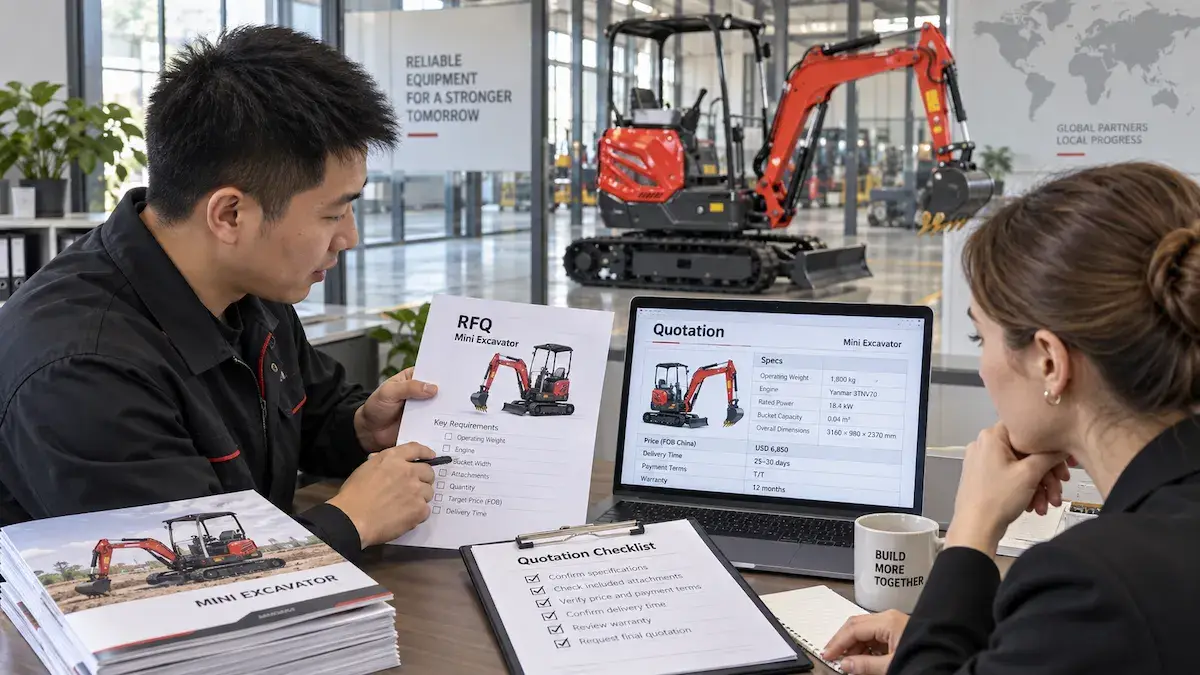
If any of these items is missing, the buyer should request clarification. A quotation that does not state the Incoterm, for example, cannot be compared directly with one that specifies FOB.
Mini Excavator Quote Comparison Checklist
The table below can be used to compare two or three supplier quotations on the same basis. Blank markers are used where information has not been provided by the supplier.
| Artículo | Proveedor A | Proveedor B | Proveedor C | What to Verify |
|---|---|---|---|---|
| Modelo de la máquina | — | — | — | Modelo y configuración exactos |
| Peso en servicio | — | — | — | Ficha técnica confirmada |
| Configuración del motor | — | — | — | Información sobre el modelo y las emisiones |
| Archivos adjuntos | — | — | — | Included vs optional |
| Equipamiento opcional | — | — | — | Acoplador rápido, cabina, luces |
| Incoterm | — | — | — | EXW, FOB, CIF, DDP |
| Gastos de envío incluidos | — | — | — | ¿Qué tramo, qué puerto? |
| Embalaje | — | — | — | Método y protección |
| Documentos | — | — | — | Factura, albarán, conocimiento de embarque, manuales |
| Warranty terms | — | — | — | Cobertura y exclusiones |
| Piezas de recambio | — | — | — | Incluido o disponible |
| Vigencia de la oferta | — | — | — | Intervalo de fechas confirmado |
Buyers should not fill in the columns with their own assumptions. If a supplier has not provided a value, that item should remain unconfirmed and be raised during the next communication.
Why the Lowest Mini Excavator Quote May Not Be the Lowest Total Cost
A lower quotation is not automatically the better commercial decision. Differences in machine configuration, included services and commercial terms can result in a higher landed cost or higher ownership cost later.
Common reasons a lower quote may not represent a lower total cost:
- Attachments are not included
- Motor o especificaciones diferentes
- Freight is excluded
- Destination charges are excluded
- Spare parts are excluded
- Documentation or certification is not provided
- Packaging is minimal
- Warranty scope is limited
Los compradores deben comparar los presupuestos sobre la misma base. Esto implica normalizar el Incoterm, confirmar los accesorios y la documentación incluidos, y comprobar que la ficha técnica se corresponda con la máquina objeto del presupuesto. Solo así es posible comparar los precios de forma significativa.
Common RFQ Mistakes Overseas Buyers Should Avoid
Several recurring mistakes reduce the usefulness of an RFQ and make quotation comparison harder.
- Asking only for the “best price” without context
- Not specifying the destination country
- Not stating the required quantity
- Comparing quotations that use different Incoterms
- Comparing different machine configurations
- Failing to include attachments in the RFQ
- Ignoring shipping and destination charges
- Requesting a quotation without explaining the application
- Assuming model names mean the same thing across suppliers
Buyers can avoid these issues by preparing a short, clear RFQ. The template in the next section can be copied and adapted.
Mini Excavator RFQ Template for Overseas Buyers
The following template can be used as a starting point. It does not need to be followed exactly. The important point is to give the supplier enough information to prepare a meaningful quotation.
Subject: RFQ – Mini Excavator for [Country]
Hello,
We are looking for a mini excavator for our market. Details below:
- Country: [Destination country]
- Required model or operating weight: [If known]
- Cantidad: [Número de unidades]
- Aplicación: [Paisajismo / excavación de zanjas / alquiler / etc.]
- Requisitos del motor: [Si procede]
- Accesorios: [cuchara / martillo hidráulico / barrena / etc.]
- Incoterm: [EXW / FOB / CIF / DDP]
- Puerto de destino: [Si se conoce]
- Certification or documentation: [If applicable]
- Piezas de recambio: [Cualquier requisito específico]
- Target purchase date: [Approximate]
Please provide a quotation with the machine configuration, engine information, included attachments, Incoterm, quotation validity, and any items that are optional. If some information is missing on our side, please advise what is needed.
Thank you.
This template is deliberately short. Buyers can add more information if it is relevant. The objective is to give the supplier enough context to prepare a usable quotation rather than a rough indication.
What Happens After You Send an RFQ?
The process after sending an RFQ typically follows a similar sequence across suppliers, although the details vary.
- The supplier reviews the requirements
- The supplier may ask clarifying questions
- The machine configuration is confirmed
- A quotation is prepared
- The buyer compares specification and commercial terms
- Technical and commercial details are clarified
- Final terms are confirmed before ordering
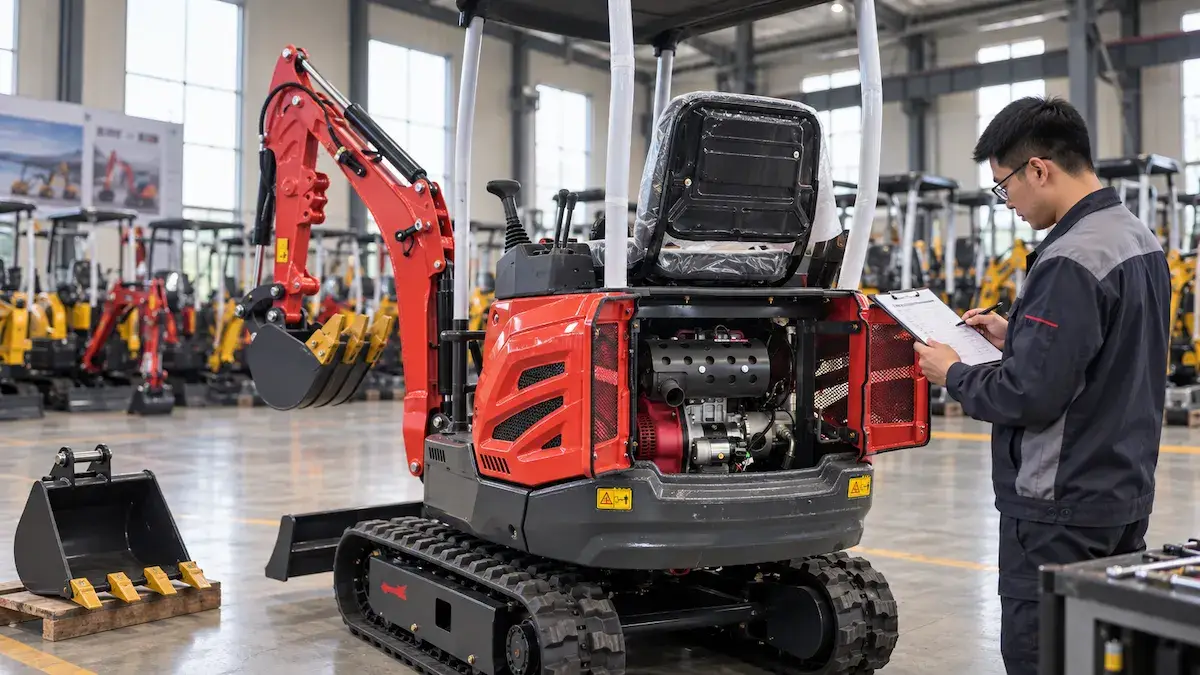
Buyers should expect some back-and-forth, especially on the first RFQ. This is normal. Suppliers may need to confirm details such as engine availability, attachment compatibility or destination-specific documentation before issuing a final quotation.
If the buyer plans to verify the machine before shipment, the Lista de comprobación para la inspección en fábrica de miniexcavadoras covers the production and testing points to confirm. If spare parts support is part of the decision, the Mini Excavator Spare Parts & After-Sales Support Guide explains what to ask before ordering.
Request a Mini Excavator Quote
Provide your required model or size, quantity, application, attachments, destination country or port, and preferred Incoterm. Our team can review the information, confirm the required configuration, and prepare a quotation based on the agreed requirements.
Frequently Asked Questions About Mini Excavator Quotes
What information do I need to request a mini excavator quote?
Provide the required model or size, quantity, application, destination country, preferred Incoterm, attachments and any certification or documentation requirements. Engine preference and spare-parts requirements are also useful. Buyers do not need to know every answer before contacting a supplier.
Why do mini excavator quotations from different suppliers vary?
Quotations can differ because of engine configuration, attachments, Incoterm, packaging, documentation, spare-parts inclusion, warranty scope and quotation validity. Comparing quotations on the same basis is essential before drawing conclusions.
Should I request FOB or CIF pricing?
FOB is often requested by buyers who have their own freight forwarder and want to control shipping. CIF may be preferred by buyers who want the supplier to arrange freight and insurance to the destination port. The best option depends on the buyer’s experience and logistics setup.
Can I request a quote if I do not know the exact excavator model?
Yes. Describing the application, working conditions and required digging depth can help the supplier recommend a suitable model. The size guide and specification guide can also help narrow the options.
Do attachments need to be included in the RFQ?
Attachments should be listed in the RFQ if they are required. They affect the machine price, hydraulic configuration and shipping. If attachments are uncertain at the RFQ stage, they can be confirmed during the quotation process.
How should I compare mini excavator quotations?
Compare quotations using the same Incoterm, the same machine configuration, the same attachment list and the same document set. Use a comparison table to record model, engine, attachments, Incoterm, freight, documents, warranty and quotation validity.
What destination information should I provide for a shipping quote?
Provide the destination country, destination port if known, and the preferred Incoterm. If the buyer has a customs broker or freight forwarder, this can also be mentioned. Destination information affects freight, documentation and import requirements.