
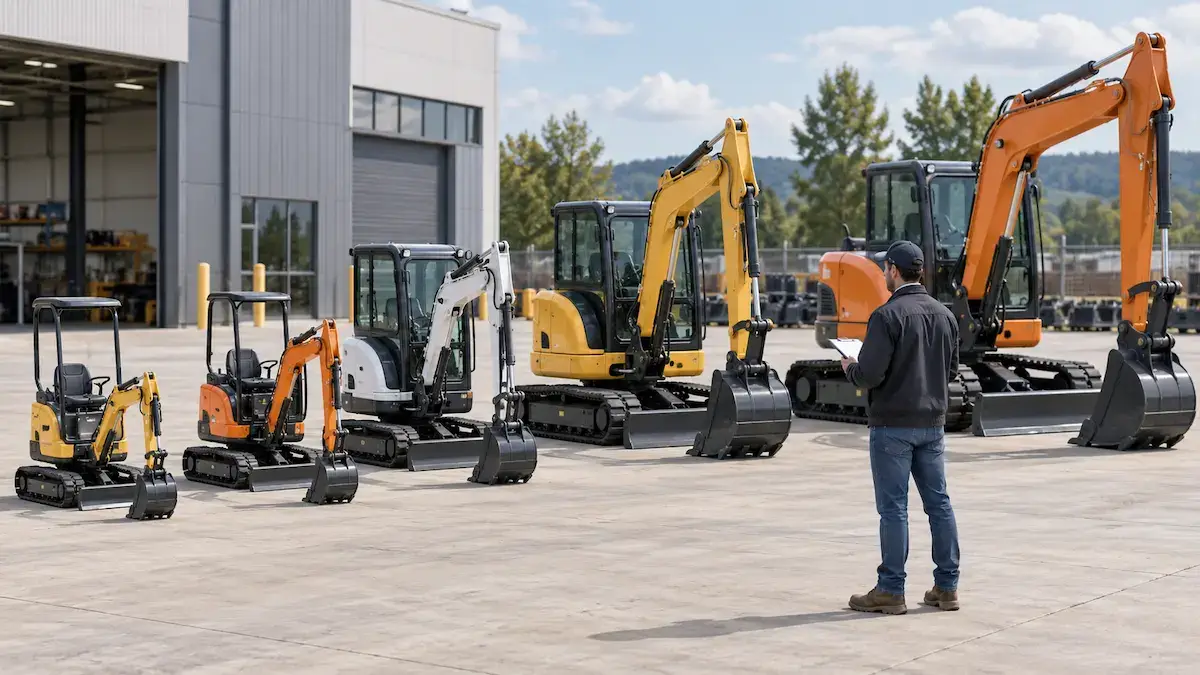
A mini excavator product mix is not simply a list of every model the supplier offers. For a dealer, it is a commercial decision about which size classes, configurations and attachments to actively support — and which to quote only when a customer specifically requests them. A wider range is not automatically better. Every additional model or configuration adds complexity to sales, service, spare parts and repeat ordering.
This guide is written for dealers, distributors and importers building or refining a mini excavator range for resale. It focuses on customer segmentation, size-class coverage, model overlap, configuration strategy and the data signals that should drive product-mix decisions. For sourcing strategy, refer to the Mini Excavator Wholesale Guide, and for first-order planning, refer to the Mini Excavator MOQ & First Order Guide.
What Makes a Good Mini Excavator Product Mix for Dealers?
A useful dealer product mix should cover meaningful customer groups, avoid excessive overlap between similar models, keep configurations understandable, support practical attachment choices, remain manageable for service and spare parts, and be easy to quote and reorder.
There is no universal number of models that fits every dealer. The correct range depends on local customer demand, service capability, capital availability and the supplier’s actual product structure. The mix should be reviewed periodically using real inquiry, quotation and sales evidence.
Start with Customer Segments, Not Model Numbers
Product-mix planning should begin with the customers the dealer intends to serve, not with the supplier catalog. The model list is the result of the customer strategy, not the starting point.
Examples of customer groups a dealer may consider:
- Landscaping businesses
- Property maintenance contractors
- Small construction contractors
- Empresas contratistas de servicios públicos
- Empresas de alquiler
- Agricultural users
- General contractors
These are examples, not guaranteed target markets. The relevant customer groups depend on the dealer’s local environment.
For each customer segment, the dealer can consider:
- Job type and typical project size
- Working-space limitations (gates, indoor work, tight access)
- Transport method
- Expected digging requirement
- Attachment demand
- Budget range
- Service and parts expectations
Keeping the customer segment analysis at portfolio level is important. This is not about choosing a machine for a specific job — that is covered in the Guía de tamaños de miniexcavadoras. The question here is which customer groups the dealership will actively serve, and what range of machine classes that implies.
Build a Size-Class Ladder for the Dealership
A practical way to plan the range is to group the supplier’s available models into size classes, then decide which classes deserve active support in the dealer’s market. The table below uses the current ZHAOLU range as an example.
| Clase de tamaño | Current ZHAOLU Models | Potential Dealer Role | Questions to Validate |
|---|---|---|---|
| 0,5 toneladas | ZL-05 | Micro / narrow-access offering | Do customers request this size? Is transport easy? Does it overlap too heavily with the sub-1-ton class? |
| 0,7–0,9 toneladas | ZL-10, ZL-12, ZL-15, ZL-13 | Sub-1-ton offering | Which sub-1-ton size fits most local jobs? How different are the specifications between these models? Can the dealer support the attachments? |
| 1,2–1,4 toneladas | ZL-17, ZL-18 | Mid-range compact offering | Does this class receive enough qualified inquiries? Can it serve multiple customer segments? Is the configuration easy to explain? |
| 2,3–2,5 toneladas | ZL-25, ZL-30, ZL-35 | Larger compact offering | Do local customers need the extra capability? Can the dealer transport and service this size class? Is demand confirmed or assumed? |
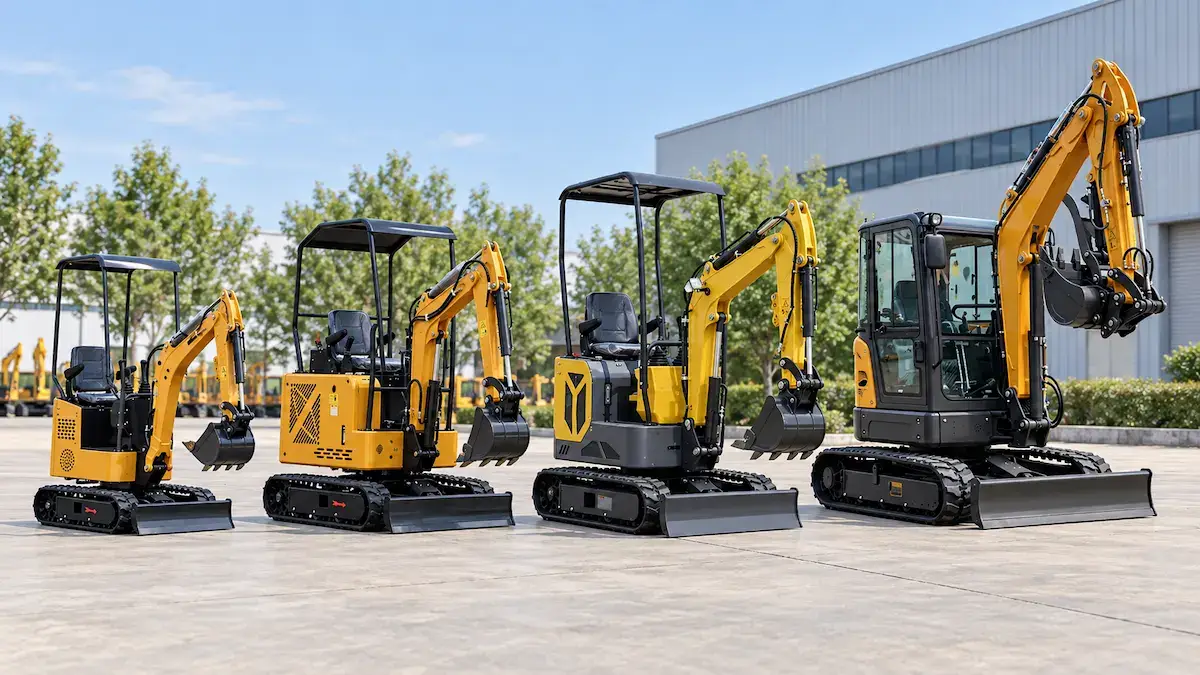
The table is a planning framework, not a stocking recommendation. Dealers should confirm whether the actual specifications of nearby models differ enough to justify keeping them all in the active range. The full product range can be reviewed on the Mini Excavator Product Category page, and detailed specifications should be checked on each individual model page.
Core Models vs Secondary Models
Within a product mix, some models typically function as core offerings while others serve narrower roles. This is a portfolio concept, not a fixed classification for any specific model.
For an individual dealership, a core model may be a machine class that:
- Receives consistent inquiries
- Fits several customer types
- Is easy for sales staff to explain
- Has manageable service requirements
- Generates repeat quotation activity
A secondary model may:
- Serve a narrower customer group
- Fill a specific size gap in the range
- Support a particular application
- Be quoted when demand is confirmed rather than stocked continuously
These categories should not be assigned in advance. Dealers should determine which models function as core offerings based on their own market evidence: which classes receive qualified inquiries, which configurations are easy to sell and support, and which models drive repeat business.
Avoid Too Much Overlap Between Similar Models
ZHAOLU has several models in nearby operating-weight classes, including several sub-1-ton options and several in the 1.2–1.4 ton range. This is common in mini excavator ranges, because different buyers have different requirements even within a similar weight class.
When multiple models occupy nearby size classes, dealers should compare:
- Exact specifications
- Machine dimensions
- Configuración del motor
- Hydraulic configuration
- Attachment compatibility
- Price position relative to the class
- Customer demand
- Service requirements
before deciding whether all of them belong in the active dealer range.
Unnecessary SKU overlap can create several operational problems:
- Harder sales decisions for staff
- More quotation variations to prepare
- More documentation to manage
- More parts references to track
- Greater service complexity
- Customer confusion when the difference between models is not clear
Overlap is not automatically a problem. In some markets, nearby models serve genuinely different customer groups. In others, a narrower range is easier to support. The right decision depends on the dealer’s market. The Guía de especificaciones de miniexcavadoras explains how to compare machine parameters before deciding which models to keep in the active range.
Keep Configuration Strategy Simple
Model count is only one source of complexity. A dealer can also create complexity by offering too many configurations of the same model.
Configuration variables may include:
- Motor
- Hydraulic setup
- Auxiliary hydraulics
- Bucket type
- Coupler
- Archivos adjuntos
- Controls
- Equipamiento opcional
Not every option is available on every model. Where multiple configurations are available, dealers should decide which ones they actually need to support, rather than offering every possible combination.
Configuration consistency matters for:
- Quotations
- Sales training
- Service and troubleshooting
- Spare-parts identification
- Repeat orders
Dealers evaluating configuration strategy should apply the same discipline described in How to Choose a Mini Excavator Supplier in China: confirm what configurations the supplier can repeat consistently, and document the agreed baseline for future orders. Hydraulic configuration details are covered in the Guía del sistema hidráulico de las miniexcavadoras.
Plan Attachments as Part of the Product Mix
Attachments should be planned alongside the machine range, not treated as a separate product decision. Attachment demand often follows the same customer segments that drive model selection.
Common attachment categories in a dealer range:
- Cubeta estándar
- Narrow bucket
- Grading bucket
- Breaker
- Barrena
- Ripper
- Pinza
Not every attachment fits every machine. Attachment requirements may influence:
- Hydraulic configuration on the machine
- Coupler compatibility
- Dealer inventory
- Sales training
- Quotations
- Piezas de recambio
- Shipping space and packing
Dealers should decide which attachment categories they intend to actively support, and confirm mounting and hydraulic compatibility for each machine class. The Guía de accesorios para miniexcavadoras explains how to check attachment compatibility.
Consider Spare Parts and Service Complexity
Every additional model or configuration can increase the parts and service workload for the dealer. This is a practical consideration for portfolio planning, not a theoretical one.
Additional models may increase:
- Part numbers to track
- Filters to stock
- Hoses and fittings
- Componentes eléctricos
- Hydraulic parts
- Service documentation
- Technician learning requirements
Dealers should ask the supplier:
- Which parts are shared between models?
- Which parts are model-specific?
- How are parts identified?
- Are parts diagrams available?
- What machine identification is required for parts requests?
Shared parts between nearby models can reduce service complexity, but this should be confirmed rather than assumed. The Guía de recambios para miniexcavadoras explains parts categories and identification requirements.
Inventory Depth vs Product Range Width
Product-mix planning involves two separate decisions: how wide the range is, and how deep the inventory is within each chosen model.
Range width is the number of different model classes the dealer actively offers.
Inventory depth is the number of units the dealer holds within each selected model.
A dealer with limited capital may prefer a narrower range with clearer market evidence, then expand depth once demand is confirmed. A dealer serving several established customer segments may justify broader coverage. Both decisions should depend on real local demand rather than on assumptions.
There is no universal stocking quantity. The right level depends on the dealer’s capital, sales capacity, service capability and supplier order structure. The Mini Excavator MOQ & First Order Guide covers the trade-offs involved in structuring a first order.
Use Inquiry and Quotation Data to Adjust the Product Mix
The product mix should be reviewed using real market signals rather than judgment alone. Useful data points include:
- Qualified inquiries by machine class
- Quotation requests by model
- Attachment requests
- Customer application information
- Common customer objections
- Price sensitivity by segment
- Reason for lost sales
- Sales conversion by size class
- Repeat inquiries
- Service issues observed
- Parts demand
- Inventory age
Examples of how this data can inform decisions:
- If one size class repeatedly receives qualified inquiries but few quotations convert, the dealer should investigate why — pricing, configuration, attachments or sales process.
- If a model receives little interest over time, the dealer should reconsider whether it needs to remain in the active range or be quoted only on request.
- If buyers repeatedly ask for a size class that is not currently offered, the dealer should investigate whether the range should expand.

One or two inquiries are not enough to redefine the entire product strategy. Product-mix decisions should be based on patterns over time, not individual conversations.
Do Not Choose a Product Mix Only from Competitor Catalogs
Competitor catalogs can show what is available in the market, but they do not prove local demand. Copying another dealer’s complete model range without understanding the underlying business decisions can lead to overstocking or supporting models that do not fit the dealer’s own customer base.
Before using competitor ranges as a reference, the dealer should consider:
- Their customer base
- Their sales volume
- Their stock strategy
- Their service structure
- Their local regulations
- Their pricing strategy
Competitor research is one input, not the decision itself.
Mini Excavator Product Mix Planning Table
The following table can be used to structure the product-mix review. Every status starts at “To Review” — the purpose is to make sure important items are examined rather than assumed.
| Planning Area | Questions to Ask | Evidence to Review | Status |
|---|---|---|---|
| Target customers | Which customer groups will the dealership serve? | Local market data, existing customer base | To Review |
| Applications | What jobs do these customers actually perform? | Inquiry records, customer interviews | To Review |
| Size classes | Which size classes cover the main applications? | Inquiry distribution by class | To Review |
| Model overlap | Do any models overlap too closely? | Specification comparison | To Review |
| Especificaciones | Are the differences between models clear? | Specification sheets | To Review |
| Configuration | Which configurations will the dealer support? | Supplier confirmation | To Review |
| Archivos adjuntos | Which attachments do customers request? | Inquiry and quotation data | To Review |
| Transport | Can the dealer transport the selected classes? | Local transport options | To Review |
| Piezas de recambio | Which parts are shared and which are model-specific? | Supplier parts information | To Review |
| Service capability | Can technicians support the range? | Training and service records | To Review |
| Inquiry volume | Which classes receive qualified inquiries? | Inquiry log | To Review |
| Quotation activity | Which models receive the most quotations? | Quotation records | To Review |
| Sales results | Which classes actually convert? | Sales data | To Review |
| Inventory | Which models move and which sit? | Inventory age and turnover | To Review |
| Repeat-order demand | Do customers request the same class again? | Repeat purchase records | To Review |
Questions Dealers Should Ask Before Adding a Model
- Which customer segment is this model intended to serve?
- What customer problem does it solve that the current range does not?
- Does another model already cover the same demand?
- How different are the specifications from the closest existing model?
- Does the dealer understand the exact configuration?
- Which attachments will customers request with this model?
- Will additional spare parts need to be stocked?
- Will technicians need different service information?
- How will the machine be transported?
- How often has this size class been requested?
- Has the model received qualified quotation activity?
- Will adding the model simplify or complicate the sales process?
- Can the same configuration be reordered consistently?
- Should the model be stocked or quoted only when demand exists?
How the ZHAOLU Range Can Be Used for Dealer Product-Mix Planning
ZHAOLU currently lists mini excavators approximately from 0.5 ton to 2.5 ton. The available models can be grouped approximately as follows:
- 0,5 toneladas — ZL-05
- 0,7–0,9 toneladas — ZL-10, ZL-12, ZL-15, ZL-13
- 1,2–1,4 toneladas — ZL-17, ZL-18
- 2,3–2,5 toneladas — ZL-25, ZL-30, ZL-35
Dealers can review the individual model pages and specification sheets before deciding which classes fit their market. The full range is listed on the Mini Excavator Product Category page, and commercial supplier information is available on the Proveedor de miniexcavadoras page. Dealers are not expected to stock every class — the range exists to be planned against local demand, not to be copied entirely.
Planning a Mini Excavator Product Range for Your Market?
If you are planning a mini excavator product range for dealership, distribution, rental or resale, send your target market, customer types, required size classes, attachments and destination. ZHAOLU can provide model and quotation information based on the confirmed requirements.
Frequently Asked Questions About Mini Excavator Product Mix
What is a mini excavator product mix?
A mini excavator product mix is the combination of size classes, models, configurations and attachments that a dealer actively offers for resale. It is a commercial decision about coverage, complexity and repeatability, not simply a list of every model a supplier offers.
How many mini excavator models should a dealer offer?
There is no universal number. The correct range depends on local customer demand, service capability, capital availability and the supplier’s product structure. Dealers should base the decision on actual inquiry, quotation and sales evidence rather than on a fixed model count.
Should a dealer stock every mini excavator size?
Not necessarily. Stocking every size class can increase inventory, service and spare-parts complexity without necessarily matching local demand. Many dealers may be better served by a narrower range aligned with their main customer segments, while quoting additional classes when demand is confirmed.
How should dealers choose between similar mini excavator models?
Dealers should compare exact specifications, dimensions, engine configuration, hydraulic configuration, attachment compatibility, price position, customer demand and service requirements. Nearby models should not be treated as identical, and the decision should be based on what each model actually adds to the range.
Should attachments be part of a dealer product-mix plan?
Yes. Attachment demand often follows the same customer segments that drive model selection. Attachment compatibility, hydraulic configuration, coupler types and spare parts should be planned together with the machine range rather than treated as separate decisions.
How does spare-parts support affect product selection?
Every additional model or configuration can increase part numbers, filters, hoses, electrical parts and service documentation. Dealers should confirm which parts are shared, which are model-specific and how parts are identified before expanding the range.
How can dealers use inquiry data to improve their product range?
Dealers can track qualified inquiries, quotation requests, attachment requests, lost-sale reasons and repeat inquiries by machine class. Patterns over time indicate which classes to keep active, which to quote on request and where the range may need to expand.
When should a dealer add another mini excavator model?
A new model should be added when there is a clear customer segment or application that the current range does not serve, when the demand is supported by inquiry and quotation data, and when the dealer can support the additional configuration, attachments and spare parts involved.